
How to Design and Deliver a Standalone Mindfulness Programme as a Yoga Teacher
From session structure to participant recruitment to insurance — everything you need in place before you run your first dedicated mindfulness programme.
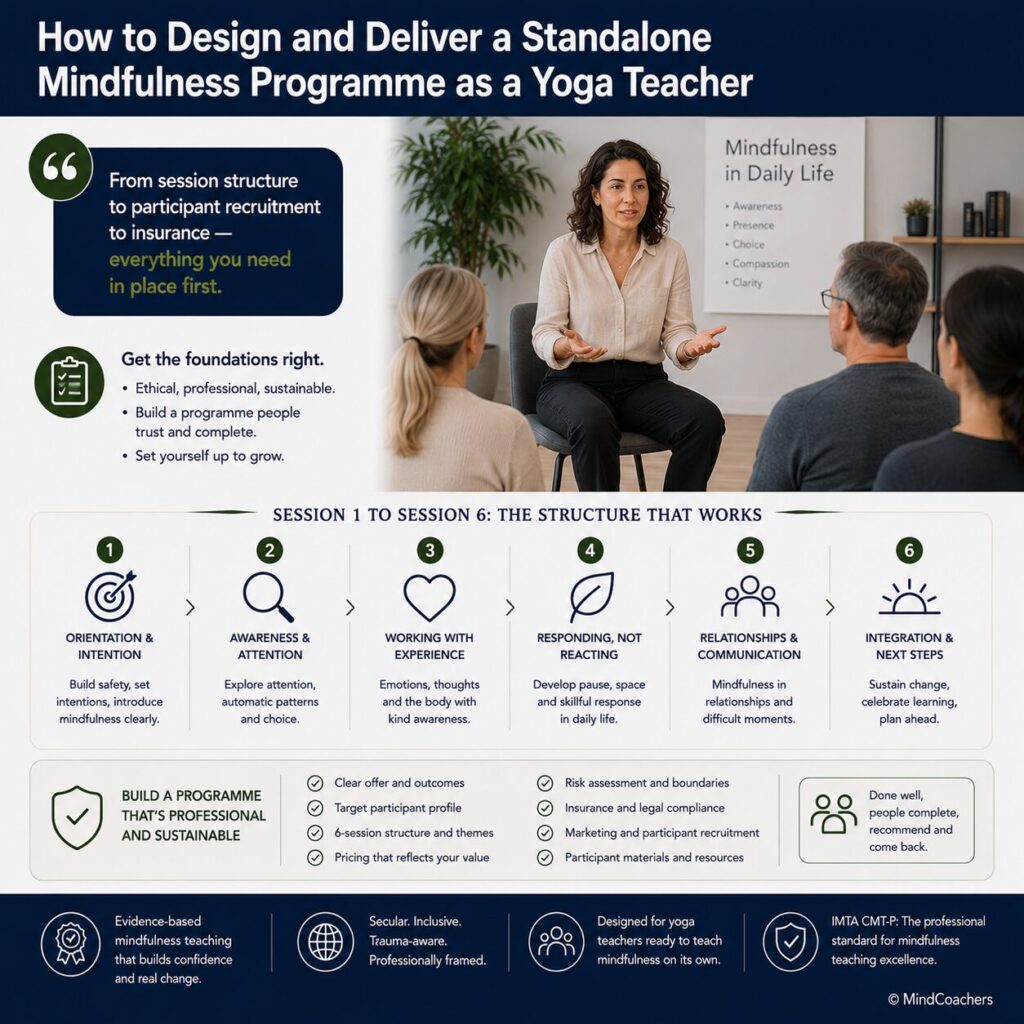
Running your first standalone mindfulness programme is a different professional undertaking from teaching yoga. The participant relationship is different, the session structure is different, the facilitation style is different, and the professional and liability requirements are different. This guide covers all of it — specifically for yoga teachers who have the practice depth and facilitation experience, and who now want to build a formal mindfulness programme from scratch.
The guide assumes you are at or approaching IMTA CMT-P qualified status. If you are still evaluating whether to pursue formal training, the best mindfulness teacher training for yoga teachers: 2027 comparison and what formal mindfulness teaching adds to a yoga practice are the relevant starting points. This is the implementation guide for practitioners who have decided — and who want to know exactly how.
The practicum component of the MCMI — MindCoachers Certified Mindfulness Instructor gives trainees direct experience of designing and delivering standalone mindfulness sessions from Week 1. The MCMI practicum covers why early teaching experience is central to the competency development — and this article translates those practicum learnings into a full programme design framework.
Key takeaways
→ A standalone mindfulness programme is a structured series of sessions designed specifically to develop present-moment awareness — not yoga with mindfulness elements. The design, facilitation style, and participant relationship are categorically different.
→ Start with participant outcome, not content: define what participants will be able to do at programme end, then work backwards to select practices, sequence sessions, and design home practice.
→ Secular framing is required for any institutional or corporate audience; yogic framing is appropriate for yoga-community audiences. The practices are the same in both cases — the theoretical scaffolding and language differ.
→ Three things must be in place before you deliver the first session: IMTA CMT-P credential (or verified completion pathway), professional liability insurance that explicitly covers mindfulness facilitation, and a participant screening process.
→ The MCMI — MindCoachers Certified Mindfulness Instructor develops programme design competency from Week 1 through a concurrent 35-hour practicum. Two credentials result: the MCMI certificate (automatic, included in tuition) and the IMTA CMT-P (post-graduation IMTA application, ~€150–250). Distinct steps.
What a standalone mindfulness programme is — and what it is not
A standalone mindfulness programme is a structured series of sessions in which participants attend specifically to develop present-moment awareness through formal mindfulness practices, guided inquiry, and home practice. It is not yoga with mindfulness elements, not a meditation drop-in, and not a wellness workshop with mindfulness content included.
The structural differences from yoga class are significant:
- No physical practice — participants are seated throughout, which changes the facilitation dynamic entirely and creates different participant needs around comfort, restlessness, and physical settling
- Inquiry-based facilitation — a substantial proportion of session time is spent in guided inquiry after practices: participants sharing what they noticed, the teacher facilitating group reflection without directing the content
- Home practice as central pedagogy — the development of personal practice between sessions is the primary mechanism of change, not the in-session practices alone
- Psychological orientation — the session content draws on psychological theory (attention, stress response, rumination, defusion) rather than yogic or somatic frameworks
Understanding this distinction is the foundation for effective programme design. Why mindfulness without structure does not scale explains why the structural rigour matters — not just for participant outcomes but for your professional positioning.
Choosing the right format: 4, 6, or 8 sessions?
The session count decision should be driven by participant population and programme context, not by format preference:
- 4-session format: appropriate for introductory or corporate audience contexts where time commitment is a significant barrier and the goal is establishing a foundational practice rather than full 8-week programme outcomes. Good for corporate pilot programmes and first-cohort testing. Limitation: insufficient session count to develop the full practice range and home practice habituation.
- 6-session format: the most versatile format for yoga teacher-led programmes. Long enough to develop meaningful practice depth and cover the full practice range (breath, body scan, open awareness, thoughts, emotions, compassion); short enough to recruit participants who baulk at an 8-week commitment. Well-matched to yoga community audiences.
- 8-session format: the standard evidence-based format for MBSR and MBCT, and the format expected by NHS-adjacent and EAP commissioners. Required for institutional credibility in clinical or healthcare-adjacent contexts. Longer home practice habituation produces more durable outcomes. For yoga teachers new to standalone programme delivery, starting with 6 sessions is recommended.
Session length: 90 minutes is the recommended minimum for meaningful practice and inquiry time. 2-hour sessions are appropriate for 8-week formats. Half-day or full-day intensive formats are also viable for corporate contexts.
Designing session content when you have never built a curriculum before
Start with the participant outcome, not the content. Before selecting a single practice, define what you want participants to be able to do — independently, at home, without you — at programme end. A useful outcome specification for a 6-session introductory programme:
- Guide themselves through a 10-minute seated awareness practice independently
- Recognise a stress or anxiety response as it is arising and apply a mindfulness-based interruption technique
- Hold a difficult thought or emotion with greater equanimity — observing it without immediately acting from it
Then work backwards from those outcomes to the session sequence. A useful structural template for a 6-session programme:
- Session 1 — Attention anchor practices: breath awareness, sound awareness, establishing the foundational attention object. Home practice: 10 minutes breath awareness daily.
- Session 2 — Somatic awareness and the body as information: body scan, interoceptive awareness, using bodily sensation as real-time information. Home practice: body scan 3-4 times per week.
- Session 3 — Working with thoughts: thinking observer practice, cognitive defusion, distinguishing thoughts from facts. Home practice: informal thought observation during daily activity.
- Session 4 — Working with difficult emotions: RAIN practice (Recognise, Allow, Investigate, Nurture), opening to difficult experience rather than contracting from it. Home practice: apply RAIN to one difficult moment per day.
- Session 5 — Compassion and self-care: loving-kindness practice, self-compassion, relating to oneself with the same care extended to others. Home practice: brief loving-kindness practice daily.
- Session 6 — Integration and sustainable practice design: review of practices, identification of personal practice priorities, design of post-programme daily practice. Home practice: participant-designed personal practice routine.
This sequence is adapted from the secular mindfulness curriculum framework taught in the MCMI — MindCoachers Certified Mindfulness Instructor. The practices are stable across secular programmes; what formal training adds is the facilitation competency to hold each session at depth.
How to frame and recruit participants from your existing yoga community
Your existing yoga student base is a warm audience who already trust your teaching. The framing challenge is not credibility — it is positioning the new offering clearly enough that participants understand it is different from what they already attend.
The framing that works: position by what it delivers, not by what it is. Not: “I am running a mindfulness course.” Instead: “I am running a six-week evidence-based mindfulness programme for stress, anxiety, and better sleep. No yoga experience required — all you need is a chair and a willingness to show up.”
Practical recruitment steps for a first-cohort programme:
- Announce in class three to four weeks before the start date with a clear description of what the programme involves and what it produces
- Send a dedicated email to your yoga mailing list with the same framing — not embedded in a general newsletter
- Offer an early-bird rate for the first cohort (5-10% below your intended standard price) to incentivise early commitment
- Invite two to three existing students individually — a personal invitation from a trusted teacher is significantly more effective than a general announcement
- Cap the first cohort at 8-12 participants — small enough to develop facilitation confidence, large enough to create viable group dynamics
For the full practice setup context, setting up a mindfulness teaching practice covers the operational and business development steps beyond the programme design.
Secular vs yogic framing: how to choose and when it matters
The framing question is not about personal authenticity — it is about participant population. Use the framing that matches your participants, not your own orientation.
For yoga community audiences who share your spiritual or contemplative orientation, yogic and Buddhist framing is entirely appropriate. References to prana, dharma, or samadhi land with participants who share that context. The practices are unchanged; the theoretical scaffolding is familiar and meaningful.
For corporate participants, NHS referrals, educational audiences, or any institutional context, secular framing is required — not preferred, required. These participants and their commissioning organisations need mindfulness positioned as an evidence-based skill-development intervention, not as a spiritual practice. The theoretical scaffolding is cognitive science, psychological research, and secular mindfulness mechanisms.
The practical solution: design two versions of your programme framework — one yoga-community version and one secular institutional version. The practices are identical in both. The session introductions, theoretical explanations, participant handouts, and session titles differ. Maintaining both versions is not duplicative; it is the professional range that formal mindfulness teacher training develops. Why the MCMI has you teaching mindfulness from week one explains why practising both framings in the teaching practicum is essential.
The three things you need in place before you deliver the first session
Before the first participant sits down for the first session of your first standalone mindfulness programme, three things must be in place. Not recommended — required.
- IMTA CMT-P credential or verified completion pathway: running a standalone mindfulness programme is formal mindfulness teaching. It requires IMTA CMT-P or equivalent. If you are completing IMTA-accredited training and your programme start date precedes your qualification date, you need to either postpone the programme or deliver it as a practicum cohort under your training supervision structure.
- Professional liability insurance explicitly covering mindfulness facilitation: yoga teacher insurance almost universally does not cover standalone mindfulness facilitation, particularly for corporate audiences or any clinical population. Contact your insurer directly before delivering any session and obtain written confirmation that mindfulness teaching as a standalone professional activity is covered. If it is not, obtain a rider or a separate policy.
- Participant screening process: a brief pre-programme questionnaire covering mental health history, current psychiatric treatment, any known contraindications to mindfulness practice, and explicit consent to the nature of the programme. This is not bureaucratic — it is clinical safety. Body scan practices and open-monitoring practices can surface trauma responses in participants with no prior indication of risk. Screening does not prevent this, but it establishes professional due diligence and informs how you adapt facilitation.
Download the MCMI — MindCoachers Certified Mindfulness Instructor — prospectus: full curriculum, faculty profiles, pricing and cohort information.
Further reading and professional resources
Best Mindfulness Teacher Training for Yoga Teachers: 2027 Comparison
Mindfulness Teacher Training for Yoga Teachers: Bridging Practice and Formal Instruction (2027)
Mindfulness Teacher Training for Wellness Practitioners: A 2027 Guide
What Formal Mindfulness Teaching Adds to a Yoga Practice
Setting Up a Mindfulness Teaching Practice — What You Need
The MCMI Practicum — Real-World Mindfulness Teaching
Why the MCMI Has You Teaching Mindfulness From Week One
Next steps
If you are a yoga teacher ready to design and deliver your first standalone mindfulness programme, the MCMI — MindCoachers Certified Mindfulness Instructor develops the programme design competency, facilitation skills, and IMTA CMT-P credential you need — with a 35-hour concurrent practicum from Week 1 so you begin building real teaching experience during training.
Frequently asked questions
About mindfulness teacher training for psychologists and the MCMI — MindCoachers Certified Mindfulness Instructor