
Best Mindfulness Teacher Training for Yoga Teachers: 2027 Comparison
Which programmes genuinely bridge yoga teaching and formal mindfulness instruction — evaluated against secular framing depth, Yoga Alliance vs IMTA distinction, trauma-aware protocols, and professional market access.
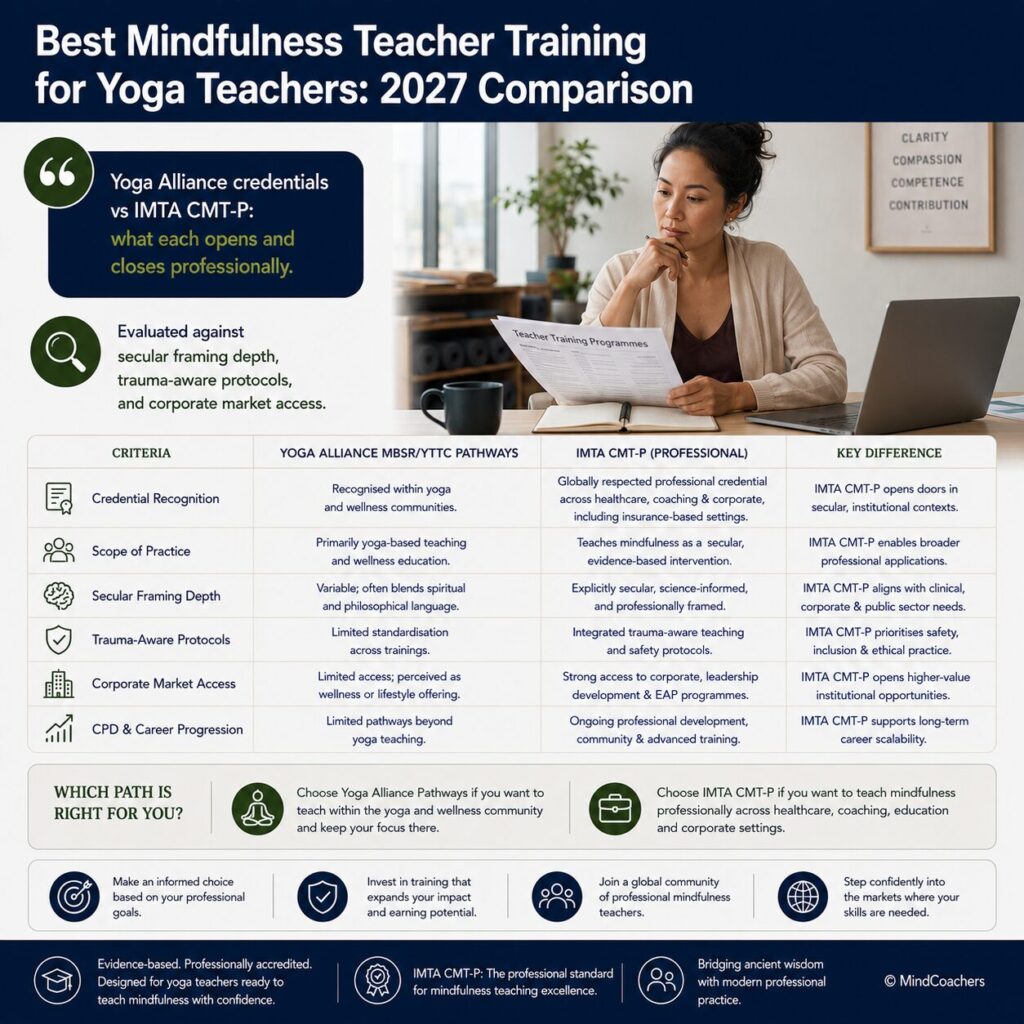
Yoga teachers evaluating mindfulness teacher training face a problem that most comparison articles do not acknowledge: the criteria that matter for this transition are almost entirely absent from general rankings. Programme duration, lineage depth, and brand recognition — the standard comparison axes — tell a yoga teacher very little about whether a programme will develop the specific competencies they are missing or open the professional contexts they want to reach.
This comparison was built for yoga teachers. It addresses the central distinction that no competitor article makes clearly: Yoga Alliance credentials are yoga instruction credentials. They do not satisfy IMTA CMT-P requirements and are not recognised by corporate, NHS, or educational institutional commissioners for mindfulness facilitation. For yoga teachers who want to access those markets, a separate and specific mindfulness teaching credential is required — regardless of total training hours or personal practice depth.
For the broader professional case for this transition, see mindfulness teacher training for yoga teachers: bridging practice and formal instruction and IMTA vs Yoga Alliance vs IMMA: mindfulness teacher accreditation compared. This article goes further: a direct programme comparison evaluated against the criteria that specifically matter for yoga teachers.
Key takeaways
→ Yoga Alliance credentials — regardless of total hours — are yoga instruction credentials. They do not produce an IMTA CMT-P and are not recognised by corporate L&D, NHS commissioners, or EAP providers for mindfulness facilitation.
→ Trauma-sensitive yoga (TSY) training and trauma-aware mindfulness teaching protocols address different scenarios and are not interchangeable. IMTA-accredited mindfulness teacher training provides the second category; TSY training does not.
→ The most important criteria for yoga teachers evaluating mindfulness teacher training are: secular framing depth, trauma-aware protocols specific to seated mindfulness practice, practicum in non-yoga contexts, and IMTA CMT-P accreditation.
→ The MCMI — MindCoachers Certified Mindfulness Instructor is the strongest option in this comparison for yoga teachers specifically — secular framing throughout, ACT integration replacing yogic philosophy, and a practicum designed for non-yoga secular contexts.
→ Two credentials result from the MCMI: the MCMI certificate (automatic on completion, included in tuition) and the IMTA CMT-P (post-graduation IMTA application, independent fee ~€150–250). They are distinct steps — never presented as one.
Why most mindfulness teacher training rankings miss the yoga teacher context entirely
General mindfulness teacher training rankings evaluate programmes against criteria that matter to a broad practitioner audience: cost, format flexibility, programme duration, and name recognition. For yoga teachers, these criteria are secondary to a set of specific professional questions that general rankings do not ask.
The questions that matter for yoga teachers are different:
- Does the programme teach secular evidence-based framing — or does it assume a contemplative/spiritual context that yoga teachers already inhabit but corporate and institutional clients do not?
- Does the practicum require non-yoga teaching contexts, or does it permit yoga-adjacent settings that do not develop the transition competency yoga teachers actually need?
- Does the trauma-aware content address seated mindfulness practice specifically — body scan dissociation, breath contraindications for trauma — or only the physical safety considerations of trauma-sensitive yoga?
- Does the credential produced satisfy IMTA CMT-P requirements — or does it produce a yoga-credentialling-body recognition that institutional commissioners do not recognise?
This comparison applies these criteria. For yoga teachers who want to understand the credential landscape before evaluating programmes, teaching mindfulness professionally as a yoga teacher: 5 things your training needs to cover provides the foundational framework.
The Yoga Alliance vs IMTA distinction: what each credential opens for yoga teachers
This is the distinction that matters most for yoga teachers evaluating mindfulness teacher training — and the one most frequently misunderstood.
A Yoga Alliance credential — RYT 200, RYT 500, ERYT — is a yoga instruction credential. It signals to yoga students and yoga event organisers that the holder has completed verified yoga teacher training to YA standards. It does not include mindfulness-specific curriculum requirements, supervised mindfulness teaching practice, concurrent practicum, or any of the elements IMTA requires for CMT-P accreditation. Corporate L&D departments, NHS commissioners, EAP providers, and educational establishments do not recognise YA credentials for mindfulness facilitation — because they are not mindfulness teaching credentials.
An IMTA CMT-P credential is a mindfulness teaching credential — recognised internationally as the professional standard for secular mindfulness teachers. It is produced by completing IMTA-accredited 200-hour training that includes specific curriculum requirements, a concurrent teaching practicum, and competency assessment against IMTA standards. For yoga teachers who want to access institutional mindfulness facilitation markets, this is the credential that opens them.
The two credential systems do not overlap. A 500-hour YA training with extensive mindfulness content produces a yoga instruction credential. An IMTA-accredited 200-hour mindfulness teacher training produces a mindfulness teaching credential. For the full credential comparison, see IMTA vs Yoga Alliance vs IMMA: mindfulness teacher accreditation compared.
The evaluation criteria for yoga teachers specifically
Five criteria were applied in this comparison, each specific to the yoga teacher professional context:
- Secular framing depth — does the curriculum teach secular evidence-based mindfulness framing throughout, or does it assume a contemplative/spiritual context? Institutional markets require secular framing.
- Trauma-aware protocol specificity — does the trauma content address seated mindfulness practice risks (body scan dissociation, breath contraindications) or only physical practice safety? These are different competency areas.
- Practicum context — does the programme require or encourage practicum in non-yoga secular contexts? This is the competency gap yoga teachers most need to develop. See how to assess trauma-aware competency in any training.
- ACT and psychological theory integration — does the curriculum include ACT and secular mindfulness mechanisms (not yogic philosophy)? This determines whether graduates can work in clinical-adjacent and corporate contexts.
- IMTA CMT-P accreditation — does the programme satisfy IMTA CMT-P requirements? This is the binary credential question for institutional market access.
Comparison at a glance: mindfulness teacher training programmes for yoga teachers
| Programme | Accreditation | Secular framing | Trauma-aware (seated) | ACT integration | Practicum | Duration |
| MCMI — MindCoachers | IMTA CMT-P | Full curriculum | Yes — specific to MBI | Full thread | 35h concurrent | 12 wks / 200h |
| MMTCP (Sounds True) | None (dharma) | Partial — dharma base | Limited | Minimal | Post-training | ~150h / 2yr |
| Breathworks | Breathworks cert | Mostly secular | Partial — pain focus | Minimal | Post-training | ~120h |
| Oxford Mindfulness — Professional | Oxford cert | Fully secular | MBCT protocol | Minimal | Post-training | Variable |
| Yoga Alliance 500h with mindfulness | YA — yoga only | Not required | TSY only (physical) | None required | Yoga contexts | 500h total |
What trauma-sensitive yoga training does — and what it does not cover
Many yoga teachers complete trauma-sensitive yoga (TSY) training and reasonably assume it covers the trauma-aware competency required for mindfulness teaching. It does not — and understanding why matters for programme evaluation.
Trauma-sensitive yoga protocols address how to cue physical yoga practice safely for participants with trauma histories: choice-based movement language, avoiding unsolicited hands-on assists, creating physical safety in the yoga room. These are specific and valuable competencies for yoga teaching contexts.
Trauma-aware mindfulness teaching protocols address what happens when seated or lying mindfulness practices surface trauma responses: body scan dissociation, breath practice triggering PTSD arousal, trauma memories arising during mindfulness inquiry, and the crisis referral protocols that apply when a participant becomes acutely distressed in a non-clinical teaching context. These are categorically different scenarios — and the protocols for managing them are correspondingly different.
TSY training does not prepare teachers for the second category. IMTA-accredited mindfulness teacher training at CMT-P level does. For yoga teachers who already hold TSY training, the two competency sets are complementary — neither substitutes for the other. How to assess trauma-aware competency in any training provides the specific questions to evaluate any programme’s depth in this area.
What the MCMI — MindCoachers Certified Mindfulness Instructor offers yoga teachers specifically
The MCMI — MindCoachers Certified Mindfulness Instructor is the programme in this comparison designed for practitioners with existing teaching experience — including yoga teachers — who want to develop formal mindfulness teaching competency at IMTA CMT-P level. Three features are directly relevant to yoga teachers.
First, secular framing throughout. The MCMI curriculum is grounded entirely in secular evidence-based mindfulness and ACT — the framing required for corporate, educational, and clinical-adjacent contexts. For yoga teachers, this fills the exact competency gap: they already have contemplative depth; what they need is secular professional framing.
Second, a concurrent 35-hour practicum from Week 1. The MCMI practicum is designed for practitioners who want to teach in non-yoga secular contexts — workplace groups, community cohorts, standalone mindfulness programmes. For yoga teachers, completing the practicum in genuinely non-yoga settings is the most effective way to develop the professional identity shift that moving from yoga practice to formal mindfulness teaching requires.
Third, ACT integration as a curriculum thread. The MCMI integrates Acceptance and Commitment Therapy throughout, replacing yogic philosophy as the theoretical framework. For yoga teachers who want to work in corporate or clinical-adjacent contexts, ACT integration is the competency that allows mindfulness teaching to be framed in performance and psychological outcome language rather than contemplative language.
The MCMI produces two credentials. The MCMI certificate is awarded automatically on completion and is included in tuition. The IMTA CMT-P is obtained through a post-graduation application to the International Mindfulness Teachers Association, with an independent fee of approximately €150–250 paid directly to IMTA. These are two distinct steps.
What the alternatives offer yoga teachers — and when they are the better choice
MMTCP — Sounds True (Tara Brach and Jack Kornfield)
The MMTCP is deeply rooted in Insight/Vipassana tradition and is rich in dharma depth and contemplative practice. For yoga teachers who want to deepen their spiritual practice as a teaching foundation — and who are primarily teaching in yoga, retreat, and contemplative contexts — MMTCP provides genuine depth. It does not provide secular evidence-based framing, ACT integration, or IMTA CMT-P accreditation. For yoga teachers whose professional destination is corporate wellbeing, NHS-adjacent, or educational institutional markets, MMTCP is not matched to that destination.
Breathworks Mindfulness Teacher Training
Breathworks is a credible programme with a specific focus on chronic pain and compassion-based mindfulness. For yoga teachers already working with chronic pain or injury recovery populations, Breathworks’ specialist content is directly relevant. The Breathworks credential is not IMTA CMT-P and is not recognised by general institutional commissioners. It is the right choice for yoga teachers whose primary teaching population is chronic pain, and who want a programme that directly addresses that population.
Oxford Mindfulness Centre — Professional Programme
The Oxford Mindfulness Centre’s professional training is fully secular and research-grounded, with strong clinical protocol depth. It is primarily oriented toward MBCT delivery in NHS contexts rather than general professional mindfulness teaching. For yoga teachers whose professional direction is specifically NHS-adjacent or clinical, the Oxford programme provides the relevant depth. For yoga teachers wanting broader institutional access, the MCMI’s combination of IMTA CMT-P, ACT integration, and corporate content is better matched.
Yoga Alliance 500-hour training with mindfulness content
A 500-hour YA training that includes substantial mindfulness content is a yoga instruction credential — regardless of mindfulness hours included. It does not produce IMTA CMT-P accreditation and is not recognised by institutional mindfulness commissioners. For yoga teachers whose professional destination is primarily the yoga market — yoga studios, retreats, wellness events — a YA 500 is appropriate. For yoga teachers who want to access the institutional mindfulness market, a separate IMTA-accredited programme is necessary.
How to choose: a decision framework for yoga teachers evaluating mindfulness teacher training
Use this framework based on your professional destination:
- If your goal is institutional mindfulness facilitation — corporate, NHS-adjacent, educational: IMTA CMT-P is the required credential. The MCMI is the strongest option in this comparison for yoga teachers, combining secular framing, ACT integration, and a concurrent practicum designed for non-yoga contexts.
- If your goal is deepening contemplative practice and dharma teaching: MMTCP provides genuine depth for yoga teachers whose primary context remains contemplative and retreat-based.
- If your goal is chronic pain and compassion-focused mindfulness: Breathworks is well-matched to yoga teachers already working with this population.
- If your goal is MBCT delivery in NHS or NHS-adjacent clinical settings: Oxford Mindfulness Centre or Bangor/Exeter MBCT pathway is the appropriate specialist route.
For yoga teachers at the beginning of this evaluation, from yoga teacher to certified mindfulness instructor covers the full professional transition and the ceiling every mindfulness practitioner eventually hits explains why informal integration eventually requires formalisation.
Download the MCMI — MindCoachers Certified Mindfulness Instructor — prospectus: full curriculum, faculty profiles, pricing and cohort information.
Further reading and professional resources
Mindfulness Teacher Training for Yoga Teachers: Bridging Practice and Formal Instruction (2027)
Teaching Mindfulness Professionally as a Yoga Teacher: 5 Things Your Training Needs to Cover
IMTA vs Yoga Alliance vs IMMA: Mindfulness Teacher Accreditation Compared (2027)
From Yoga Teacher to Certified Mindfulness Instructor
How to Assess Trauma-Aware Competency in Any Training
The Identity Shift From Practising Mindfulness to Teaching It Professionally
The Ceiling Every Mindfulness Practitioner Eventually Hits
Next steps
If you are a yoga teacher ready to formalise your mindfulness teaching at IMTA CMT-P professional level, the MCMI — MindCoachers Certified Mindfulness Instructor is built for practitioners with existing teaching experience who want to develop the secular framing, trauma-aware protocols, and professional credential that institutional contexts require.
Frequently asked questions
About mindfulness teacher training for psychologists and the MCMI — MindCoachers Certified Mindfulness Instructor