
From Clinician to Mindfulness Teacher: A Career Expansion Guide for Psychologists
How to add formal mindfulness teaching to an active clinical practice — what changes professionally, what to tell your clients, and which new contexts actually open.
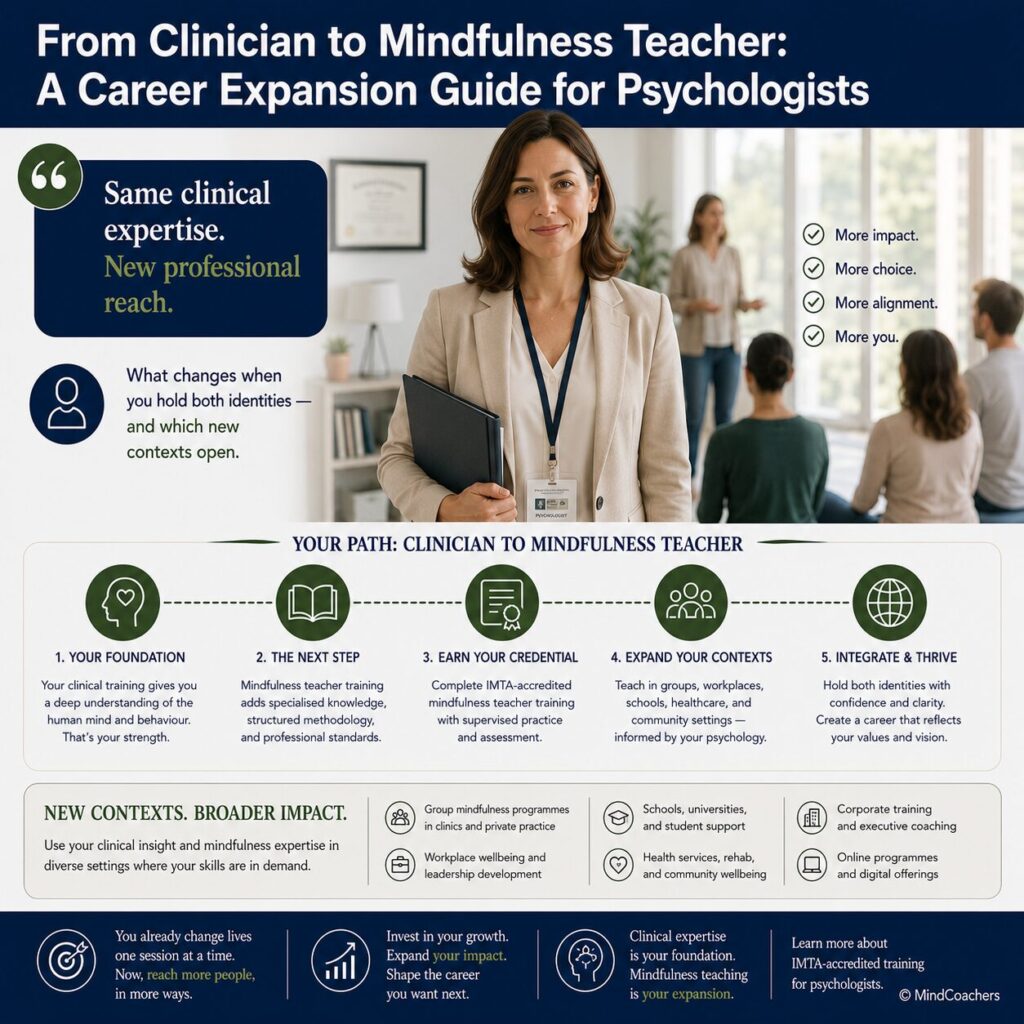
Most psychologists who complete formal mindfulness teacher training are not looking to leave clinical practice. They are looking to extend it — to reach populations and contexts that individual therapy cannot reach, to offer group-based mindfulness programmes to clients who need them, and to develop a professional identity that sits alongside their clinical one rather than replacing it.
The question of how to do this well — how to add mindfulness teaching to an active caseload without creating confusion for clients, referrers, or supervisors — is one that most training programmes do not address directly. This guide does. It covers the professional distinctions that matter, what actually changes when you hold both identities, which new contexts become accessible, and how to manage the transition practically. For the comparison of formal training options available to psychologists, see the best mindfulness teacher training for psychologists: 2027 comparison.
The starting point is mindfulness teacher training for psychologists — the segment overview that covers what the credential means, what it opens, and who it is for. This guide goes a level deeper: the practical question of how to make the transition while maintaining an active clinical practice.
Key takeaways
→ Psychologists adding formal mindfulness teaching are not changing career — they are adding a distinct professional capability that opens group and institutional contexts individual therapy does not reach.
→ IMTA CMT-P certification is the credential that institutional commissioners — NHS-adjacent, corporate, educational — recognise for mindfulness teaching. It is independent of and complementary to existing clinical registration.
→ The professional identity question — therapist or mindfulness teacher — is resolved by scope of practice clarity, not by choosing one over the other. Both identities can coexist with clear framing.
→ The MCMI — MindCoachers Certified Mindfulness Instructor is designed for practitioners in active clinical practice — 12 weeks, fully online, concurrent practicum from Week 1, no residential intensive required.
→ Two credentials result from the MCMI: the MCMI certificate (automatic on completion, included in tuition) and the IMTA CMT-P (post-graduation application to IMTA, independent fee of approximately €150–250). They are distinct steps.
Why psychologists are the fastest-growing segment completing IMTA mindfulness teacher training
Clinical practitioners bring something that most mindfulness teacher training cohorts lack: a sophisticated understanding of psychological suffering, a practised capacity for holding difficult presentations, and a professional framework for managing clinical risk in group contexts. These are not trivial additions to mindfulness teaching competency — they are the differentiators that make clinician-trained mindfulness teachers significantly more effective in complex populations.
The professional movement toward IMTA CMT-P level training among psychologists is also driven by something more structural: the growing gap between the demand for mindfulness in institutional settings and the supply of credentialled practitioners to deliver it. NHS wellbeing teams, employee assistance programmes, educational establishments, and corporate wellbeing functions are increasingly commissioning mindfulness programmes — and increasingly requiring that programme facilitators hold a verified professional credential, not just personal practice experience.
For psychologists, the IMTA CMT-P credential is the most efficient route to credentialled mindfulness teaching. It is recognised across European and North American institutional contexts, it builds on clinical competencies already in place, and it opens a professional surface area — group teaching, programme design, institutional commissioning — that clinical registration alone does not.
The professional distinction that matters: therapist vs mindfulness teacher
The most important conceptual shift for psychologists adding mindfulness teaching to clinical practice is understanding that these are different professional roles with different contexts, different relationships, and different competency frameworks. They are not the same role with different content.
As a therapist, the professional relationship is therapeutic: bounded, confidential, with specific duty of care and clinical risk management obligations. Mindfulness techniques are integrated into that relationship as clinical interventions.
As a mindfulness teacher, the professional relationship is pedagogical: the teacher guides a structured learning experience, participants are enrolled in a programme rather than referred for treatment, and the professional context is teaching rather than clinical. Why every mindfulness teacher needs a defined scope of practice explains why this distinction is not semantic — it determines screening procedures, duty of care obligations, and professional liability.
The identity shift from practising mindfulness to teaching it professionally is one that most clinicians find more manageable than they expect, once the scope-of-practice boundary is clearly held. The boundary is the key — not the identity choice.
What changes when you hold both professional identities
For most psychologists, adding formal mindfulness teaching changes three things practically:
- Professional service offering: you can now offer structured mindfulness programmes to groups — workplace cohorts, clinical CPD groups, community participants, corporate wellbeing clients — as a separate professional service, distinct from individual therapy.
- Referral pathways: you become visible to commissioners who are specifically looking for credentialled mindfulness teachers. This includes NHS wellbeing teams, EAP providers, corporate HR functions, and educational establishments — none of whom typically commission from individual therapy referral pathways.
- Income structure: group teaching generates income at a different rate-per-hour from individual therapy. An 8-week mindfulness programme with 12 participants generates significantly more income per facilitation hour than the equivalent hours in individual sessions — and at scale, this changes the economics of the professional practice considerably.
What does not change: clinical registration, duty of care obligations within clinical relationships, scope of practice within the therapeutic frame. Adding mindfulness teaching does not modify existing clinical professional obligations — it adds a new professional surface area alongside them.
Which new mindfulness teaching contexts and populations become accessible
IMTA CMT-P level training opens institutional contexts that clinical registration alone does not reach. The most immediately accessible for psychologists:
- NHS wellbeing team mindfulness facilitation: NHS trusts and PCNs increasingly commission standalone mindfulness facilitation beyond MBCT protocol delivery. IMTA CMT-P is the appropriate credential for this context.
- Corporate and organisational wellbeing: large employers commissioning workplace mindfulness programmes require credentialled facilitators. Corporate HR functions and EAP providers recognise the IMTA CMT-P as the professional standard for this market.
- Clinical CPD delivery: psychologists with IMTA CMT-P can deliver mindfulness-based CPD to other clinicians — an accessible and professionally credible initial teaching context for practitioners transitioning into formal teaching.
- Population-specific programmes: populations you already work with clinically — chronic pain, anxiety, burnout, health psychology — become accessible as teaching participants outside the therapeutic frame, in group programme contexts that reach significantly more people per intervention hour.
For context on how the CMT-P certification pathway positions the holder in the professional market, the full credential explanation covers what commissioners look for and how to present the qualification in institutional contexts.
Managing the dual professional identity with existing clients and referrers
The most common concern psychologists have about adding mindfulness teaching is that it will create confusion for existing clients or referrers. In practice, this risk is manageable with clear framing — and the confusion, where it arises, is more often internal than external.
For existing therapy clients: the key is explicit framing delivered proactively, not reactively. A brief statement at the appropriate moment: “I have completed formal mindfulness teacher training and now also offer structured mindfulness programmes — these are separate from our therapy work, for people who want to develop a mindfulness practice outside a therapeutic relationship.” Most clients find this additive rather than confusing; it extends their sense of the practitioner’s range without disrupting the existing therapeutic frame.
For referrers — GPs, psychiatrists, other psychologists: the framing is outcomes-based and boundary-clear. Reference the IMTA CMT-P credential explicitly, position the mindfulness programmes as a distinct professional offering, and describe the populations and contexts they serve. Referrers who understand the distinction between therapeutic mindfulness integration and formal teaching programmes will recognise the clinical logic of the dual role.
The first six months after mindfulness certification covers the practical post-qualification questions in detail — how to price, how to market, and how to build a teaching practice alongside an existing clinical one.
The timing question: when is the right moment to add mindfulness teaching to a clinical career?
The timing question is less about caseload and more about professional intent. Psychologists who make this transition most smoothly are those with a specific destination in mind — a population they want to reach through group teaching, a programme they want to run, or an income diversification goal that group teaching can serve. Vague curiosity about mindfulness does not generate the motivation to complete a 12-week intensive alongside an active clinical practice.
The practical question is format compatibility. The MCMI — MindCoachers Certified Mindfulness Instructor is designed specifically for this: fully online, one live session per week, concurrent practicum that can be integrated with existing clinical relationships. There is no residential intensive requiring clinical practice to be paused. Why mindfulness teacher certification does not require a career pause addresses the format question directly.
The credential question is also worth clarifying before beginning training. IMTA CMT-P training builds on clinical competencies already in place — the ACT and third-wave CBT integration in the MCMI curriculum is directly relevant to psychologists who already work in these frameworks. For those who have completed MBCT training, the IMTA CMT-P adds what MBCT training does not cover: secular programme design beyond the MBCT protocol, general teaching competency across contexts, and a credential that non-NHS commissioners recognise.
Download the MCMI — MindCoachers Certified Mindfulness Instructor — prospectus: full curriculum, faculty profiles, pricing and cohort information.
Further reading and professional resources
Best Mindfulness Teacher Training for Psychologists and Therapists: 2027 Comparison
Mindfulness Teacher Training for Psychologists (2027)
CMT-P Certification Explained: How to Become an IMTA-Certified Mindfulness Teacher
The First Six Months After Mindfulness Certification
From Teaching Mindfulness to Training Other Teachers
The Identity Shift From Practising Mindfulness to Teaching It Professionally
Why Mindfulness Teacher Certification Doesn’t Require a Career Pause
Next steps
If you are a psychologist ready to formalise mindfulness teaching alongside your clinical practice, the MCMI — MindCoachers Certified Mindfulness Instructor is designed for practitioners at exactly this stage — clinical competency already in place, active caseload maintained throughout training, and a concurrent practicum that integrates with existing professional relationships.
Frequently asked questions
About mindfulness teacher training for psychologists and the MCMI — MindCoachers Certified Mindfulness Instructor