
Best Mindfulness Teacher Training for Psychologists and Therapists: 2027 Comparison
Which mindfulness teacher training is right for psychologists? Programmes compared by clinical scope, IMTA accreditation, and CPD recognition.
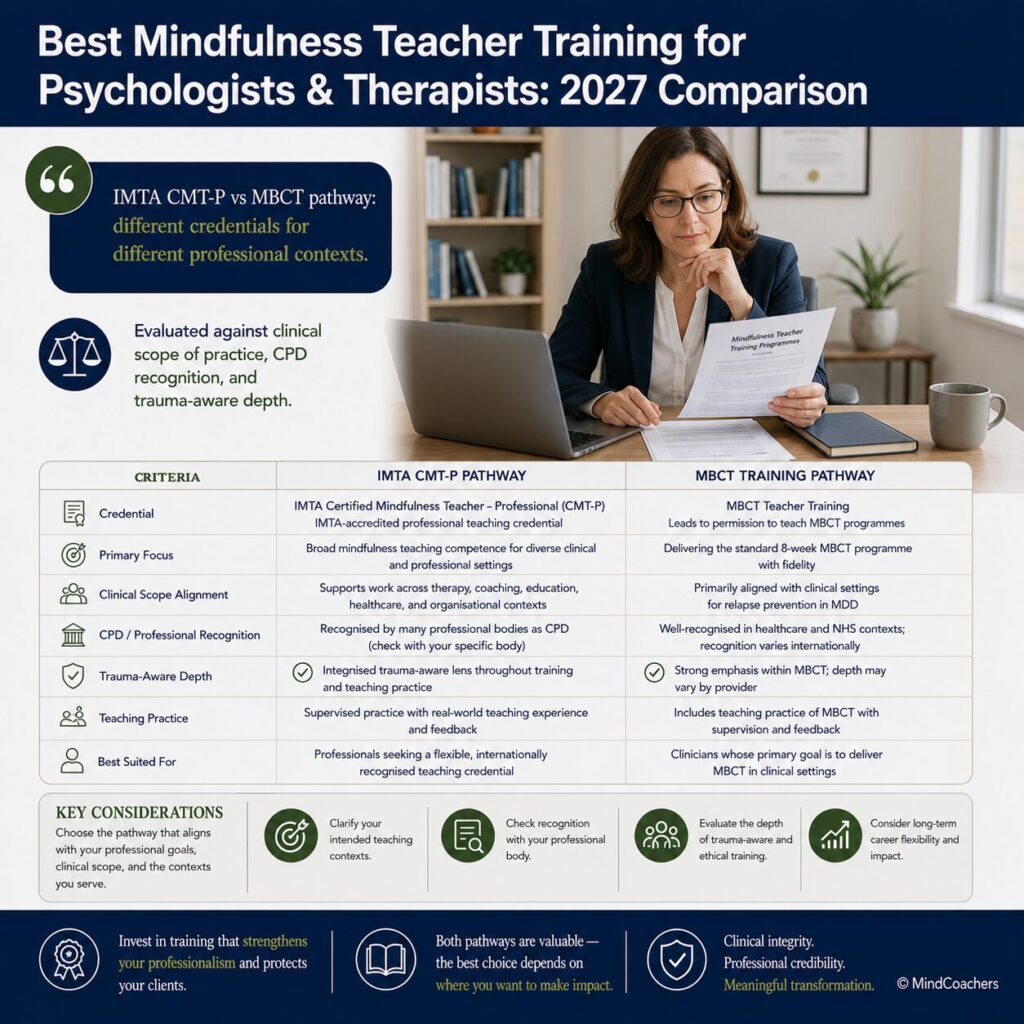
An in-depth comparison of the programmes that best serve clinical practitioners — evaluated against the criteria that actually matter for scope of practice, CPD recognition, and professional credibility.
Psychologists and therapists are turning to mindfulness teacher training in growing numbers — not to change careers, but to expand the range of what they can offer within their existing clinical practice. The demand is real, and so is the confusion. A search returns everything from weekend certificates to two-year immersions, with very little guidance on what actually matters for a clinical practitioner.
The question is not simply which programme is best. It is which programme is best for you — given your clinical context, your scope of practice, the populations you work with, and the professional credential framework your work sits within. A programme ideal for a yoga teacher is not appropriate for a practising psychologist. A credential that opens NHS MBCT delivery does not serve a therapist who wants to teach workplace mindfulness. These are different professional destinations, and they require different training decisions. The question of whether therapists can teach mindfulness without extra training is often where this evaluation begins.
This comparison was built specifically for clinical practitioners — psychologists, psychotherapists, counsellors, and therapists at all stages of career — who want an honest, structured evaluation of the main options. We applied seven criteria that matter for this segment, compared five programmes against them, and explained clearly when each programme is the right choice — and when it is not. For a broader overview, see the mindfulness teacher training for psychologists segment guide.
Key takeaways
→ IMTA-accredited 200-hour training is the appropriate professional standard for psychologists who want to teach formal mindfulness programmes across multiple contexts.
→ MBCT teacher training (Oxford/Bangor/Exeter) is the right choice for therapists whose primary goal is NHS MBCT protocol delivery for recurrent depression — it is a protocol-specific credential, not a general teaching qualification.
→ MBSR teacher training develops strong foundational practice but does not produce a credential recognised for general professional mindfulness teaching in European institutional contexts.
→ The MCMI — MindCoachers Certified Mindfulness Instructor is the strongest IMTA-accredited option for the 12-week intensive format, with ACT/third-wave CBT integration and a doctorate-level trauma-aware protocol designed for clinical practitioners.
→ Two credentials are produced by the MCMI: the MCMI certificate (automatic on completion, included in tuition) and the IMTA CMT-P (post-graduation application to IMTA, independent fee of approximately €150–250). They are distinct steps — never presented as one.
How this mindfulness teacher training comparison was built — and what makes it different from general rankings
Most mindfulness teacher training comparison articles are written for a general audience — practitioners with no specific professional context, evaluating programmes primarily on price, duration, and brand recognition. This comparison is different. It was built for clinical practitioners, evaluated against criteria specific to scope of practice, CPD recognition, and the institutional contexts psychologists and therapists actually work in. Understanding what makes a good mindfulness teacher training is the starting point — this comparison applies those criteria through a clinical lens.
We reviewed published curricula, accreditation documentation, and faculty credentials for each programme. Where information was not publicly verifiable, we have noted this. We have not ranked programmes in a simple numerical order — because the right programme depends on what you are trying to achieve professionally, not on a composite score that averages across very different professional needs.
The five programmes reviewed are the most frequently encountered by clinical practitioners evaluating mindfulness teacher training globally: the MCMI — MindCoachers Certified Mindfulness Instructor, MBCT Teacher Training (Oxford Mindfulness Centre / Bangor / Exeter), MBSR Teacher Training (UMass CFM / Brown Mindfulness Center), MMTCP (Sounds True), and Breathworks Mindfulness Teacher Training.
The evaluation criteria for clinical mindfulness teacher training
Seven criteria were applied, each chosen for its direct relevance to clinical practitioners evaluating mindfulness teaching programmes:
- Accreditation standard — IMTA CMT-P accreditation, protocol-specific recognition, or neither — determines which institutional contexts the credential opens.
- Clinical depth — ACT and third-wave CBT integration, trauma-aware protocol depth, and scope-of-practice curriculum coverage. See what most mindfulness training misses about trauma-aware practice.
- CPD recognition — Eligibility for BPS, BACP, and HCPC continuing professional development records.
- Scope of practice — Whether the credential covers general professional mindfulness teaching or is limited to a specific protocol. The comparison of IMTA vs Yoga Alliance vs IMMA accreditation provides useful context.
- Format — Compatibility with active clinical practice: online delivery, time commitment per week, cohort structure.
- Practicum structure — Whether teaching practice is concurrent (during training) or post-training, and how many hours are required. What 200-hour mindfulness teacher training actually delivers matters for clinical practitioners.
- Duration and time commitment — Total weeks or months, and realistic hours per week for a practitioner in active clinical practice.
Comparison at a glance: mindfulness teacher training programmes reviewed
| Programme | Accreditation | Clinical depth | CPD eligible | Scope | Format | Duration |
| MCMI — MindCoachers | IMTA CMT-P | ACT + third-wave CBT, trauma-aware doctorate level | Yes (BPS/BACP) | General professional teaching | Online cohort | 12 wks / 200h |
| MBCT (Oxford/Bangor/Exeter) | NHS / MBI-TAC | MBCT protocol, MBI-TAC assessed | Yes | MBCT protocol only | In-person intensive | ~160h |
| MBSR (UMass CFM / Brown) | UMass/Brown cert | MBSR protocol, foundational | As CPD evidence | MBSR protocol only | In-person + online | ~130–160h |
| MMTCP (Sounds True) | None (dharma) | Deep practice, not clinical focus | Limited | Dharma/personal teaching | Online, 2 years | ~150h |
| Breathworks | Breathworks cert | Chronic pain / compassion | As CPD evidence | Breathworks protocol | Online/in-person | ~120h |
IMTA CMT-P vs MBCT pathway: different credentials for different mindfulness teaching contexts
The most important distinction for clinical practitioners is not between individual programmes — it is between two fundamentally different credential types, each opening a different professional destination.
The IMTA CMT-P credential is the international professional standard for mindfulness teachers who want to teach across multiple contexts and populations: workplace wellbeing, general clinical groups, educational settings, community programmes, and standalone mindfulness courses. An IMTA CMT-P qualification signals to institutional commissioners — NHS-adjacent services, employee assistance programmes, educational establishments — that the holder has completed verified professional training to a recognised international standard. For psychologists wanting to extend their professional reach beyond the consulting room into group teaching, this is the appropriate qualification.
The MBCT pathway credential — offered through Oxford Mindfulness Centre, Bangor University, and Exeter — prepares therapists to deliver the specific 8-week MBCT protocol for recurrent depression. It is assessed against the MBI-TAC criteria and is recognised in NHS commissioning for MBCT groups. It does not qualify the holder to teach mindfulness in other contexts or populations. For therapists whose specific professional goal is NHS MBCT group delivery, this is the appropriate and necessary credential. For therapists who want broader teaching capability, it is not sufficient.
The decision framework is simple: if your goal is MBCT protocol delivery in NHS or NHS-adjacent settings, pursue the Oxford/Bangor/Exeter pathway. If your goal is professional mindfulness teaching across a range of contexts, pursue IMTA CMT-P level training. The differences between IMTA and other mindfulness accreditation bodies are worth understanding before making this decision.
What the MCMI — MindCoachers Certified Mindfulness Instructor offers clinical practitioners specifically
The MCMI — MindCoachers Certified Mindfulness Instructor is the programme in this comparison built explicitly for professionals already working in clinical, coaching, or wellness contexts who want to add formal mindfulness teaching to their practice. For psychologists and therapists specifically, several features of the MCMI are directly relevant. A full breakdown is available in the MCMI programme overview.
The curriculum integrates ACT (Acceptance and Commitment Therapy) and third-wave CBT frameworks throughout — not as an optional module, but as a foundational pedagogical approach. The difference between knowing ACT and teaching mindfulness with it is a distinction the MCMI curriculum addresses directly. For clinical practitioners already working within these frameworks, this integration means the mindfulness teaching they develop is consistent with their existing clinical methodology, rather than sitting in a separate professional silo.
The trauma-aware protocol in the MCMI was developed at doctorate level specifically for teaching contexts — covering body scan dissociation risk, breath practice contraindications for trauma histories, participant screening protocols, and crisis referral procedures. How to assess trauma-aware competency in any training sets out the specific questions to ask; the MCMI is designed to answer them at clinical depth. Polyvagal theory for mindfulness teachers is integrated into the curriculum’s understanding of nervous system regulation in group teaching contexts.
The format — 12 weeks, fully online, cohort-based — is designed for practitioners in active professional practice. There are no residential intensives that require clinical practice to be paused. The concurrent practicum (35 hours, running from Week 1) means participants begin teaching real participants during training, with peer feedback structured into each week. The MCMI practicum is the most common integration point for psychologists using existing clinical groups as their teaching practice context.
The MCMI produces two credentials. The MCMI certificate is awarded automatically on programme completion and is included in tuition. The IMTA CMT-P credential is obtained through a separate post-graduation application to the International Mindfulness Teachers Association, with an independent application fee of approximately €150–250 paid directly to IMTA. These are two distinct steps — the IMTA CMT-P is not automatic and is not included in MCMI tuition.
What the alternatives offer clinical mindfulness practitioners — and when they are the better choice
MBCT Teacher Training — Oxford Mindfulness Centre / Bangor University / Exeter
MBCT teacher training through the Oxford Mindfulness Centre, Bangor University Centre for Mindfulness Research and Practice, or Exeter is the appropriate route for therapists whose specific professional goal is delivery of the 8-week MBCT protocol for recurrent depression in NHS or NHS-adjacent settings. The training is protocol-specific, assessed against MBI-TAC criteria, and produces a credential recognised in NHS commissioning. It is the right choice when the professional destination is MBCT group delivery within a clinical setting that recognises and requires this specific qualification. It is not a general mindfulness teaching credential and does not prepare practitioners to teach mindfulness in workplace, educational, or community contexts.
MBSR Teacher Training — UMass CFM / Brown Mindfulness Center
MBSR teacher training through the University of Massachusetts Center for Mindfulness or Brown University develops strong foundational practice in the original 8-week MBSR protocol. It carries significant brand recognition internationally and is valued by practitioners seeking depth in the foundational secular mindfulness curriculum. However, the UMass or Brown certificate does not produce an IMTA CMT-P credential, and MBSR teacher training is not positioned as a general professional mindfulness teaching qualification in European institutional contexts. The distinction between MBSR and professional mindfulness teacher certification helps clarify when this pathway is and is not appropriate.
MMTCP — Sounds True (Tara Brach and Jack Kornfield)
The Mindfulness Meditation Teacher Certification Programme offers two years of online training rooted in Buddhist psychology and Insight meditation lineage, with faculty of exceptional depth and personal practice reputation. For clinical practitioners drawn to dharma lineage and a long-term contemplative commitment, the MMTCP provides breadth of personal practice development that is genuinely distinctive. It does not produce an IMTA CMT-P credential and is not designed for institutional professional teaching contexts. It is the right choice for practitioners whose primary motivation is personal and contemplative deepening, rather than institutional professional credentialling.
Breathworks Mindfulness Teacher Training
Breathworks is a well-regarded programme with a specific focus on chronic pain and compassion-based mindfulness, developed through clinical research in partnership with the NHS. The Breathworks credential is recognised within its specific niche — chronic pain management, compassion-based intervention — and the curriculum is evidence-grounded. For clinical practitioners working specifically with chronic pain populations, Breathworks training provides directly relevant specialist content. It is a protocol-adjacent credential rather than a general professional mindfulness teaching qualification and does not produce an IMTA CMT-P.
How to choose: a decision framework for psychologists and therapists evaluating mindfulness teacher training
The right programme depends on your professional destination, not on which programme has the highest profile or the longest history. Use this framework:
- If your goal is NHS MBCT group delivery: pursue Oxford Mindfulness Centre, Bangor, or Exeter MBCT teacher training. This is the protocol-specific credential NHS commissioning recognises for this context.
- If your goal is general professional mindfulness teaching across multiple contexts — workplace, community, educational, clinical groups, standalone courses: pursue IMTA CMT-P level training. The MCMI is the strongest option in this category for the 12-week online cohort format with ACT integration and clinical-depth trauma-aware protocol.
- If your goal is deepening personal practice and dharma understanding: MMTCP offers genuine depth in this direction, with the understanding that it is not a professional institutional credential.
- If your goal is specialising in chronic pain mindfulness delivery: Breathworks provides directly relevant specialist content within its protocol framework.
For most psychologists and therapists who want to expand their professional reach — to teach formal mindfulness programmes beyond 1:1 therapy, to offer group-based mindfulness to corporate clients, to run standalone mindfulness courses — IMTA CMT-P level training is the appropriate standard. Understanding whether you need a mindfulness teaching certification to teach is worth reading before making your decision. The MCMI is the programme in this comparison built specifically for practitioners at this professional stage.
Download the MCMI — MindCoachers Certified Mindfulness Instructor — prospectus: full curriculum, faculty profiles, pricing and cohort information.
Further reading and professional resources
Mindfulness Teacher Training for Psychologists (2027)
Can Therapists Teach Mindfulness Without Extra Training? A Clinical Perspective
What Is IMTA Accreditation for Mindfulness Teachers — And Does It Matter?
IMTA vs Yoga Alliance vs IMMA: Mindfulness Teacher Accreditation Compared (2027)
Polyvagal Theory for Mindfulness Teachers — What It Means
How to Assess Trauma-Aware Competency in Any Training
The Difference Between Knowing ACT and Teaching Mindfulness With It
What Most Mindfulness Training Misses About Trauma-Aware Practice
IMTA CMT-P certification pathway
Next steps
If you are a psychologist or therapist ready to formalise your mindfulness teaching practice at IMTA CMT-P professional level, the MCMI — MindCoachers Certified Mindfulness Instructor is built for practitioners at exactly this professional stage.
Frequently asked questions
About mindfulness teacher training for psychologists and the MCMI — MindCoachers Certified Mindfulness Instructor