
Do You Need a Mindfulness Teaching Certification — Or Can You Teach Without One?
The legal answer and the professional answer are different — and the gap between them is where most practitioners get into difficulty.
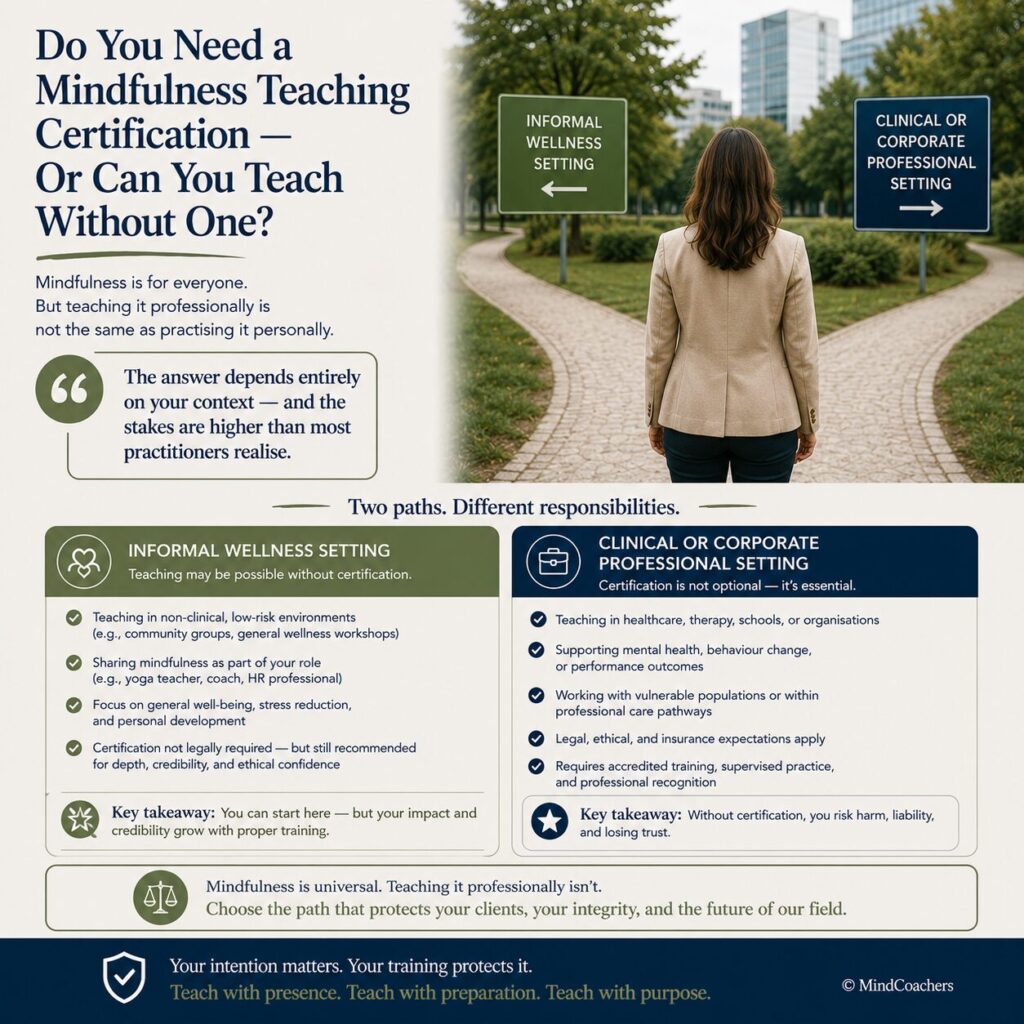
Mindfulness teaching is not a regulated profession in most European jurisdictions. There is no legal requirement to hold a specific qualification before calling yourself a mindfulness teacher or charging for mindfulness instruction. This is the straightforward answer to the question “do I need a certification?” — and it is the answer that leads many practitioners to underestimate the professional and reputational risks of teaching without one.
The more useful question is not whether a certification is legally required but whether it is professionally necessary for the contexts you intend to work in. The answer varies significantly depending on your target market — and in the contexts where professional mindfulness teaching generates sustainable income, the credential question has effectively already been answered by institutional procurement standards.
This article gives a clear-eyed account of when a certification is optional, when it is effectively required, and what the specific risks of teaching without one are in different contexts. For career and income context, see is mindfulness teaching a viable career in 2027?. For the full accreditation comparison, see IMTA vs Yoga Alliance vs IMMA: mindfulness teacher accreditation compared.
Key takeaways
→ Mindfulness teaching is unregulated — there is no legal requirement to hold a certification in most European jurisdictions.
→ The professional market — corporate, clinical, institutional — effectively requires IMTA CMT-P accreditation through procurement standards rather than law.
→ Teaching without a credential in a clinical or high-risk context creates professional liability exposure that most practitioners underestimate.
→ Yoga Alliance and lighter credentials do not satisfy the standard that professional institutional clients are beginning to specify.
→ The credential question is not primarily about ethics or legality — it is about market access and professional risk management.
The legal position: unregulated does not mean unrestricted
In the UK, EU, and most European markets, mindfulness teaching is not a regulated profession. There is no licensing body, no protected title, and no legal minimum qualification required to teach mindfulness and charge for it. This places mindfulness teaching in the same category as life coaching, nutritional advising (in most jurisdictions), and a range of other wellness and professional development practices that operate without statutory regulation.
What unregulated means in practice is that consumer protection law and professional liability become the primary legal frameworks. You cannot make claims you cannot substantiate (consumer protection). You are liable for harm resulting from your instruction (professional liability). You have a duty of care to the people you teach, regardless of whether you hold a formal qualification. These obligations exist whether or not you have a certification — the certification is evidence of competence, not the source of the obligation.
For the regulatory landscape in detail, see is mindfulness teacher training regulated? What professionals need to know.
When you can teach without a certification
There are genuine contexts where teaching mindfulness without a formal certification is reasonable:
- Introductory or taster sessions for general wellness audiences: A drop-in mindfulness session for a yoga studio, a brief introduction to mindfulness for a community group, or a taster workshop at a wellness event. These contexts involve low-risk populations, no clinical framing, and no ongoing therapeutic relationship.
- Teaching within a supervised clinical or organisational context: A psychologist who introduces mindfulness practices within their existing clinical supervision framework is operating within a regulated professional context — the regulation attaches to their clinical registration, not to a separate mindfulness teaching credential.
- Personal or community practice: Leading a peer meditation group, facilitating a community practice circle, or teaching informally within a spiritual or contemplative community does not typically require formal certification.
In all these contexts, professional liability insurance is still strongly advisable regardless of certification status. Most insurers will not cover mindfulness teaching without evidence of training — and “I did not think I needed a qualification” is not a defence in a professional liability claim.
When a certification is effectively required
Corporate and institutional procurement
Corporate L&D departments, NHS commissioning bodies, EAP providers, and professional associations do not commission mindfulness facilitators on the basis of a CV and a compelling website. They apply procurement standards — including credential verification, professional liability insurance evidence, and in some cases DBS checks — before adding a facilitator to their approved provider list.
IMTA CMT-P accreditation is increasingly the credential these procurement processes specify or recognise. A practitioner without it is typically not assessed on merit — they are filtered out at the application stage. For what credentials procurement teams specify, see mindfulness teacher certification: which credentials actually matter to employers?. For the workplace context specifically, see mindfulness in the workplace: what qualifications do corporate facilitators need?.
Clinical and NHS-adjacent contexts
Teaching mindfulness in any context that involves clinical populations — participants with diagnosed mental health conditions, people in active treatment, or groups that include individuals with complex presentations — without appropriate training creates significant professional liability exposure. The duty of care in these contexts is higher, the risk of harm is greater, and the absence of a formal credential removes the primary evidence of competence that would otherwise mitigate liability.
NHS trusts commissioning mindfulness facilitators, IAPT services integrating mindfulness into their programmes, and clinical organisations running wellbeing groups all require credential verification. IMTA CMT-P is the standard most consistently recognised in these contexts. For clinical practitioners specifically, see mindfulness teacher training for psychologists and can therapists teach mindfulness without extra training? A clinical perspective.
Professional coaching and CPD delivery
Executive coaches integrating mindfulness into their practice, HR professionals delivering mindfulness-based CPD, and wellness practitioners offering mindfulness programmes to professional audiences all operate in contexts where their clients’ professional credibility is implicated in the choices they make about who they bring in. A coach who refers a client to an uncredentialed mindfulness practitioner is making a professional judgement that reflects on them.
For coaches specifically, see mindfulness teacher training for executive and leadership coaches.
The professional liability question
The most underappreciated risk of teaching mindfulness without a formal credential is not reputational — it is professional liability. Mindfulness practice, while generally safe for healthy adult populations, is not risk-free. Intensive practice can surface trauma. Body-scan practices can be distressing for individuals with dissociation histories. Breath practices can trigger panic in people with anxiety disorders.
A practitioner who teaches in a context where these outcomes occur, and who cannot demonstrate evidence of training in trauma-aware protocols, scope-of-practice boundaries, and participant risk assessment, is in a significantly weaker position in a professional liability claim than one who can. The credential is not a guarantee against adverse events — it is evidence that you had the training to anticipate and manage them.
This is why professional liability insurance is a prerequisite for mindfulness teaching in any professional context — and why most insurers require evidence of relevant training before issuing coverage. For the training that provides this foundation, see what makes a good mindfulness teacher training? 7 criteria.
What a lighter credential does and does not provide
Some practitioners complete shorter mindfulness teacher training programmes — weekend certificates, online courses of 20–40 hours — and market themselves as mindfulness teachers on that basis. These credentials are not worthless: they indicate engagement with the subject and some level of training. But they do not satisfy the professional standard that institutional clients are beginning to specify, and they typically do not include the supervised teaching practice and concurrent practicum that make a credential credible to liability insurers and professional commissioners.
Yoga Alliance credentials — frequently cited on mindfulness teacher profiles — are yoga instruction credentials, not mindfulness teaching credentials. For the full comparison, see IMTA vs Yoga Alliance vs IMMA: mindfulness teacher accreditation compared. For yoga teachers specifically, see mindfulness teacher training for yoga teachers: bridging practice and formal instruction.
The practical decision framework
The credential question is best approached as a market access and risk management question rather than an ethical or legal one:
- What market am I targeting? If corporate, clinical, or institutional: IMTA CMT-P is effectively required. If general wellness or community: lighter credentials or no credential may be sufficient.
- What is my liability exposure? If teaching vulnerable populations, clinical contexts, or anything adjacent to therapy: a formal credential substantially reduces liability risk.
- What does my insurance require? Check before you teach. Most professional liability insurers require evidence of relevant training.
- What are my professional peers doing? If you work in a field (coaching, psychology, HR) where credentialling norms are well-established, the mindfulness credential question should be approached with the same rigour.
For timeline and format context, see how long does it take to become a certified mindfulness teacher?. For income implications, see mindfulness teacher salary guide: realistic income ranges for Europe. For demand context, see demand for mindfulness teachers in Europe: 2027–2030 forecast.
Download the MCMI — MindCoachers Certified Mindfulness Instructor — prospectus: full curriculum, faculty profiles, pricing and cohort information.
Further reading and professional resources
↗ Is mindfulness teaching a viable career in 2027?
↗ IMTA vs Yoga Alliance vs IMMA: mindfulness teacher accreditation compared
↗ Mindfulness teacher certification: which credentials actually matter to employers?
↗ Is mindfulness teacher training regulated? What professionals need to know
↗ What makes a good mindfulness teacher training? 7 criteria
↗ Best IMTA-accredited mindfulness teacher training programmes: 2027 guide
Next steps
For practitioners who have decided that IMTA CMT-P accreditation is the right standard for their professional context, the MCMI — MindCoachers Certified Mindfulness Instructor offers a 12-week intensive pathway to qualification. IMTA accreditation is confirmed at CMT-P level. The curriculum includes trauma-aware protocols, scope-of-practice clarity, and supervised teaching practice from week one — the foundations that support both professional liability insurance and institutional procurement applications.
Frequently asked questions
About mindfulness teacher training for psychologists and the MCMI — MindCoachers Certified Mindfulness Instructor