
Mindfulness Teacher Training for Executive and Leadership Coaches (2027)
What formal mindfulness teacher training adds to an executive or leadership coaching practice — and why coaches who hold both credentials are accessing a different client tier.
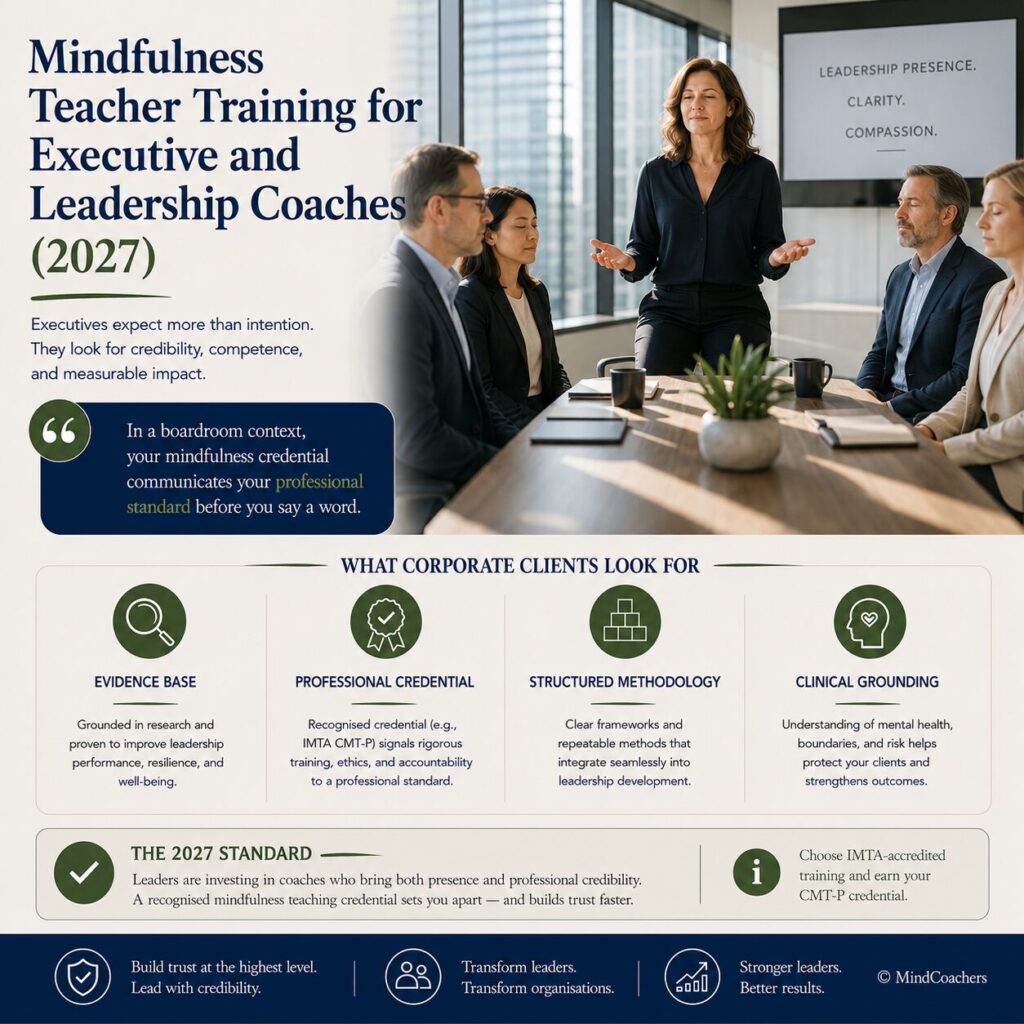
Executive and leadership coaches are the fastest-growing segment of professionals completing formal mindfulness teacher training. The driver is client demand: senior leaders and executives are increasingly expecting mindfulness-integrated coaching programmes — and coaches who can deliver mindfulness as a formal practice, not just reference it as a concept, are positioned differently in the market.
But the credential question for coaches is more nuanced than it first appears. Adding mindfulness teacher training to a coaching practice is not simply about expanding a service offering. It changes the nature of what coaches can deliver — how they structure development work, how they hold complexity with clients, how they talk about performance and presence in language that resonates with senior audiences. Done well, it is not an add-on; it is a professional evolution.
This article addresses what formal mindfulness teacher training adds to a coaching practice that coaching training alone does not provide, which coaches benefit most from it, and what to look for in a programme that serves the coaching context specifically. For practical implementation guidance, see adding mindfulness certification to your coaching practice: a practical guide. For the workplace context, see mindfulness in the workplace: what qualifications do corporate facilitators need?.
Key takeaways
→ Executive and leadership coaches are the fastest-growing segment completing formal mindfulness teacher training — driven by client demand for mindfulness-integrated programmes.
→ Formal mindfulness teacher training provides what coaching training does not: the ability to guide formal mindfulness practices, structure a mindfulness curriculum, and hold a teaching context distinct from a coaching context.
→ The credential combination — ICF or equivalent coaching credential plus IMTA CMT-P — positions coaches in a different market tier from those offering mindfulness-informed coaching without formal teaching credentials.
→ ACT integration is the most strategically relevant curriculum content for executive coaches — it bridges mindfulness and performance in language that senior audiences respond to.
→ The primary risk for coaches adding mindfulness is blurring the boundary between coaching and teaching contexts — formal training addresses this through scope-of-practice content.
Why executive coaches are adding formal mindfulness teaching credentials
The demand driver is specific: senior leaders and executives in high-performance organisations are increasingly sophisticated consumers of personal development. They are aware of the research on mindfulness and performance. They have often encountered mindfulness through corporate wellbeing programmes, retreats, or personal practice. When they engage a coach, they arrive with an expectation that mindfulness will be available as a formal practice — not just referenced in conversation.
A coach who can guide a formal mindfulness practice in a session, structure a six-session mindfulness development programme alongside coaching, or design a team mindfulness experience for a leadership group, is offering something qualitatively different from one who talks about mindfulness but cannot teach it. The blog post why executive coaches need a mindfulness teaching credential gives the demand perspective directly from the coaching market.
The commercial implication is significant. Coaches who hold both an ICF credential and an IMTA CMT-P are positioned to command premium rates for mindfulness-integrated coaching engagements, to access corporate L&D contracts that would otherwise require a separate mindfulness facilitator, and to offer leadership team mindfulness programmes as a distinct service line. For the income context, see mindfulness teacher salary guide: realistic income ranges for Europe.
What formal mindfulness teacher training adds to coaching practice
The ability to guide formal practices
The most direct addition is the most obvious one: a qualified mindfulness teacher can guide formal mindfulness practices — body scans, breath awareness, compassion practices, open monitoring — in coaching sessions and programmes. This sounds simple; it is not. Guiding a practice well requires specific skills: the right language register (invitational, not directive), the ability to pace guidance to the room, the capacity to hold silence without filling it, and the sensitivity to notice and respond to what arises for participants. These are teachable skills that require practice and feedback to develop.
Coaches who have attended mindfulness retreats or practised mindfulness personally often underestimate this. Having participated in guided practices does not qualify you to guide them. The video the difference between knowing ACT and teaching mindfulness with it makes this distinction precisely — for coaches who know ACT, the gap between knowing the framework and teaching mindfulness within it is the gap that formal training closes.
Curriculum design for mindfulness development
Formal mindfulness teacher training teaches you how to design and deliver a structured mindfulness curriculum — a sequence of practices and didactic content that develops a client’s mindfulness practice over time. This is different from including mindfulness in coaching sessions ad hoc. A structured mindfulness development programme alongside coaching — six to eight sessions with a designed sequence, home practice assignments, and a conceptual framework — is a distinct professional offering that requires pedagogical competency beyond coaching skill.
For coaches working with senior leaders, the ability to design a personal mindfulness development programme is particularly relevant. Senior leaders respond well to structure, to evidence-based frameworks, and to the explicit integration of mindfulness with performance — all of which a structured programme delivers more effectively than ad hoc mindfulness in coaching sessions.
ACT integration
Acceptance and Commitment Therapy (ACT) is the most strategically relevant theoretical framework for executive coaches adding mindfulness to their practice. ACT integrates mindfulness within a performance-relevant language — psychological flexibility, defusion, values clarification, committed action — that translates naturally to leadership and organisational contexts. A coach who can teach mindfulness within an ACT framework, rather than as a standalone wellness practice, is positioned to hold the coaching-mindfulness integration at a level of sophistication that senior clients find credible.
For coaches without an ACT background, formal mindfulness teacher training is where this integration is best developed. The IMTA-accredited programmes that include ACT as a substantive curriculum thread — not just as an optional module — are the most relevant for coaches. For how to evaluate curriculum content, see how to read a mindfulness teacher training curriculum before you enrol.
Scope-of-practice clarity in the coaching context
The boundary between coaching and mindfulness teaching is not always obvious in practice. When a coach guides a formal mindfulness practice with a client, they are temporarily acting as a mindfulness teacher, not as a coach. When a client raises psychological distress during a mindfulness practice in a coaching session, the coach needs clarity about how to respond — whether to stay in the teaching role, shift to the coaching role, or refer.
Formal mindfulness teacher training addresses this directly. Scope-of-practice content in IMTA-accredited programmes is designed to help practitioners hold the boundary between their primary professional role and their mindfulness teaching role — a boundary that is particularly important for coaches, who may be tempted to let their coaching instincts override the structure of a mindfulness teaching context.
What mindfulness teacher training does not add — and what coaches might assume it does
Mindfulness teacher training is not coaching training and does not expand a coach’s clinical competency. It does not qualify a coach to work with clinical presentations in a therapy context. It does not replace the depth of a coach’s existing ICF or professional body credential. And it does not automatically generate corporate mindfulness facilitation revenue — building a corporate client base for mindfulness programming requires the same relationship-building and market development work as building any other coaching service line.
The most common misunderstanding is that mindfulness teacher training turns a coach into a wellbeing consultant. It does not — unless the coach actively repositions their practice in that direction. What it does is expand the range and depth of what a coaching practice can offer to existing and prospective clients. For the strategic repositioning question, see the blog post from mindfulness teacher to wellbeing strategic advisor.
What to look for in a mindfulness teacher training programme as an executive coach
- ACT integration as a curriculum thread: Not a single session on ACT, but an integrated framework running through the full curriculum. This is the content most directly relevant to coaching contexts.
- Faculty with coaching or organisational context: Doctorate-level specialists are important — but for executive coaches specifically, faculty who have experience in organisational and leadership contexts add relevance. Look for faculty profiles that include this background.
- Corporate application content: Does the curriculum specifically address mindfulness in organisational settings? Language for corporate audiences, navigating budget conversations, designing team mindfulness experiences — for coaches, these are high-value curriculum components. See the blog post corporate mindfulness language — how to open budgets.
- IMTA CMT-P accreditation: The credential that corporate L&D departments and coaching professional bodies are beginning to recognise. Without it, corporate procurement processes are harder to navigate.
- 12-week intensive format: For coaches in active practice, the intensive format — weekly sessions over twelve weeks — suits the schedule better than extended monthly programmes. See 12-week vs 12-month mindfulness teacher training: which is right for you?.
For the video that explains what premium coaching rates depend on once mindfulness is integrated, see why premium mindfulness teaching rates depend on communicable structure.
The ICF and coaching body credential question
The ICF (International Coaching Federation) does not endorse specific mindfulness teacher training programmes or require a mindfulness teaching credential for ICF membership. However, ICF-credentialed coaches who complete IMTA-accredited mindfulness teacher training are eligible to claim CCE (Continuing Coach Education) credits for the training hours, depending on the programme’s ICF CCE recognition status. Check with your specific programme whether CCE recognition has been pursued.
EMCC (European Mentoring and Coaching Council) and other European coaching bodies similarly do not mandate mindfulness credentials but recognise IMTA-accredited training as substantive CPD. For the credential comparison context, see which credentials actually matter to employers?.
Download the MCMI — MindCoachers Certified Mindfulness Instructor — prospectus: full curriculum, faculty profiles, pricing and cohort information.
Further reading and professional resources
↗ Adding mindfulness certification to your coaching practice: a practical guide
↗ Mindfulness in the workplace: what qualifications do corporate facilitators need?
↗ What makes a good mindfulness teacher training? 7 criteria
↗ How to read a mindfulness teacher training curriculum before you enrol
↗ 12-week vs 12-month mindfulness teacher training: which is right for you?
↗ Is mindfulness teaching a viable career in 2027?
Next steps
The MCMI — MindCoachers Certified Mindfulness Instructor is designed for established professionals, including executive and leadership coaches who are adding formal mindfulness teaching to their practice. The curriculum integrates ACT as a substantive thread, includes corporate application content, and addresses the scope-of-practice boundary between coaching and mindfulness teaching from week one. IMTA accreditation is confirmed at CMT-P level. The twelve-week intensive format suits coaches in active practice.
Frequently asked questions
About mindfulness teacher training for psychologists and the MCMI — MindCoachers Certified Mindfulness Instructor