
Mindfulness Teacher Salary Guide: Realistic Income Ranges for Europe (2027)
What mindfulness teachers actually earn across different contexts, countries, and credential levels — without the optimism bias.
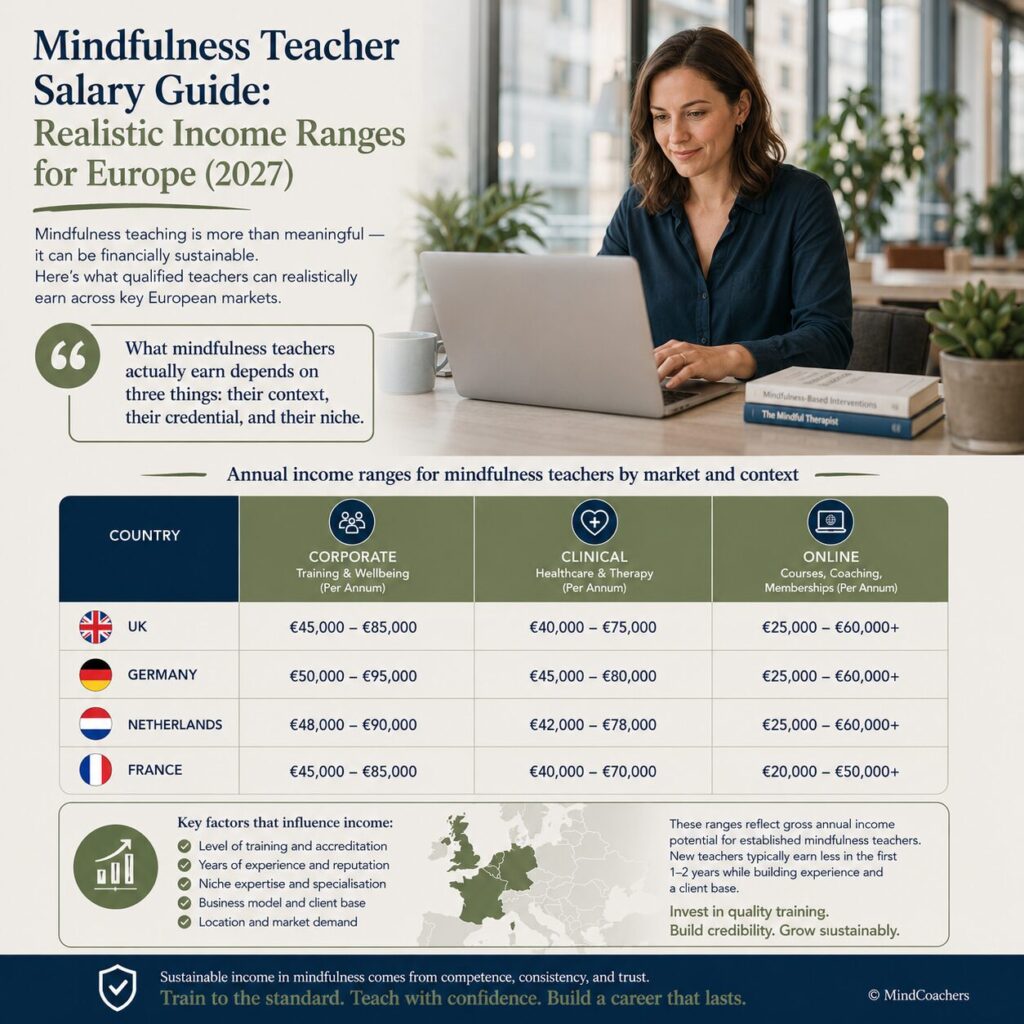
Most articles about mindfulness teacher income either understate the earning potential to manage expectations or overstate it to sell training programmes. This article does neither. It provides specific, realistic income ranges for mindfulness teachers across Europe in 2027, broken down by market segment, country, and credential status — with an honest account of what drives the variation.
The short version: mindfulness teaching income varies enormously, and the most important variables are not geography or years of experience but market segment and credential status. A credentialed mindfulness teacher delivering corporate wellbeing programmes in the Netherlands earns fundamentally different income from an uncredentialed practitioner running drop-in mindfulness classes in the same city. Both are “mindfulness teachers.” The income gap between them is not marginal.
For the broader career viability question, see is mindfulness teaching a viable career in 2027?. For demand projections, see demand for mindfulness teachers in Europe: 2027–2030 forecast.
Key takeaways
→ Corporate and institutional mindfulness teaching pays 2–5x more than general wellness instruction in comparable markets.
→ IMTA CMT-P accreditation is the primary determinant of access to professional-rate work — the credential gap is economically significant.
→ UK, Germany, and Netherlands represent the highest-earning markets for professional mindfulness teachers in Europe.
→ Most sustainable mindfulness teacher income is portfolio-based — no single source is sufficient as a primary income.
→ Online programme income is highly variable — niche, credentialed offerings outperform general wellness programmes substantially.
How to read this guide
The income ranges below are drawn from market research, practitioner surveys, and publicly available procurement rate data across five European markets. They represent realistic ranges for practitioners at different stages — not aspirational projections and not minimum wage scenarios. All figures are pre-tax and in EUR equivalent where relevant.
Three variables shape mindfulness teacher income more than any others: market segment (where you teach), credential status (whether you hold IMTA CMT-P accreditation or equivalent), and experience and reputation (particularly the ability to demonstrate outcomes to institutional clients). Geography matters, but less than these three.
Income by market segment
Corporate and workplace wellbeing
This is the highest-paying segment for professional mindfulness teachers in Europe. Corporate clients — L&D departments, HR functions, EAP providers — procure mindfulness facilitation as a professional service and pay accordingly.
- Day rate (UK): £600–2,000 per day for workshop delivery. Senior practitioners with corporate client relationships and IMTA credentials at the upper end.
- Day rate (Germany/Netherlands): €700–1,800 per day. Netherlands slightly higher for English-language delivery to international companies.
- Day rate (France): €500–1,200 per day. Growing market but lower average rates than Northern Europe.
- Day rate (Nordics): €800–2,200 per day. Highest per-day rates in Europe for credentialed facilitators.
- Programme delivery (8-week corporate group): €3,000–8,000 total per cohort, depending on group size, format, and client.
Access to corporate procurement typically requires IMTA CMT-P accreditation or equivalent, professional liability insurance, and the ability to demonstrate measurable outcomes. For practitioners targeting this segment, see mindfulness in the workplace: what qualifications do corporate facilitators need? and mindfulness teacher training for executive and leadership coaches.
Clinical and NHS-adjacent contexts
The clinical segment offers more predictable but typically lower income than corporate delivery — with the significant advantage of institutional stability and referral pathways.
- NHS contracted mindfulness facilitator (UK): NHS Band 6–7 equivalent (£32,000–45,000 FTE) for employed positions. Freelance clinical mindfulness work: £300–600 per session.
- Private clinical referrals: £80–150 per individual session; £45–80 per participant for group programmes in clinical settings.
- Charitable/third sector: Lower rates than NHS or private — £25,000–38,000 FTE equivalent for programme delivery roles.
Clinical contexts typically require IMTA CMT-P or MBCT-specific credentials. For clinical practitioners specifically, see mindfulness teacher training for psychologists.
Professional coaching and CPD delivery
Executive and leadership coaches who add formal mindfulness teacher training to their practice command premium positioning — clients at senior levels increasingly expect mindfulness-integrated coaching programmes. CPD delivery for other professionals is a growing revenue stream.
- Mindfulness-integrated coaching (individual): €150–400 per session at senior coaching rates — driven primarily by coaching credentials, not mindfulness teaching credentials alone.
- CPD delivery (professional associations, clinical bodies): €500–1,500 per half-day. Higher for specialist clinical audiences.
- Retreat and residential CPD: €800–2,500 per day all-in for facilitation, excluding accommodation and materials.
For coaches specifically, see mindfulness teacher training for executive and leadership coaches and adding mindfulness certification to your coaching practice: a practical guide.
Yoga, wellness, and general public
The general wellness market offers the lowest rates and highest competition. Drop-in classes, public-facing mindfulness courses, and yoga studio programmes are accessible entry points but rarely viable as primary income sources.
- Drop-in class (public): €10–25 per participant. Viable only at consistent high attendance.
- 8-week public MBSR/mindfulness programme: €200–400 per participant. More viable per-hour than drop-in but requires marketing infrastructure.
- Yoga studio add-on programmes: Revenue share typically 40–60% of class income — rates driven by studio pricing, not teacher credential.
For practitioners in this segment looking to move into professional markets, see mindfulness teacher training for yoga teachers: bridging practice and formal instruction and mindfulness teacher training for wellness practitioners: a 2027 guide.
Online programmes and digital income
Online mindfulness teaching income is the most variable of all segments — ranging from negligible to substantial, with no reliable middle ground. The determining factor is niche specificity and credential-backed positioning.
- General wellness online programme: Highly competitive, low conversion. Most practitioners earn below €500/month from general online mindfulness content.
- Niche professional programme (e.g. mindfulness for clinicians, corporate teams): €500–2,000 per participant for structured programmes with credential-backed positioning and professional audience.
- Membership/subscription: €15–50/month per subscriber. Requires significant audience before producing meaningful income.
The credential premium — what the numbers show
The income data consistently shows a significant premium for IMTA CMT-P accredited practitioners over uncredentialed practitioners in professional contexts. The premium operates through access, not just rate — IMTA-accredited practitioners can enter procurement processes, provider panels, and institutional relationships that are typically inaccessible without recognised credentials.
In practical terms, an IMTA-accredited practitioner delivering corporate wellbeing programmes at €1,000/day earns 3–5x more per day than the same practitioner running public drop-in classes at €15 per participant. The credential does not cause the rate difference — it opens access to the segment where the rate exists.
For the full credential comparison, see IMTA vs Yoga Alliance vs IMMA: mindfulness teacher accreditation compared. For what credentials employers actually specify, see mindfulness teacher certification: which credentials actually matter to employers?.
Building to a viable income: realistic timelines
Portfolio income from mindfulness teaching typically builds over 2–4 years for practitioners starting from formal training. The trajectory varies significantly by starting point:
- Practitioners with existing professional networks (coaches, psychologists, HR professionals) can typically access corporate or clinical referral income within 6–12 months of completing IMTA-accredited training.
- Practitioners starting without professional networks typically need 18–36 months to build the corporate relationships and testimonials that institutional clients require.
- Practitioners combining mindfulness teaching with existing practice (yoga, coaching, therapy) can generate supplementary income from mindfulness teaching within the first year.
For the full timeline question, see how long does it take to become a certified mindfulness teacher?. For whether a credential is necessary at all, see do you need a mindfulness teaching certification — or can you teach without one?.
Download the MCMI — MindCoachers Certified Mindfulness Instructor — prospectus: full curriculum, faculty profiles, pricing and cohort information.
Further reading and professional resources
↗ Is mindfulness teaching a viable career in 2027?
↗ Demand for mindfulness teachers in Europe: 2027–2030 forecast
↗ How long does it take to become a certified mindfulness teacher?
↗ Do you need a mindfulness teaching certification — or can you teach without one?
↗ Mindfulness teacher certification: which credentials actually matter to employers?
↗ IMTA vs Yoga Alliance vs IMMA: mindfulness teacher accreditation compared
↗ Mindfulness in the workplace: what qualifications do corporate facilitators need?
Next steps
The income data makes a consistent case for IMTA-accredited training as a market positioning investment. The MCMI — MindCoachers Certified Mindfulness Instructor is accredited by IMTA at CMT-P level and designed for practitioners making a deliberate decision to enter the professional tier of mindfulness teaching. The curriculum addresses corporate, clinical, and coaching contexts specifically — the three segments where professional rates apply.
Frequently asked questions
About mindfulness teacher training for psychologists and the MCMI — MindCoachers Certified Mindfulness Instructor