
Best Online Mindfulness Teacher Training Programmes (2027): Ranked and Compared
Online delivery does not lower the professional bar — but it does change what you need to look for. Here is how to evaluate online programmes against the criteria that matter.
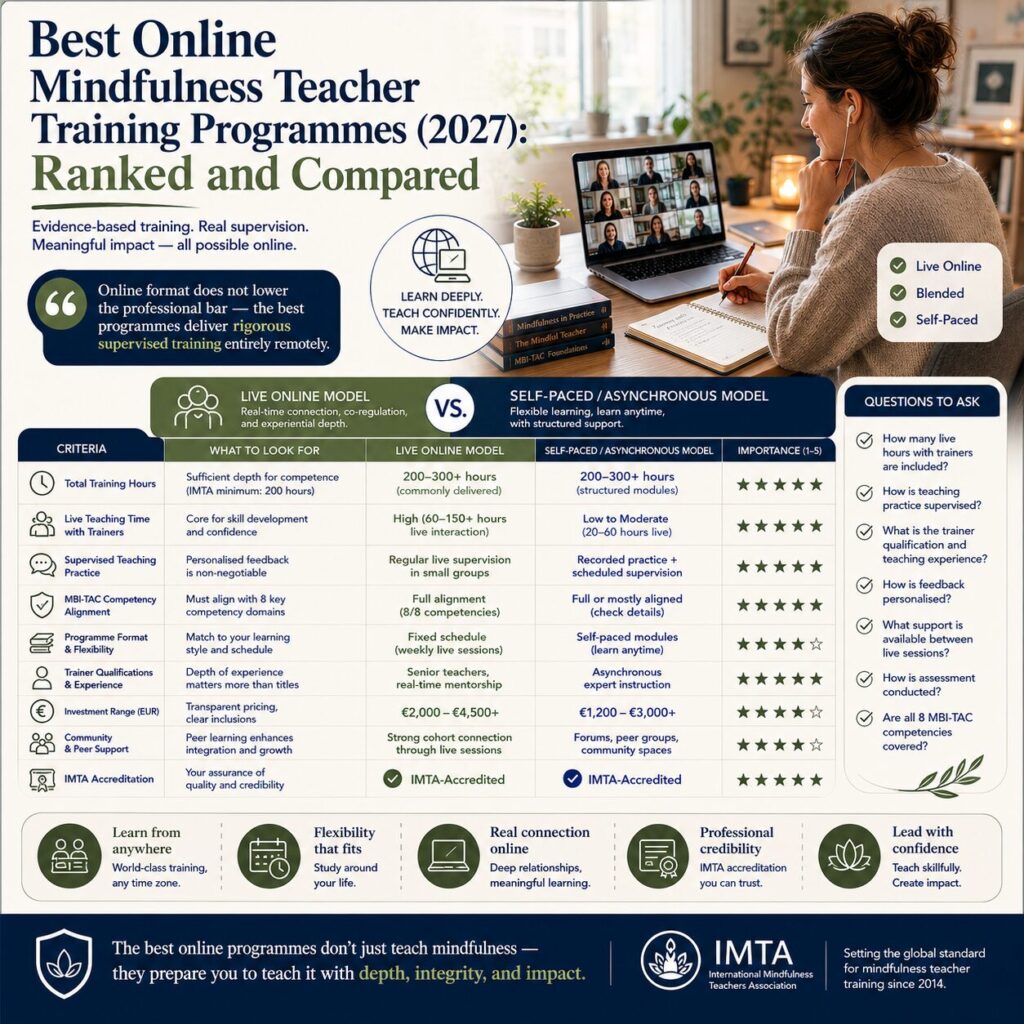
The shift to online delivery in professional education has been one of the most significant structural changes of the past decade — and mindfulness teacher training has not been exempt. The majority of IMTA-accredited programmes now offer online or hybrid delivery. The question is no longer whether online mindfulness teacher training can be rigorous. The evidence says it can. The question is which structural features make it rigorous — and which features are used to reduce costs while presenting an equivalent product.
This article gives you a practical framework for evaluating online mindfulness teacher training programmes: what the research says about online vs in-person outcomes, what structural features compensate for the absence of physical co-presence, and what to look for in any online programme you are considering. For the full evaluation framework, see what makes a good mindfulness teacher training? 7 criteria. For the direct format comparison, see online vs in-person mindfulness teacher training: what the evidence says. For the best IMTA-accredited options overall, see best IMTA-accredited mindfulness teacher training programmes: 2027 guide.
Key takeaways
→ Online mindfulness teacher training can produce equivalent professional outcomes to in-person delivery — provided the structural features that compensate for lack of physical co-presence are in place.
→ The critical structural features are: live synchronous sessions (not asynchronous video), cohort model with fixed schedule, concurrent practicum, and structured peer feedback with video review.
→ Asynchronous-first programmes — where the majority of content is pre-recorded video — are not equivalent to live online cohort programmes, regardless of total hour count.
→ Timezone coverage matters for international cohorts — verify that live session times are workable for your location before committing.
→ IMTA accreditation applies equally to online and in-person programmes — the standard does not distinguish between delivery formats.
What the evidence says about online mindfulness teacher training
Research on online professional education consistently shows that outcomes depend not on delivery modality but on pedagogical structure. A live online session with structured interaction, peer teaching, and real-time feedback produces learning outcomes comparable to an equivalent in-person session. A pre-recorded video lecture produces learning outcomes comparable to an equivalent textbook chapter — useful for content delivery, insufficient for skill development.
The specific research base for mindfulness teacher training online delivery is less extensive than the general professional education literature, but the findings are consistent. The MBI-TAC competency framework — the peer-reviewed instrument for assessing mindfulness teaching quality — can be applied to online teaching contexts. The competencies it assesses are not format-dependent; they are competencies in presence, relational attunement, group facilitation, and guided practice that can be developed and assessed in online settings provided the programme creates the conditions for them to be practised and observed.
What this means practically: the question is not “is this online?” but “is this live and interactive?” For the full evidence on why live interaction matters more than delivery format, see online vs in-person mindfulness teacher training: what the evidence says. The video why teaching mindfulness online doesn’t lower the professional bar explains what genuine online professional standards look like.
The structural features that make online programmes rigorous
1. Live synchronous sessions — not asynchronous video
This is the most important structural distinction in online mindfulness teacher training. A programme delivered primarily through pre-recorded video content is an asynchronous course, not a live training — regardless of how many total hours it claims. Live synchronous sessions — where you are present with your instructor and cohort in real time, responding to what is actually happening in the room — are the vehicle for the kind of learning that teaching competence requires.
Ask any online programme: what percentage of the total hours are live and synchronous vs pre-recorded and asynchronous? A well-structured online programme will have a clear answer. A programme that is vague on this question is probably protecting a ratio that does not reflect well on it. For the full hour breakdown question, see how many teaching practice hours does a mindfulness training actually need?.
2. Cohort model with fixed schedule
A cohort model — where you progress alongside the same group of practitioners at the same pace, with live sessions at fixed times — replicates online the most important structural feature of in-person training: the peer learning dynamic. Teaching the same people week after week, receiving feedback from practitioners who have watched your development across the programme, and holding a group dynamic that evolves over time are the conditions that develop the relational competencies mindfulness teaching requires.
A self-paced online programme cannot replicate this. For the evidence on why cohort learning matters, see why cohort learning produces better teachers than solo study. The video why learning to teach mindfulness alone misses the point addresses the specific gap that self-paced formats cannot fill.
3. Concurrent practicum with external participants
IMTA requires a concurrent practicum — teaching real people outside the training context while the curriculum is running. This requirement applies equally to online programmes. An online programme that defers the practicum to after programme completion, or that allows participants to substitute peer teaching for external teaching, is not meeting the spirit of the concurrent practicum requirement.
Ask specifically: when does the practicum begin? Does it run concurrently with the curriculum from the start? Is it supervised, and how? For the full case on why concurrent timing matters, see why teaching practice from day one makes better mindfulness teachers.
4. Structured peer feedback with video review
In an online context, the absence of physical co-presence makes structured feedback infrastructure even more important than in in-person settings. The most rigorous online programmes build in video review of teaching sessions — participants record their guided practices, submit them for peer and instructor review, and receive written feedback against a structured competency framework.
This is not the same as informal peer feedback in a Zoom breakout room. Ask any online programme: how are teaching sessions assessed? Is there a video submission requirement? Is feedback written and documented against specific criteria? For the supervision gap that many online programmes fail to address, see the supervision gap in professional mindfulness teaching.
5. Timezone coverage
For online programmes with international cohorts, timezone coverage is a practical prerequisite. A programme that schedules all live sessions at UK business hours excludes practitioners in East Asia, the Americas, and Australasia from meaningful participation. Verify the live session schedule — specific days and times — before committing to any online programme.
Red flags in online mindfulness teacher training programmes
- Majority asynchronous content: If more than 40% of the programme is pre-recorded video, ask what is lost in the transition from live to asynchronous delivery.
- Self-paced with no fixed cohort: If you can start anytime and progress at your own pace, there is no cohort dynamic — and no peer learning.
- Vague on live hours: Any programme that cannot tell you specifically how many hours are live and synchronous vs pre-recorded is protecting a ratio.
- Practicum deferred to after completion: The concurrent practicum is a structural requirement, not an add-on. A programme that defers it is not meeting the IMTA standard as intended.
- No video review of teaching: If teaching sessions are not recorded and reviewed, there is no structured feedback — only informal peer commentary.
For the blog post equivalent of this checklist, see online vs in-person mindfulness training — format matters.
What good online mindfulness teacher training looks like in practice
A well-structured online mindfulness teacher training programme has the following characteristics:
- Weekly live cohort sessions: 90–180 minutes, scheduled at fixed times, with the same group of participants throughout.
- Teaching practice from session one: Peer teaching exercises begin in the first session. The concurrent practicum is launched in the first week.
- Video submission and structured feedback: Teaching sessions are recorded, submitted, and reviewed against a written competency framework.
- Asynchronous content between sessions: Pre-recorded content supplements live sessions — it does not replace them.
- Small cohort size: Cohorts of 12–20 participants allow meaningful peer relationships to develop. Larger cohorts dilute the teaching practice and feedback opportunity.
- IMTA accreditation: Verified on the IMTA accredited programmes list.
For the full curriculum evaluation framework that applies to online as much as in-person programmes, see how to read a mindfulness teacher training curriculum before you enrol. For programme format comparison, see 12-week vs 12-month mindfulness teacher training: which is right for you?.
The MCMI online delivery model
The MCMI — MindCoachers Certified Mindfulness Instructor is delivered fully online as a weekly live cohort programme. All sessions are synchronous — no pre-recorded substitutes for live instruction. The cohort model runs across twelve weeks, with the same group of practitioners in every session. Teaching practice begins in session one; the 35-hour concurrent practicum is launched in the first week.
Video submission and structured peer feedback are built into the programme structure from week two. Cohort size is capped to ensure meaningful peer relationships and sufficient teaching practice time per participant. Session times are scheduled to serve UK and European practitioners, with timezone accommodation reviewed for each cohort.
IMTA accreditation is confirmed at CMT-P level and verifiable on the IMTA accredited programmes list. The full programme structure, curriculum, and faculty profiles are available at mindcoachers.com/en/mtt-mindfulness-teacher-training/ before enrolment.
Download the MCMI — MindCoachers Certified Mindfulness Instructor — prospectus: full curriculum, faculty profiles, pricing and cohort information.
Further reading and professional resources
↗ Online vs in-person mindfulness teacher training: what the evidence says
↗ Best IMTA-accredited mindfulness teacher training programmes: 2027 guide
↗ What makes a good mindfulness teacher training? 7 criteria
↗ How many teaching practice hours does a mindfulness training actually need?
↗ 12-week vs 12-month mindfulness teacher training: which is right for you?
↗ Why teaching practice from day one makes better mindfulness teachers
↗ Why cohort learning produces better teachers than solo study
↗ MBI-TAC: Mindfulness-Based Interventions Teaching Assessment Criteria
Next steps
The MCMI — MindCoachers Certified Mindfulness Instructor is a fully online, IMTA-accredited programme built around live synchronous cohort sessions, teaching practice from week one, and a 35-hour concurrent practicum. It delivers the structural features that make online mindfulness teacher training rigorous — and delivers them for UK and European professional market practitioners.
Frequently asked questions
About mindfulness teacher training for psychologists and the MCMI — MindCoachers Certified Mindfulness Instructor