
IMTA vs Yoga Alliance vs IMMA: Mindfulness Teacher Accreditation Compared (2027)
Three accreditation bodies, three different standards. Here is what each one actually requires — and what the professional market is beginning to specify.
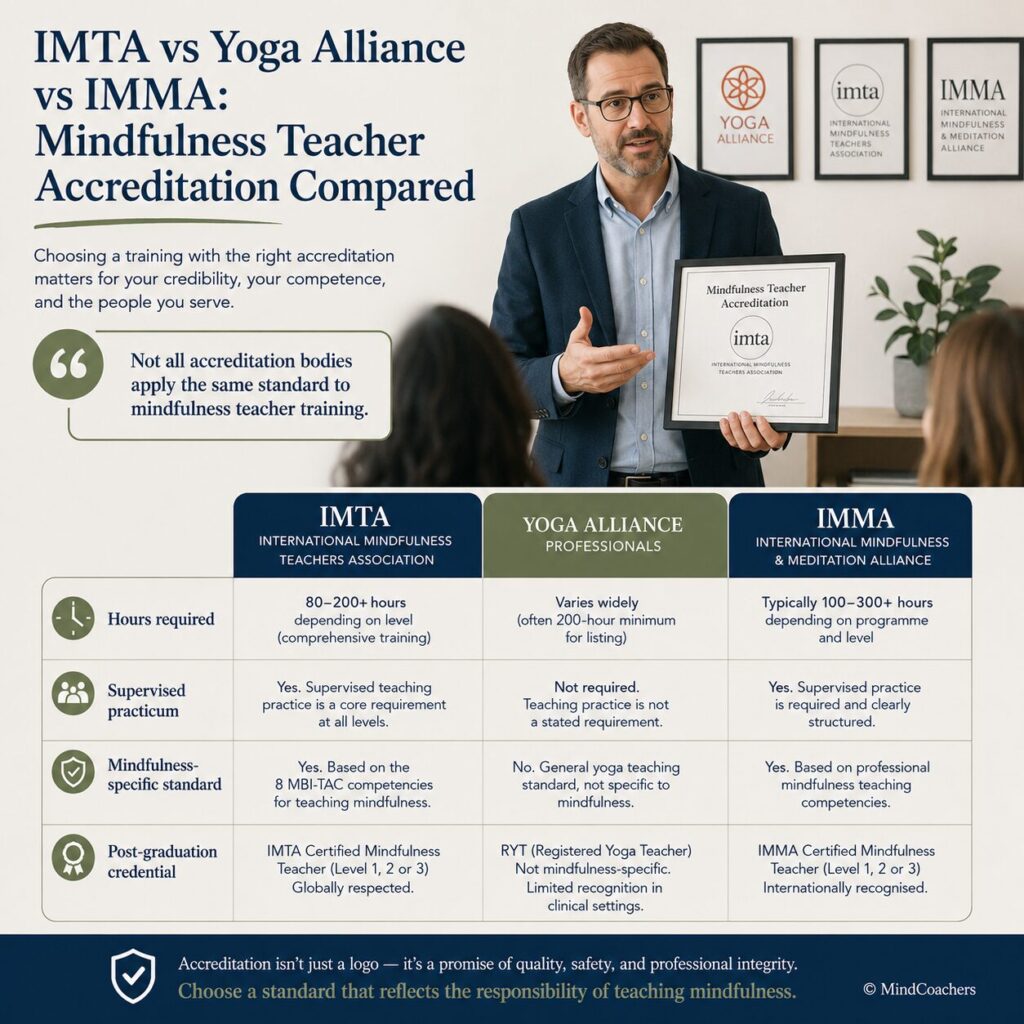
The International Mindfulness Teachers Association (IMTA)
IMTA was established specifically to create a professional standard for mindfulness teaching. Its CMT-P (Certified Mindfulness Teacher – Professional) credential is the most rigorous independently assessed credential currently available. For the full CMT-P application pathway, see CMT-P certification explained: how to become an IMTA-certified mindfulness teacher. For what credentials employers actually check, see mindfulness teacher certification: which credentials actually matter to employers?.
What IMTA requires for CMT-P accreditation:
- 200-hour minimum: Across all categories. For a detailed breakdown, see how many teaching practice hours does a mindfulness training actually need?.
- Concurrent practicum: Teaching real people during training, not after it. For the evidence on why this matters, see why teaching practice from day one makes better mindfulness teachers.
- Supervised teaching practice: Hours specifically dedicated to guiding mindfulness practices under qualified supervision, with structured feedback.
- Ethics and scope of practice content: Substantive coverage. For the regulatory context, see is mindfulness teacher training regulated? What professionals need to know.
- Trauma awareness content: Evidence-based approach to trauma-sensitive teaching.
- Faculty credentials: IMTA reviews the qualifications of programme faculty before granting accreditation. For how to assess curriculum depth, see how to read a mindfulness teacher training curriculum before you enrol.
Critically, the CMT-P credential is not awarded automatically on completion of an IMTA-accredited programme. Graduates must apply to IMTA directly, submitting evidence of teaching practice hours, personal practice, and programme completion — with a separate fee of approximately €150–250 paid directly to IMTA.
Verify any programme’s accreditation status directly on the IMTA accredited programmes list. For a deeper look at what IMTA accreditation actually means, see what is IMTA accreditation for mindfulness teachers — and does it matter?.
Yoga Alliance
Yoga Alliance is the largest yoga teacher credentialing body in the world. Its RYT and E-RYT credentials are widely recognised within the yoga industry — but Yoga Alliance is not a mindfulness teaching standard. It has no mindfulness-specific curriculum requirements, no concurrent practicum requirement for mindfulness teaching, and no framework for assessing mindfulness teaching competence.
For practitioners who come from a yoga background and are adding formal mindfulness teacher training, Yoga Alliance recognises your yoga teaching; IMTA recognises your mindfulness teaching. They are different frameworks for different competencies. See mindfulness teacher training for yoga teachers: bridging practice and formal instruction and teaching mindfulness professionally as a yoga teacher: 5 things your training needs to cover for a fuller treatment of this transition.
The International Mindfulness and Meditation Alliance (IMMA)
IMMA is a more recently established body that offers accreditation for mindfulness and meditation teacher training programmes. Its standard is lower than IMTA’s in several key respects: the hour threshold is lower, the practicum requirements are less stringent, and the faculty credential review is less rigorous.
For practitioners asking whether any credential is actually required, see do you need a mindfulness teaching certification — or can you teach without one?. For those working in corporate wellness contexts, see mindfulness in the workplace: what qualifications do corporate facilitators need?.
Side-by-side comparison
IMTA CMT-P
- Standard type: Mindfulness-specific professional standard
- Hour requirement: 200 hours minimum
- Practicum: Concurrent — required
- Supervised teaching: Required with structured feedback
- Faculty review: Yes — independent assessment
- Credential awarded by: IMTA independently, post-graduation application
- Professional recognition: Highest — clinical, corporate, institutional
Yoga Alliance RYT/E-RYT
- Standard type: Yoga instruction standard — not mindfulness-specific
- Hour requirement: 200 or 500 hours (yoga instruction)
- Practicum: Not required for mindfulness teaching specifically
- Professional recognition: Yoga contexts only — not a mindfulness teaching credential
IMMA
- Standard type: Mindfulness and meditation — lighter standard
- Hour requirement: Lower threshold than IMTA
- Practicum: Less stringent requirements
- Professional recognition: Introductory and wellness contexts — limited clinical recognition
What the professional market actually specifies
NHS wellbeing programmes, clinical supervision contexts, and EAP providers commissioning mindfulness teachers are increasingly specifying IMTA accreditation. For practitioners working in clinical practice, see mindfulness teacher training for psychologists and can therapists teach mindfulness without extra training?. For corporate contexts, see mindfulness teacher training for executive and leadership coaches and mindfulness in the workplace: what qualifications do corporate facilitators need?.
For a broader look at whether mindfulness teaching is regulated, see is mindfulness teacher training regulated? What professionals need to know. For career and income context, see is mindfulness teaching a viable career in 2027?.
The dual credential question
Completing an IMTA-accredited programme produces two credentials: the provider-issued completion certificate (automatic, included in tuition) and the IMTA CMT-P (separate post-graduation application, approximately €150–250 fee paid directly to IMTA). These are distinct and should always be presented as distinct. For the full CMT-P application pathway, see CMT-P certification explained: how to become an IMTA-certified mindfulness teacher.
Download the MCMI — MindCoachers Certified Mindfulness Instructor — prospectus: full curriculum, faculty profiles, pricing and cohort information.
Further reading and professional resources
↗ What makes a good mindfulness teacher training? 7 criteria
↗ What is IMTA accreditation for mindfulness teachers — and does it matter?
↗ CMT-P certification explained: how to become an IMTA-certified mindfulness teacher
↗ Mindfulness teacher certification: which credentials actually matter to employers?
↗ Is mindfulness teacher training regulated? What professionals need to know
↗ Best IMTA-accredited mindfulness teacher training programmes: 2027 guide
↗ IMTA accredited programmes list — verify accreditation status
Next steps
The MCMI — MindCoachers Certified Mindfulness Instructor is accredited by IMTA at CMT-P level. Accreditation is confirmed and verifiable on the IMTA website. Completion of the MCMI produces the provider-issued MCMI certificate automatically. Graduates who meet IMTA post-graduation requirements can apply separately to IMTA for the CMT-P credential — the fee for this application (approximately €150–250) is paid directly to IMTA and is not included in MCMI tuition.
Frequently asked questions
About mindfulness teacher training for psychologists and the MCMI — MindCoachers Certified Mindfulness Instructor