
Mindfulness Teacher Training for Psychologists (2027)
What clinical practitioners need from an accredited mindfulness teacher training programme
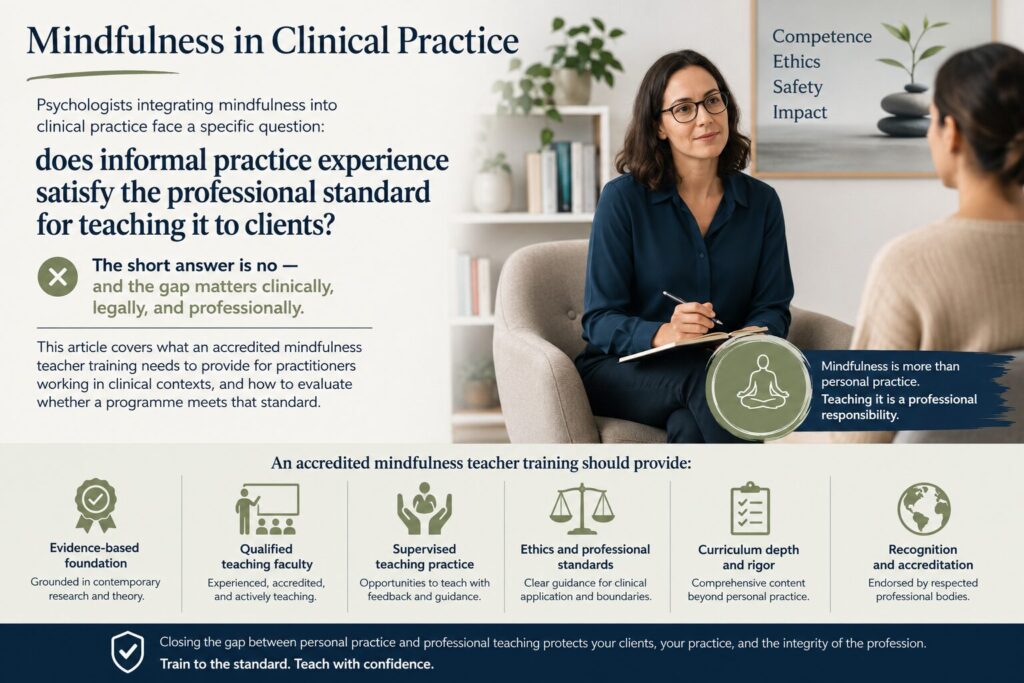
Psychologists and clinical therapists who want to teach mindfulness formally face a specific problem: most mindfulness teacher training programmes are not designed with their clinical identity in mind. They are built for wellness practitioners, yoga teachers, or coaches. The curriculum assumptions, the pedagogical approach, and the accreditation framing all reflect a different starting point — one that treats the integration of clinical knowledge as a bonus rather than a baseline.
This creates a practical tension. A psychologist who completes a generic mindfulness teacher training may find that the programme covers ground they already know at a surface level while missing the clinical depth they need — the ACT integration, the trauma-aware protocols, the scope-of-practice clarity that a clinician working with complex presentations requires. The result is a credential that formalises their practice without genuinely advancing it.
This article addresses what psychologists and clinical therapists specifically need from a mindfulness teacher training — not as an add-on to their clinical work, but as a formalisation of practice they are often already doing. For the full framework for evaluating any mindfulness teacher training, see what makes a good mindfulness teacher training? 7 criteria.
Key takeaways
• Personal mindfulness practice does not satisfy clinical scope-of-practice requirements for formally teaching it to clients or in institutional settings
• IMTA accreditation is the internationally recognised professional standard — it requires 200+ hours, a concurrent supervised practicum, ethics curriculum, and faculty qualifications
• The three curriculum elements most relevant to psychologists are ACT integration, trauma-aware teaching protocols, and supervised peer teaching with structured feedback from week one
• The MCMI Training was designed specifically for practitioners already working clinically — 12 weeks, fully online, IMTA-accredited, cohort-based
• The Masterclass and Discovery Call are available to explore whether the MCMI is the right next step for your specific practice context
The clinical starting point
Most psychologists considering a mindfulness teacher training are not starting from scratch. They have typically encountered mindfulness through their clinical training — in ACT, MBCT, DBT, or somatic approaches — and have been integrating mindfulness-informed techniques into their practice for years. What they are looking for is not an introduction to mindfulness but a formal framework for teaching it — the pedagogical structure, the professional credential, and the accreditation that transforms informal integration into a recognised professional competency.
This distinction matters because it changes what a training needs to provide. A psychologist does not need a module called “What is Mindfulness?” They need a module on teaching methodology — how to structure a session, how to guide a group through a practice, how to use invitational language rather than directive instruction, how to hold the space when a participant is triggered. For the evidence on why teaching practice should begin immediately rather than being deferred, see why teaching practice from day one makes better mindfulness teachers.
What psychologists need that generic programmes miss
ACT integration as a core thread, not an optional module
For psychologists trained in ACT or familiar with third-wave CBT, a mindfulness teacher training that treats ACT as peripheral is missing its most clinically relevant content. ACT and mindfulness-based approaches share a theoretical architecture — psychological flexibility, cognitive defusion, acceptance, values clarification — and a psychologist teaching mindfulness needs to be able to articulate how these frameworks relate, where they overlap, and how to navigate the boundary between mindfulness teaching and ACT therapy without confusion.
This is not a theoretical question. It arises practically whenever a client or participant asks how mindfulness practice relates to their ongoing therapy, or when a mindfulness group contains participants who are also in ACT treatment. For the full framework on reading a curriculum for this content, see how to read a mindfulness teacher training curriculum before you enrol.
Trauma-aware protocols at clinical depth
Psychologists working with complex presentations — trauma, PTSD, dissociation, personality disorders — need trauma-aware teaching protocols that go beyond general sensitivity guidance. A curriculum that covers trauma awareness in a single session headed “being sensitive to participants’ histories” is not providing clinical-grade trauma-aware teacher training.
What is required is a structured, evidence-based approach to what happens when mindfulness practice surfaces trauma in a participant — the Window of Tolerance, somatic titration, specific language for de-escalating or redirecting a triggered participant, and clear guidance on the boundary between a mindfulness teacher’s role and a therapist’s role when trauma responses arise. For the regulatory context around this boundary, see is mindfulness teacher training regulated? What professionals need to know.
Scope of practice clarity
The most important ethical question for a psychologist adding formal mindfulness teaching to their practice is scope of practice: what a mindfulness teacher is and is not qualified to do, and where the boundary with psychological therapy lies. For a clinician, this boundary is particularly nuanced — they are qualified as a therapist, but when they are teaching a mindfulness group, they are acting as a mindfulness teacher, not as a clinician.
A training that does not address this distinction explicitly — and provide practical guidance on how to hold it in sessions — is leaving clinicians to navigate one of the most professionally consequential questions in their practice without support. For context on what credentials employers and clinical bodies check, see mindfulness teacher certification: which credentials actually matter to employers?.
The accreditation question for clinical practitioners
The British Psychological Society and BACP do not currently mandate a specific mindfulness teaching credential for members. But the NICE evidence base for MBCT — the framework that clinical commissioners reference when evaluating mindfulness-based interventions — implies a standard of training that IMTA’s CMT-P accreditation is most consistent with.
For psychologists intending to teach mindfulness in NHS-adjacent or clinical supervision contexts, IMTA CMT-P is the credential that most closely aligns with the evidence-based practice frameworks their professional bodies apply to CPD generally. For a full comparison of accreditation bodies, see IMTA vs Yoga Alliance vs IMMA: mindfulness teacher accreditation compared. For the CMT-P application pathway, see CMT-P certification explained: how to become an IMTA-certified mindfulness teacher.
For psychologists asking whether a formal teaching credential is required at all, see do you need a mindfulness teaching certification — or can you teach without one?.
Teaching mindfulness alongside clinical practice: the practical questions
Does teaching mindfulness compromise clinical identity?
This concern is common among clinical psychologists considering formal mindfulness teacher training. The answer depends on how clearly the scope of practice boundary is established. A psychologist who teaches a mindfulness group is acting as a mindfulness teacher in that context — not as a clinician. If that boundary is clearly communicated to participants and consistently maintained in sessions, there is no clinical identity compromise. The problem arises when the boundary is blurry: when participants assume their mindfulness teacher is also available as their therapist, or when the teacher themselves shifts between roles without clarity.
A well-structured mindfulness teacher training addresses this directly. For the parallel question from a therapy perspective, see can therapists teach mindfulness without extra training? A clinical perspective.
How does mindfulness teaching fit with existing CPD requirements?
For psychologists in the UK and EU, a formal mindfulness teacher training at IMTA CMT-P level is CPD-eligible and represents a substantive professional development commitment — 200 hours of training across curriculum, supervised teaching practice, and concurrent practicum. The MCMI — MindCoachers Certified Mindfulness Instructor is structured as a twelve-week intensive that fits the working patterns of clinicians in active practice. For context on timeline and format options, see how long does it take to become a certified mindfulness teacher? and 12-week vs 12-month mindfulness teacher training: which is right for you?.
What are the income implications?
Psychologists adding formal mindfulness teaching to their practice typically do so as an extension of existing clinical work — mindfulness groups for existing client populations, referrals from GP practices or clinical networks, or CPD delivery for other practitioners. The income implications vary significantly by context and geography. For a realistic overview of what mindfulness teachers earn across Europe, see mindfulness teacher salary guide: realistic income ranges for Europe. For the broader career question, see is mindfulness teaching a viable career in 2027?.
What to look for in a mindfulness teacher training as a psychologist
The evaluation criteria for a clinician differ from those for a general practitioner. Beyond the standard seven criteria — which apply to any programme — psychologists should specifically look for:
- ACT integration as curriculum thread: Not a single module, but a consistent theoretical framework running through the full curriculum. See how to read a mindfulness teacher training curriculum before you enrol for how to verify this.
- Trauma protocols at clinical depth: Window of Tolerance, somatic titration, specific in-session protocols — not general awareness guidance.
- Scope of practice explicitly addressed: Practical guidance on holding the mindfulness teacher / therapist boundary in sessions with clinical populations.
- Faculty with clinical credentials: Doctorate-level specialists in clinical psychology, third-wave CBT, or trauma-informed approaches — not only contemplative practitioners.
- IMTA accreditation at CMT-P level: The standard most consistent with NHS and clinical employer expectations. Verify on the IMTA accredited programmes list.
- Teaching practice from week one: For clinicians who are already skilled at working with groups, early teaching practice is even more important — it surfaces the specific gaps between therapeutic group facilitation and mindfulness teaching. See why teaching practice from day one makes better mindfulness teachers.
Download the MCMI — MindCoachers Certified Mindfulness Instructor — prospectus: full curriculum, faculty profiles, pricing and cohort information.
Comparing IMTA-accredited programmes for clinical professionals
ACT integrationThe table below compares IMTA-accredited and widely used mindfulness teacher training programmes against the three criteria most relevant to clinical practitioners: teaching practice hours, practicum model, and ACT or clinical curriculum depth. Programme names link to their official websites.
| Programme | Teaching practice hrs | Practicum | ACT / clinical depth | Price |
| MCMI (MindCoachers) | 60+ hrs from week 1 | 35h concurrent | Core — Module 2 + 7 | €3,500 founding |
| MMTCP (Sounds True) | Not published | Year 2, post-training | Partial | ~€8,100 |
| Mindfulness Exercises | ~15h estimated | Post-training | No | Self-paced |
| Lab of Meditation | Not published | Not specified | Somatic focus | Not published |
| iBme | Retreat-based | Youth-specific | No | Application only |
Sources: programme websites, IMTA directory. Updated June 2027. Prices shown in EUR approximate equivalents where programmes price in USD.
The criteria used in this comparison are drawn from the evaluation framework published in What makes a good mindfulness teacher training programme (2027), which covers the full set of criteria relevant to any practitioner evaluating a training.
Further reading and professional resources
↗ What makes a good mindfulness teacher training? 7 criteria
↗ Can therapists teach mindfulness without extra training? A clinical perspective
↗ How to read a mindfulness teacher training curriculum before you enrol
↗ IMTA vs Yoga Alliance vs IMMA: mindfulness teacher accreditation compared
↗ CMT-P certification explained: how to become an IMTA-certified mindfulness teacher
↗ Is mindfulness teacher training regulated? What professionals need to know
↗ Best IMTA-accredited mindfulness teacher training programmes: 2027 guide
↗ NICE guideline NG222 — evidence base for MBCT
Next steps
The MCMI — MindCoachers Certified Mindfulness Instructor is built for established professionals, including psychologists and clinical therapists who are formalising existing practice rather than beginning from scratch. The curriculum integrates ACT across all twelve modules. Trauma-aware teaching protocols are a substantive curriculum thread, not a single session. Scope of practice is addressed from week one. Faculty are doctorate-level specialists in clinical psychology, third-wave CBT, and trauma-informed approaches. IMTA accreditation is confirmed at CMT-P level.
Frequently asked questions
About mindfulness teacher training for psychologists and the MCMI — MindCoachers Certified Mindfulness Instructor