
Best Mindfulness Teacher Training for Executive and Leadership Coaches: 2027 Comparison
Which programmes actually serve coaches — evaluated against ICF CCE eligibility, ACT integration, corporate application content, and the credential that opens institutional mindfulness facilitation.
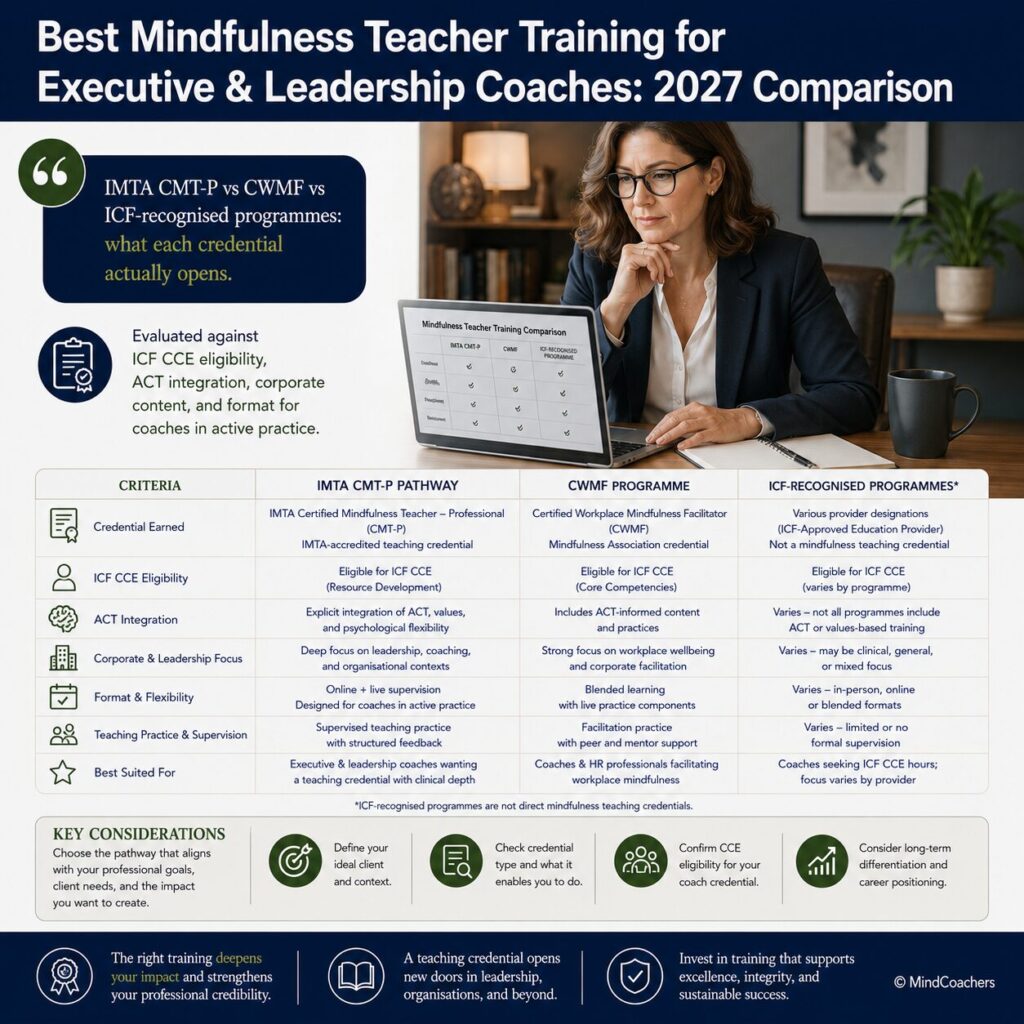
Executive and leadership coaches evaluating mindfulness teacher training face a specific problem: most comparison articles are not written for them. They are written for yoga teachers, therapists, or general practitioners looking for the most broadly recognised credential. The criteria that matter for coaches — ICF CCE recognition, ACT integration as a curriculum thread, corporate mindfulness application content, and a credential that opens institutional facilitation contracts — rarely appear in general rankings.
This comparison was built for coaches. It evaluates five programmes against seven criteria specific to the coaching professional context, explains clearly what each credential opens and for whom, and provides a decision framework for coaches at different stages of practice. For the broader professional case for adding mindfulness to coaching, see why executive coaches need a mindfulness teaching credential and the mindfulness teacher training for executive and leadership coaches segment guide.
The five programmes reviewed represent the main options coaches encounter: the MCMI — MindCoachers Certified Mindfulness Instructor, Sounds True MMTCP, Mindful Leader CWMF, the Search Inside Yourself (SIY) Leadership Institute programme, and the Oxford Mindfulness Centre’s general professional mindfulness training. They are evaluated honestly — the right programme for a coach depends on professional destination, not on composite score.
Key takeaways
→ IMTA CMT-P accreditation at 200-hour level is the professional standard that opens institutional mindfulness facilitation contracts — corporate, NHS-adjacent, EAP — that ICF credentials alone do not access.
→ ACT integration as a curriculum thread — not an optional module — is the feature that makes mindfulness teacher training most directly applicable to executive coaching, because ACT’s performance language bridges mindfulness and the outcomes senior clients require.
→ The Mindful Leader CWMF is a credible corporate-specific option at approximately 40 hours, but it does not reach the depth of IMTA CMT-P and is not recognised by NHS or EAP commissioners requiring IMTA-level accreditation.
→ IMTA CMT-P accreditation and ICF CCE recognition are independent — a programme can hold one, both, or neither. Always confirm ICF CCE status directly with the programme before assuming credits are claimable.
→ The MCMI — MindCoachers Certified Mindfulness Instructor is the strongest option in this comparison for the 12-week intensive format with ACT integration, corporate mindfulness content, and IMTA accreditation. Two credentials result: the MCMI certificate (automatic, included in tuition) and the IMTA CMT-P (post-graduation IMTA application, independent fee ~€150–250). They are distinct steps.
How this mindfulness teacher training comparison was built — and why most rankings miss the coaching context
Most mindfulness teacher training comparison articles evaluate programmes against criteria relevant to yoga teachers or therapists: lineage depth, retreat intensity, personal practice emphasis. These criteria matter for some practitioners and some professional destinations. For executive and leadership coaches, they are largely irrelevant.
The criteria that matter for coaches are different: does the programme integrate ACT as a curriculum thread rather than a tangential reference? Does it include content on corporate mindfulness application — how to work with sceptical executives, how to design a mindfulness development programme within an organisational coaching engagement, how to price and position the capability? Does the credential open institutional facilitation contracts? Is the format compatible with an active coaching practice?
This comparison applies seven criteria specific to the coaching professional context. We reviewed published curricula, accreditation documentation, and faculty credentials for each programme. For the broader accreditation landscape, IMTA vs Yoga Alliance vs IMMA: mindfulness teacher accreditation compared provides the full framework.
The evaluation criteria for executive and leadership coaches
Seven criteria were applied, each chosen for direct relevance to coaches evaluating mindfulness teaching programmes:
- Accreditation standard — IMTA CMT-P, CWMF, ICF CCE recognised, or none. Determines which institutional contexts the credential opens.
- ACT integration — is ACT a curriculum thread or an optional module? For coaches, ACT integration determines how directly the training transfers to coaching practice. See the difference between knowing ACT and teaching mindfulness with it.
- Corporate mindfulness content — does the curriculum cover corporate application: language for sceptical executives, organisational programme design, L&D procurement framing?
- ICF CCE recognition — does completion generate ICF Continuing Coach Education hours, and in which categories?
- Format — compatible with active coaching practice: online delivery, weekly time commitment, cohort structure.
- Practicum structure — concurrent or post-training, and how many hours required.
- Duration and commitment — total weeks and hours per week for a coach with an active client base.
Comparison at a glance: mindfulness teacher training programmes for coaches
| Programme | Accreditation | ACT integration | ICF CCE | Corporate content | Format | Duration |
| MCMI — MindCoachers | IMTA CMT-P | Full curriculum thread | Confirm directly | Yes — explicit module | Online cohort | 12 wks / 200h |
| MMTCP (Sounds True) | None (dharma) | Minimal | No | Minimal | Online, 2 years | ~150h |
| Mindful Leader CWMF | IACET / CWMF | Partial | No | Strong — corporate focus | Online | ~40h |
| Search Inside Yourself (SIY) | SIY certificate | Partial | Some programmes | Strong — Google origin | In-person intensive | ~30h |
| Oxford Mindfulness — Professional | Oxford cert | Minimal | No | Limited | In-person/online | Variable |
IMTA CMT-P vs CWMF vs ICF-recognised programmes: what each credential opens for coaches
Understanding what each credential type opens — and closes — is the most important step in making this decision as a coach.
The IMTA CMT-P credential is the international professional standard for mindfulness teachers and is the credential recognised by the widest range of institutional commissioners globally. Corporate L&D functions, NHS-adjacent wellbeing teams, EAP providers, and educational establishments that commission mindfulness facilitation increasingly specify IMTA CMT-P as the minimum credential standard. For coaches who want to offer standalone mindfulness facilitation to organisations — not just mindfulness-integrated coaching — this is the credential that opens that market.
The CWMF — Certified Workplace Mindfulness Facilitator (Mindful Leader) is a corporate-specific credential at approximately 40 hours, accredited through IACET. It is a credible entry-level credential for corporate mindfulness facilitation and is specifically positioned for the organisational context. It does not reach the depth of IMTA CMT-P and is not recognised by NHS or EAP commissioners that specify IMTA-level training. For coaches wanting rapid corporate market entry with a lighter time commitment, CWMF is a viable option. For coaches wanting the broadest institutional recognition, IMTA CMT-P is the stronger standard.
The ICF CCE credits question is separate from both. ICF CCE recognition is a feature of specific programmes, not a credential type. Some IMTA-accredited programmes have pursued ICF CCE recognition; others have not. Always confirm CCE status directly with the programme. The IMTA CMT-P certification pathway and ICF CCE recognition are independent processes — a programme can hold one, both, or neither.
What the MCMI — MindCoachers Certified Mindfulness Instructor offers executive coaches specifically
The MCMI — MindCoachers Certified Mindfulness Instructor is the programme in this comparison built for professionals already in active coaching, clinical, or wellness practice who want to add formal mindfulness teaching. For executive and leadership coaches specifically, three features are directly relevant.
First, ACT integration as a curriculum thread. The MCMI integrates Acceptance and Commitment Therapy and third-wave CBT frameworks throughout the curriculum — not as a guest lecture or optional module, but as a foundational methodological lens. For coaches who already use ACT-informed approaches with clients, this integration means the mindfulness teaching they develop is immediately applicable within existing coaching engagements. Why premium mindfulness teaching rates depend on communicable structure explains how ACT integration supports the articulation of value to sceptical corporate clients.
Second, corporate mindfulness application content. The MCMI curriculum includes explicit content on corporate mindfulness facilitation: how to work with executive populations, how to design a parallel mindfulness development programme within a coaching engagement, and how to use the language that corporate L&D procurement responds to. For guidance on that language specifically, see corporate mindfulness language — how to open budgets.
Third, format compatibility. The MCMI is fully online, 12 weeks, with one live session per week and a concurrent 35-hour practicum from Week 1. There is no residential intensive requiring coaching practice to be paused. The programme is designed for practitioners in active professional practice. See adding mindfulness certification to your coaching practice for the practical integration guide.
The MCMI produces two credentials. The MCMI certificate is awarded automatically on programme completion and is included in tuition. The IMTA CMT-P credential is obtained through a separate post-graduation application to the International Mindfulness Teachers Association, with an independent application fee of approximately €150–250 paid directly to IMTA. These are two distinct steps — the IMTA CMT-P is not automatic and is not included in MCMI tuition.
What the alternatives offer executive coaches — and when they are the better choice
MMTCP — Sounds True (Tara Brach and Jack Kornfield)
The Mindfulness Meditation Teacher Certification Programme is a two-year online programme rooted in Buddhist psychology and Insight meditation lineage. For coaches drawn to deep dharma practice and long-form contemplative development, the MMTCP provides personal practice depth that is genuinely distinctive. It is not designed for the professional institutional market: it does not emphasise ACT integration, corporate application content, or the secular evidence-based framing that organisational L&D procurement requires. It is the right choice for coaches whose primary motivation is contemplative deepening rather than institutional professional credentialling.
Mindful Leader CWMF — Certified Workplace Mindfulness Facilitator
The CWMF is a credible 40-hour corporate-specific programme for coaches who want rapid market entry into corporate mindfulness facilitation with a lighter time commitment. It is specifically designed for the organisational context, with strong corporate application content and a certificate that corporate clients recognise. It does not produce IMTA CMT-P level depth, is not recognised by NHS or EAP commissioners that specify IMTA-level training, and does not develop the full teaching competency that 200-hour training provides. It is the right choice when corporate market entry speed is the priority and institutional breadth is not required.
Search Inside Yourself (SIY) Leadership Institute
The Search Inside Yourself programme originates from Google’s internal leadership development and carries strong brand recognition in the corporate L&D market. It is a 30-hour intensive with strong emotional intelligence and leadership integration content — well-matched to coaches working in leadership development contexts. It produces a SIY certificate rather than an IMTA credential, and is best suited to coaches whose primary context is corporate leadership development rather than broader mindfulness teaching across multiple settings.
Oxford Mindfulness Centre — Professional Programme
The Oxford Mindfulness Centre offers professional mindfulness training for practitioners who want to develop mindfulness practice within a clinical and research-grounded framework. It is primarily oriented toward clinical and therapeutic contexts rather than coaching. For coaches whose primary context is organisational rather than clinical, the Oxford programme is less directly applicable — though for coaches also working in clinical-adjacent roles, the research depth and protocol rigour are genuinely valuable.
How to choose: a decision framework for executive coaches evaluating mindfulness teacher training
Use this framework based on your professional destination:
- If your goal is institutional mindfulness facilitation — corporate, EAP, NHS-adjacent: IMTA CMT-P is the credential that opens this market. The MCMI is the strongest option in this comparison for the 12-week format with ACT integration and corporate content.
- If your goal is rapid corporate market entry with lighter commitment: CWMF (Mindful Leader) is a viable entry-level corporate credential at approximately 40 hours, with the understanding that it does not produce IMTA CMT-P depth or institutional breadth.
- If your goal is leadership development coaching with mindfulness integration: SIY Leadership Institute is well-matched for coaches whose primary context is corporate leadership development and who want strong L&D brand recognition.
- If your goal is deep personal practice and contemplative development: MMTCP provides genuine depth in this direction, with the understanding that it is not designed for the institutional professional market.
For most executive and leadership coaches who want to open institutional mindfulness facilitation alongside their coaching practice, IMTA CMT-P is the appropriate credential standard. Understanding what mindfulness actually adds to executive coaching is the starting point for evaluating whether this professional move makes sense at this stage of practice.
Download the MCMI — MindCoachers Certified Mindfulness Instructor — prospectus: full curriculum, faculty profiles, pricing and cohort information.
Further reading and professional resources
Mindfulness Teacher Training for Executive and Leadership Coaches (2027)
Adding Mindfulness Certification to Your Coaching Practice: A Practical Guide
IMTA vs Yoga Alliance vs IMMA: Mindfulness Teacher Accreditation Compared (2027)
Why Executive Coaches Need a Mindfulness Teaching Credential
Corporate Mindfulness Language — How to Open Budgets
The Difference Between Knowing ACT and Teaching Mindfulness With It
Why Premium Mindfulness Teaching Rates Depend on Communicable Structure
Next steps
If you are an executive or leadership coach ready to add formal mindfulness teaching to your professional practice, the MCMI — MindCoachers Certified Mindfulness Instructor is built for coaches at exactly this professional stage — active practice maintained throughout, ACT integration throughout the curriculum, and a concurrent practicum from Week 1.
Frequently asked questions
About mindfulness teacher training for psychologists and the MCMI — MindCoachers Certified Mindfulness Instructor