
Adding Mindfulness Certification to Your Coaching Practice: A Practical Guide
From choosing the right programme to integrating formal mindfulness into existing client work — the practical decisions coaches face when adding mindfulness teacher training.
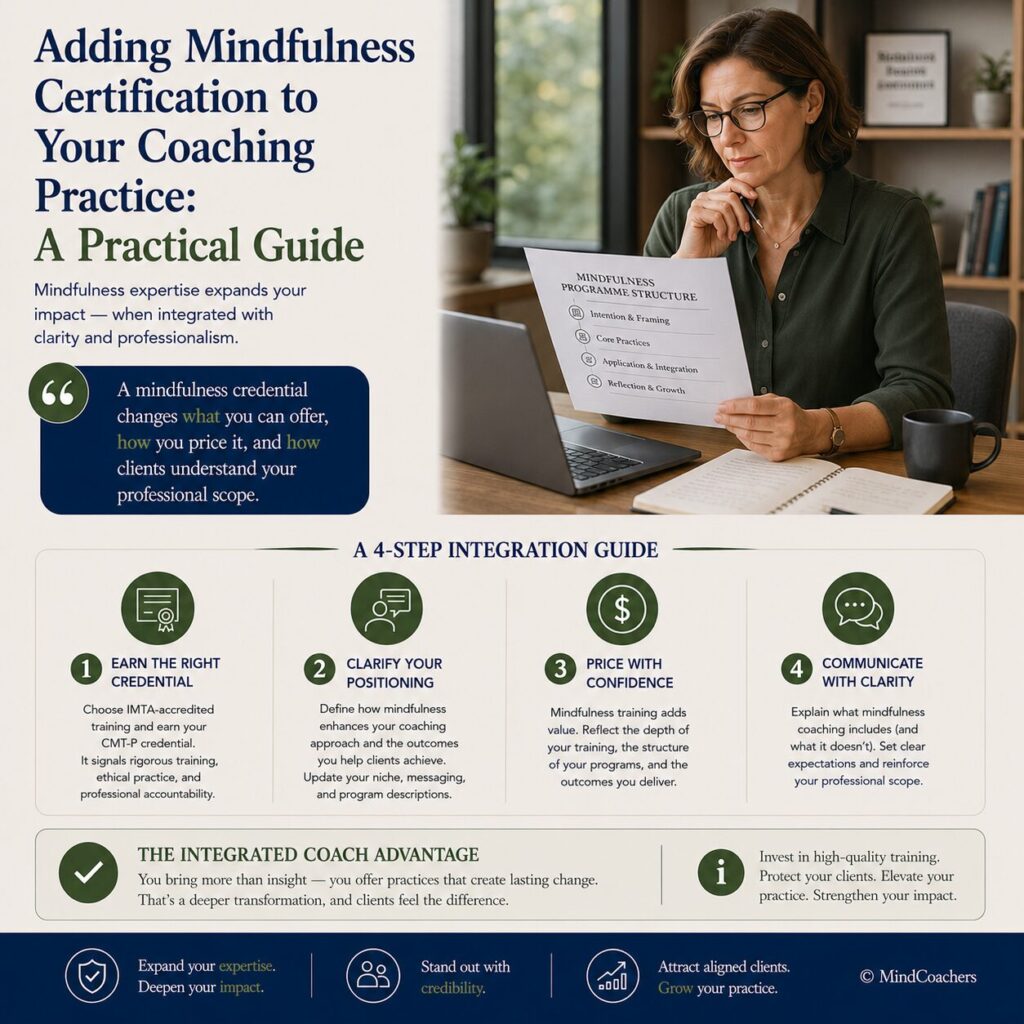
The decision to add formal mindfulness teacher training to a coaching practice involves more practical questions than most coaches expect. Choosing a programme is step one. But the more consequential decisions come after: how to structure the concurrent practicum when you already have a full client schedule, how to integrate formal mindfulness into existing coaching relationships, how to position the new credential to existing and prospective clients, and how to price mindfulness-integrated work relative to your existing coaching fees.
This article addresses those practical decisions — not the strategic case for adding mindfulness certification (that is covered in mindfulness teacher training for executive and leadership coaches), but the implementation questions that coaches face once the decision is made. It is a guide to doing it well rather than a guide to deciding whether to do it.
Key takeaways
→ The concurrent practicum is the most logistically challenging element for coaches in active practice — the most viable approach is integrating it with existing client relationships.
→ Introducing formal mindfulness to existing coaching clients requires explicit framing — a clear explanation of what is changing and why, not a gradual drift from coaching to teaching.
→ Pricing mindfulness-integrated coaching should reflect the additional credential and the distinct value delivered — not default to existing coaching rates.
→ The referral network is more important than the credential for building a mindfulness coaching practice — existing clients and professional contacts are the fastest route to first engagements.
→ Insurance coverage for mindfulness teaching is typically a separate policy addition to existing coaching PI — check before you start practicum hours.
Step 1: Choosing the right programme for a coach in active practice
The practical constraints of a coach in active practice shape the programme decision more than most coaches realise before they start looking. The key variables:
Format: intensive vs extended
A 12-week intensive — weekly live sessions — is the format that works best for most coaches in active practice. The weekly commitment is predictable, the cohort momentum is self-sustaining, and the twelve-week timeline keeps the disruption to existing client schedules manageable. A 12-month part-time programme spreads the cost of disruption across a longer period, but also extends the period during which you are managing training alongside practice — which for coaches with busy client schedules often creates more friction than a focused twelve-week commitment. For the full format comparison, see 12-week vs 12-month mindfulness teacher training: which is right for you?.
ACT integration and corporate content
For executive and leadership coaches, the programme’s treatment of ACT and corporate mindfulness application is more important than for any other practitioner segment. Verify before committing: is ACT an optional module or a substantive curriculum thread? Does the programme include content on mindfulness in organisational settings — language for corporate audiences, team mindfulness design, navigating budget conversations? These are the content areas that will be most directly applicable to existing coaching clients. For how to read a curriculum to verify this, see how to read a mindfulness teacher training curriculum before you enrol.
IMTA accreditation
For coaches intending to access corporate mindfulness facilitation contracts or position the credential with professional coaching bodies, IMTA CMT-P accreditation is the standard to target. For the credential comparison, see IMTA vs Yoga Alliance vs IMMA: mindfulness teacher accreditation compared. For the best current IMTA-accredited options, see best IMTA-accredited mindfulness teacher training programmes: 2027 guide.
Step 2: Managing the concurrent practicum alongside coaching practice
The concurrent practicum — supervised real-world teaching that runs alongside the curriculum — is consistently the most logistically challenging element for coaches in active practice. Unlike clinical practitioners who may have patient groups or yoga teachers who have existing classes, coaches typically do not have ready-made groups to teach mindfulness to. The practicum requires access to real participants; finding them while managing a full coaching schedule requires advance planning.
Option A: Integrate with existing clients
The most natural approach for coaches is to introduce formal mindfulness practice elements with willing existing coaching clients during the practicum period. This requires explicit informed consent — clients need to understand what is changing about the coaching engagement and why — and clear documentation of sessions for the practicum log. The advantage is that you already have a relationship; the practicum deepens it rather than requiring new participant recruitment.
Option B: Run a pilot group programme
Some coaches use the practicum period to run a structured pilot mindfulness programme — a 4–6 week group offering at reduced or no cost — specifically for the purpose of accumulating supervised teaching hours. This approach produces more concentrated teaching practice, generates testimonials, and creates a documented programme that can be refined into a commercial offering post-qualification. The disadvantage is the additional marketing and coordination required to recruit a group during training.
Option C: Corporate taster sessions
Coaches with existing corporate relationships can negotiate to deliver introductory mindfulness sessions — tasters for L&D teams, leadership groups, or team offsites — during the practicum period. These sessions provide teaching practice in the exact context where formal mindfulness facilitation will eventually be delivered commercially. They also introduce the mindfulness offering to corporate clients before the credential is complete. For the corporate language that opens these conversations, see corporate mindfulness language — how to open budgets.
Step 3: Introducing formal mindfulness to existing coaching clients
The transition from mindfulness-informed coaching (referencing mindfulness concepts in conversation) to mindfulness-integrated coaching (guiding formal practices as part of sessions) requires explicit client framing. Most coaching clients will welcome the addition — but the framing matters.
The most effective framing is specific and benefits-focused: “I have been completing formal mindfulness teacher training alongside our coaching work. From our next session, I’d like to introduce a short structured practice at the start of each session — it typically takes 8–10 minutes and provides a foundation for the work we do in the coaching conversation. I’ll explain more before we start.” This framing is honest, specific about what is changing, and positions the addition as an enhancement rather than a departure.
What to avoid: gradual drift from coaching to teaching without explicit framing, using mindfulness practice with a client before completing sufficient training to do it well, or introducing practices that are inappropriate for a client’s current presentation without clinical risk assessment. For the self-compassion practices specifically — which require careful framing with coaching clients — see what self-compassion adds to a mindfulness teaching practice.
Step 4: Positioning the credential to existing and prospective clients
Once qualified, how coaches position the new credential matters for uptake. The most effective positioning for coaching clients is not credential-led but outcome-led:
Credential-led (less effective): I have now completed a 200-hour IMTA-accredited mindfulness teacher training and hold the CMT-P credential.
Outcome-led (more effective): “Our coaching work now integrates formal mindfulness practice — structured practices that develop the attentional and regulatory skills that the research consistently links to leadership effectiveness. The mindfulness component is grounded in IMTA-accredited teacher training, which is the standard increasingly required for corporate mindfulness facilitation.”
The credential is the evidence; the outcome is the selling point. For the premium rate conversation that follows, see why premium mindfulness teaching rates depend on communicable structure.
Step 5: Pricing mindfulness-integrated coaching
Mindfulness-integrated coaching — coaching engagements that include formal mindfulness practice as a structured component — should be priced above standard coaching rates. The rationale is straightforward: the credential represents additional investment, the offering delivers additional value, and the market for mindfulness-integrated coaching at premium rates is distinct from the market for standard coaching.
The most practical pricing approach for coaches adding mindfulness to an existing practice:
- Existing clients during transition: Introduce formal mindfulness at no additional cost during the first 2–3 sessions. Once the integration is established and the value is visible, reframe the engagement as a mindfulness-integrated programme at a higher rate.
- New clients: Position mindfulness-integrated coaching as a distinct offering from the outset, with a premium rate that reflects the dual qualification.
- Corporate mindfulness facilitation: Price at corporate facilitation rates — typically higher than per-session coaching rates — for standalone mindfulness workshops and programmes. See mindfulness teacher salary guide: realistic income ranges for Europe for rate benchmarks by context.
Step 6: Insurance and professional indemnity
Most coaching professional indemnity (PI) insurance policies do not automatically cover mindfulness teaching as an additional professional activity. Before beginning practicum hours, verify with your insurer that mindfulness teaching is covered under your existing policy — or add mindfulness teaching to your coverage. Most insurers can extend PI coverage to mindfulness teaching for a modest additional premium, provided evidence of formal training is submitted.
Do not begin practicum hours without confirming coverage. A practicum session that results in an adverse event (participant distress, a disclosure of clinical history, a trauma response) without PI coverage creates personal liability exposure. For the full insurance context, see setting up a mindfulness teaching practice — what you need.
Step 7: Building the referral network for mindfulness coaching
The fastest route to first commercial mindfulness-integrated coaching engagements is the existing referral network — not new marketing. The most valuable people to tell about the new credential are:
- Existing coaching clients, who are the most accessible market for mindfulness-integrated coaching upgrades
- Corporate HR and L&D contacts, who are the procurement gateway for corporate mindfulness facilitation
- Other coaches in your network, who may refer clients specifically seeking mindfulness-integrated coaching
- Professional coaching associations and networks, who may list you as a mindfulness specialist
For how referral network matters as much as credential in building practice, see why your referral network matters as much as your credential. For the blog post that addresses executive coach demand specifically, see why executive coaches need a mindfulness teaching credential.
Download the MCMI — MindCoachers Certified Mindfulness Instructor — prospectus: full curriculum, faculty profiles, pricing and cohort information.
Further reading and professional resources
↗ Mindfulness teacher training for executive and leadership coaches
↗ Mindfulness in the workplace: what qualifications do corporate facilitators need?
↗ 12-week vs 12-month mindfulness teacher training: which is right for you?
↗ CMT-P certification explained: how to become an IMTA-certified mindfulness teacher
↗ Mindfulness teacher salary guide: realistic income ranges for Europe
↗ Best IMTA-accredited mindfulness teacher training programmes: 2027 guide
Next steps
The MCMI — MindCoachers Certified Mindfulness Instructor is the twelve-week intensive pathway to IMTA CMT-P for coaches in active practice. The curriculum integrates ACT throughout, includes corporate application content, and supports practicum integration with existing coaching relationships. IMTA accreditation is confirmed at CMT-P level. The cohort format provides the peer network that coaches use to cross-refer mindfulness coaching clients after qualification.
Frequently asked questions
About mindfulness teacher training for psychologists and the MCMI — MindCoachers Certified Mindfulness Instructor