
Integrating Mindfulness Into Executive Coaching: A Step-by-Step Programme Guide
How to structure mindfulness within a coaching engagement — from the first three-minute practice to a parallel six-session mindfulness development programme.
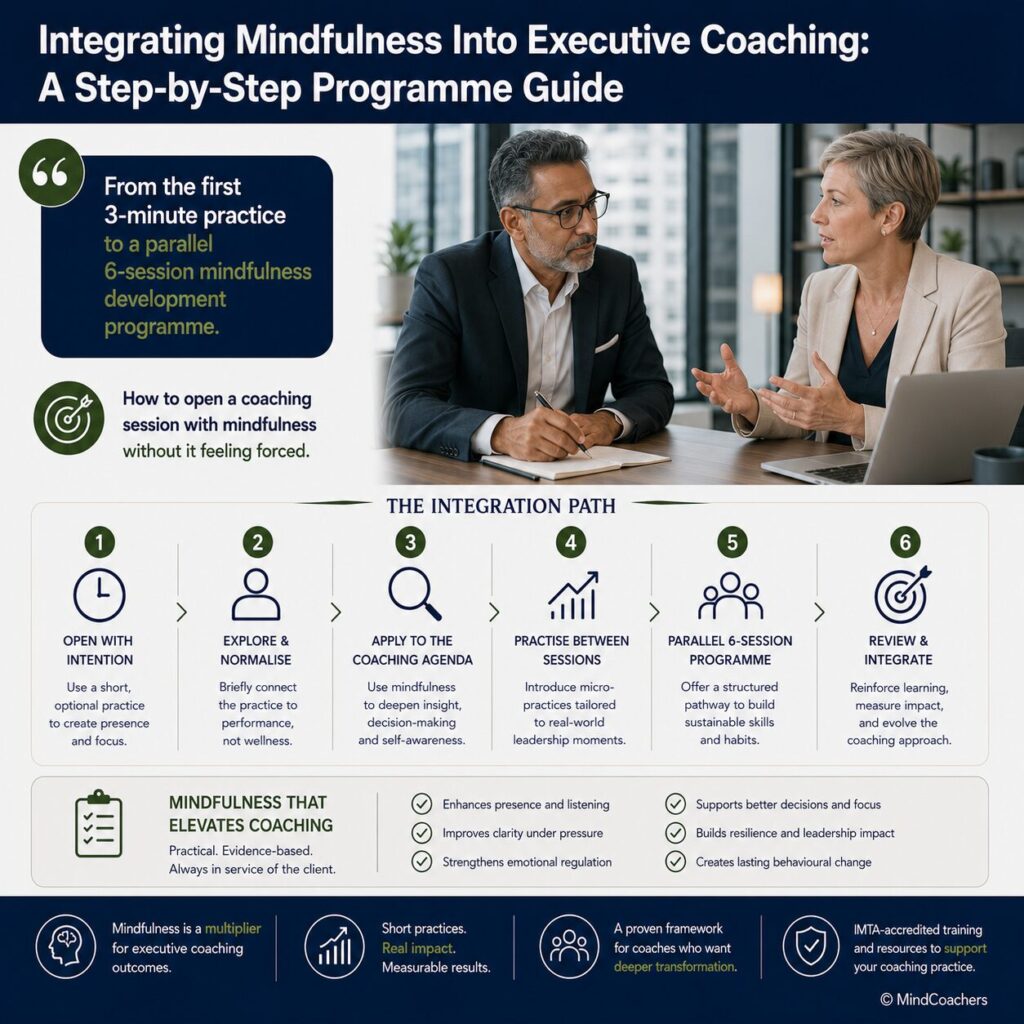
Most coaches who integrate mindfulness into executive coaching do so informally at first — a brief grounding practice at the session opening, a reference to present-moment attention when a client is visibly overloaded, a debrief conversation that draws on mindfulness concepts without naming them as such. This works, to a point. At some stage, informal integration reaches its natural ceiling: the client who asks for more, the organisation that wants a structured programme, the coaching engagement where the mindfulness component would deliver more value if it were deliberately designed rather than improvised.
This guide is for coaches who have moved past the informal stage — or who want to. It covers the full arc: from the first in-session practice to a parallel six-session mindfulness development programme. It is practical and specific. For the professional case for this move and the credential context, see what mindfulness actually adds to executive coaching and adding mindfulness certification to your coaching practice.
The MCMI — MindCoachers Certified Mindfulness Instructor is the programme that develops the specific competencies this guide draws on — invitational language, practice selection, programme design, trauma-aware facilitation within coaching contexts. It is built for coaches in active practice who want to formalise these competencies at IMTA CMT-P professional level.
Key takeaways
→ A three-minute breath awareness practice framed as a “cognitive reset” is the most reliable entry point for mindfulness in executive coaching — short enough not to trigger restlessness, precise enough to produce a measurable attentional shift.
→ Mindfulness practices in executive sessions work best when framed in performance language before and after — not as standalone wellness exercises but as attentional preparation for the quality of thinking the session requires.
→ The decision between integrated mindfulness (within coaching sessions) and parallel programme (separate mindfulness development track) depends on client intent: integration serves presence and regulation; a parallel programme develops a sustained personal practice.
→ A six-session parallel mindfulness programme, priced and contracted separately from coaching, is a distinct and scalable professional service — not a coaching add-on.
→ Guiding structured practices in coaching sessions requires formal teaching competency — invitational language, in-session risk management, debrief protocol. The MCMI — MindCoachers Certified Mindfulness Instructor develops these competencies alongside IMTA CMT-P accreditation. Two credentials result: the MCMI certificate (automatic, included in tuition) and the IMTA CMT-P (post-graduation IMTA application, ~€150–250). Distinct steps.
Starting point: the three-minute practice that changes the session
The most reliable entry point for mindfulness in executive coaching is a short breath awareness practice at the session opening — framed explicitly as attentional preparation, not as wellness. The framing matters more than the practice itself at this stage.
The introduction: “I typically open with a short attention practice — three minutes. It shifts the quality of thinking available for the conversation we are about to have. It takes the attentional bandwidth that is still on email and meetings and brings it here.” This framing is performance-oriented and respects the executive’s cognitive register. It also sets an implicit expectation: what follows requires full attentional presence, and the practice is preparation for that standard.
The practice itself: eyes open or softly closed, attention to breath sensation at the nostrils or chest, with light guidance for the first 60 seconds and then silence. Three minutes. No elaborate instruction. When the practice ends, move directly into the coaching conversation — minimal debriefing at first. The attentional shift speaks for itself, and the client will notice it without being asked to analyse it.
Over the first two to three sessions, the practice becomes routine. At that point, you can invite the client to do it independently before your sessions as a preparation protocol — and that invitation is the first step toward a self-managed practice. Corporate mindfulness language — how to open budgets provides the specific language for framing this with corporate clients at procurement and contracting stage.
How to open a coaching session with mindfulness without it feeling forced
The quality that makes a mindfulness opening feel natural or forced is almost entirely in the coach’s confidence and pacing. Clients pick up immediately on a coach who is uncertain about the practice — and respond with scepticism. Coaches who have guiding experience (from formal training, not personal practice alone) move through the opening with the ease that confidence produces.
Practical guidance:
- Name it once at programme kick-off: “I open sessions with a short attention practice. First time will be three minutes. After that it becomes background.” This prevents it from needing re-explanation every session.
- Use consistent language: avoid varying the framing between sessions. Consistency builds expectation and reduces the cognitive overhead the client brings to the practice.
- Transition without ceremony: “Let’s take three minutes” — then begin. No lengthy explanation, no check-in about readiness. The decisive transition is what makes it feel professional rather than tentative.
- Do not over-debrief early practices: a brief “what did you notice?” is sufficient for the first few sessions. Over-processing the practice before the client has enough experience to have something to report creates awkwardness.
Choosing the right mindfulness practice for the right executive client
Practice selection in executive coaching should follow two principles: match the client’s cognitive register, and match the developmental edge. Analytical, performance-oriented clients respond best to practices with a clear functional framing; clients exploring leadership presence or emotional intelligence may be ready for wider practice range.
- Breath awareness (“cognitive reset”): universal starting point. Three to five minutes. Works reliably with the most sceptical executive clients when framed as attentional preparation rather than relaxation.
- Body scan (“somatic inventory”): introduces interoceptive awareness — the capacity to read physical signals as real-time information about cognitive and emotional state. Effective once basic breath awareness is established.
- Thinking observer (“decentring practice”): observing thoughts as events rather than facts. Directly applicable to reactive leadership patterns and rumination. ACT-grounded framing makes this immediately relevant to coaching work.
- Values-clarification exercises: ACT-based practices connecting present-moment awareness to values and committed action. Particularly effective in leadership transition and identity work contexts. What self-compassion adds to a mindfulness teaching practice provides the compassion-practice context for clients navigating difficult transitions.
Practices to avoid with executive clients: visualisation and imagination-based practices (trigger analytical resistance), body scan without prior breath awareness establishment (too unfamiliar), extended silent sits beyond ten minutes (exceeds the coaching session frame).
When to offer mindfulness as an integrated element vs a standalone programme
The decision between integrating mindfulness within coaching sessions and offering a parallel mindfulness development programme depends on what the client needs and what the coaching engagement can contain.
Use integrated mindfulness within sessions when:
- The client’s goal is presence and regulation — reducing reactivity, improving in-the-moment attentional quality, developing leadership presence
- The coaching engagement is the primary developmental container and mindfulness is one element within it
- The client is not yet ready for a sustained daily practice commitment
Offer a parallel mindfulness development programme when:
- The client specifically wants to develop a sustained personal practice alongside coaching
- The organisation is commissioning mindfulness development alongside coaching for the same individual or team
- The mindfulness component has grown to the point where it would benefit from its own structure, cadence, and contracting
The parallel programme is a separate professional service — separate sessions, separate fee, separate contracting. It is not a coaching add-on. Pricing and positioning it correctly is covered in the next section.
Designing a six-session mindfulness development programme alongside coaching
A six-session parallel mindfulness development programme for executive clients has a clear structure. Each session is 45–60 minutes, separate from coaching sessions, with its own opening practice, teaching content, and closing integration. The sequence:
- Session 1 — Breath awareness and attentional training: establish the foundational practice, introduce the performance framing, set practice homework (10 minutes daily).
- Session 2 — Somatic awareness and the body as information: body scan adapted for analytical clients, introduction to interoceptive signals as real-time leadership data.
- Session 3 — Thinking observer and cognitive defusion: distinguishing thoughts from facts, observing narrative mind without being governed by it. ACT defusion practices.
- Session 4 — Values, psychological flexibility, and committed action: ACT values-clarification, connecting mindfulness practice to leadership values. This session is the bridge between mindfulness development and coaching work.
- Session 5 — Difficult emotions and compassion practices: equanimity in high-pressure situations, self-compassion as regulatory rather than indulgent capacity.
- Session 6 — Integration and sustainable practice design: building a post-programme personal practice architecture. What does daily practice look like in a senior leadership schedule? How to use brief practices in the working day.
This structure is drawn from the secular mindfulness curriculum framework taught in the MCMI — MindCoachers Certified Mindfulness Instructor. The specific facilitation competencies — invitational language, inquiry protocol, trauma-aware facilitation — are developed through formal IMTA CMT-P level training, not improvised from personal practice.
Pricing, contracting, and framing the expanded offer
A parallel mindfulness development programme must be priced and contracted separately from coaching. Bundling it into a coaching retainer undervalues the service and creates scope ambiguity. The pricing framework:
- Six sessions at 45–60 minutes each, priced as a programme rather than per session
- Rate: a fraction of your coaching day rate, reflecting the credential and preparation involved — typically 60–80% of your half-day rate for the full six-session programme
- Contracting: a separate service agreement covering scope (mindfulness development, not coaching), cancellation terms, and the credential basis (IMTA CMT-P or equivalent)
The framing in client conversations: “Alongside our coaching work, I offer a structured six-session mindfulness development programme — separate sessions, separate focus. It develops the attentional and regulatory foundations that make the coaching work land at a different depth. Many clients find the combination produces outcomes neither element produces alone.” This framing is additive rather than substitutive, and it positions the mindfulness programme as a professional service rather than a coaching enhancement.
For the full positioning and pricing framework for mindfulness-qualified coaches, see why premium mindfulness teaching rates depend on communicable structure. For the credential requirements before delivering this programme, see why executive coaches need a mindfulness teaching credential.
Download the MCMI — MindCoachers Certified Mindfulness Instructor — prospectus: full curriculum, faculty profiles, pricing and cohort information.
Further reading and professional resources
Best Mindfulness Teacher Training for Executive and Leadership Coaches: 2027 Comparison
Mindfulness Teacher Training for Executive and Leadership Coaches (2027)
Adding Mindfulness Certification to Your Coaching Practice: A Practical Guide
What Mindfulness Actually Adds to Executive Coaching — And What the Evidence Shows
Corporate Mindfulness Language — How to Open Budgets
What Self-Compassion Adds to a Mindfulness Teaching Practice
Why Premium Mindfulness Teaching Rates Depend on Communicable Structure
Why Mindfulness Teacher Certification Doesn’t Require a Career Pause
Next steps
If this guide reflects where you are in your coaching practice — already integrating mindfulness informally and ready to formalise the competency — the MCMI — MindCoachers Certified Mindfulness Instructor develops exactly the competencies covered here: invitational language, practice selection, programme design, trauma-aware facilitation, and the IMTA CMT-P credential that corporate clients and liability insurers recognise.
Frequently asked questions
About mindfulness teacher training for psychologists and the MCMI — MindCoachers Certified Mindfulness Instructor