
How Mindfulness Makes You a More Effective Therapist: The Clinical Evidence
What the research shows about mindfulness-trained therapists — and why the competency gap between informal integration and formal teaching matters more than most clinicians realise.
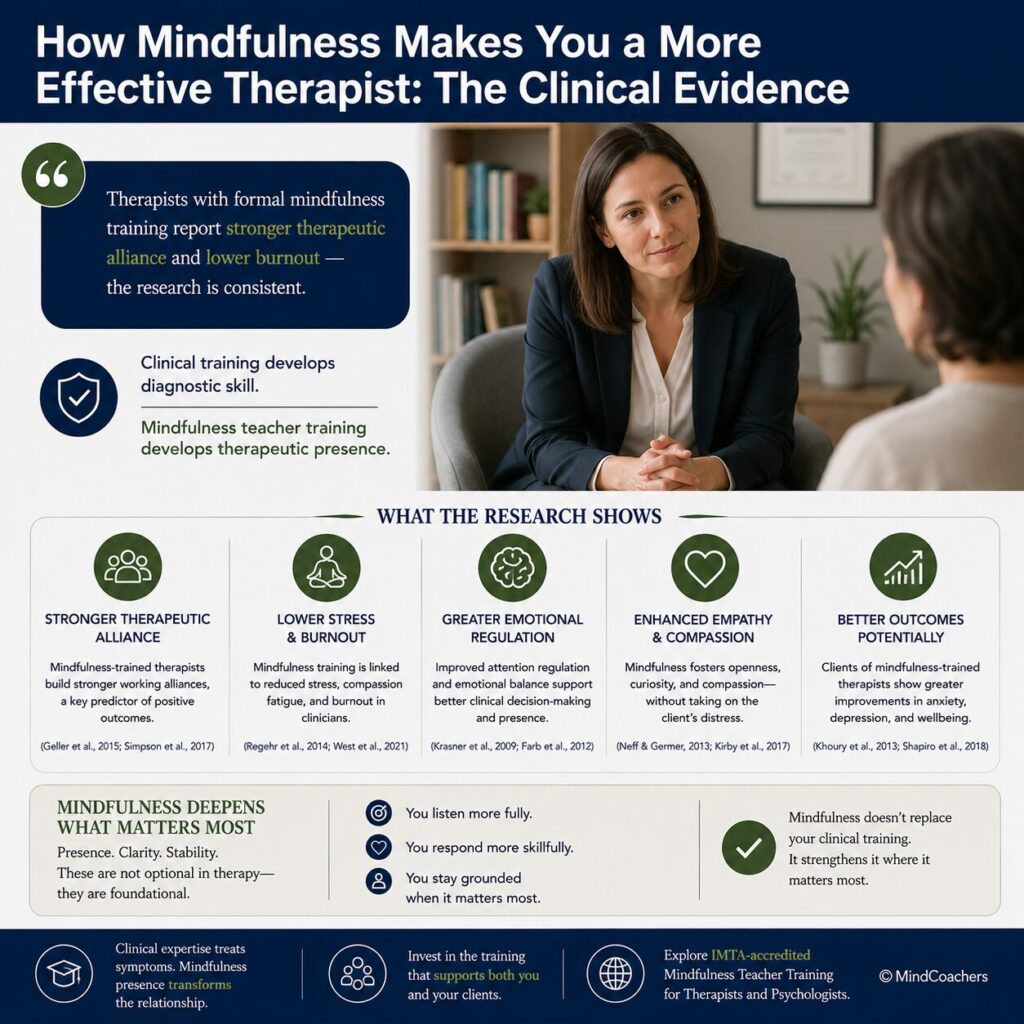
Most therapists already have a sense that mindfulness makes them better at their work. They notice the difference in session presence when their own practice is consistent. They see clients respond differently when they introduce a brief grounding exercise. The intuition is strong — but the evidence behind it is stronger still, and most clinicians have never read it.
There is now a substantial body of research on therapist mindfulness practice and client outcomes. It covers therapeutic alliance, burnout reduction, session presence, and the measurable difference in outcomes when mindfulness-based interventions are delivered by formally trained practitioners versus those integrating it informally. The findings are consistent across modalities and populations, and they point in a clear direction: formal mindfulness teacher training produces competencies that informal integration does not.
This article draws on that evidence base for psychologists and therapists who are already curious about formalising their mindfulness practice. It addresses the clinical research directly, examines what formal training adds that self-directed practice does not, and explains why the gap between knowing mindfulness and being able to teach it is larger — and more consequential — than most clinicians initially assume. For those considering the next step, the comparison of mindfulness teacher training programmes for psychologists provides the full evaluation of available options.
Key takeaways
→ Multiple meta-analyses show mindfulness-based interventions delivered by formally trained therapists produce significant improvements in depression, anxiety, and chronic pain — with effect sizes that are meaningful and consistent.
→ Therapist mindfulness training is associated with stronger therapeutic alliance, reduced burnout, and greater session presence — effects documented across multiple studies of therapist self-practice.
→ Informal integration and formal mindfulness teaching are different competency levels. The gap lies in precision: invitational language, guided practice structure, and trauma-aware facilitation are developed through formal training, not personal practice alone.
→ The MCMI — MindCoachers Certified Mindfulness Instructor is built specifically for clinical practitioners wanting to formalise these competencies at IMTA CMT-P professional level.
→ Two credentials result from the MCMI: the MCMI certificate (automatic on completion, included in tuition) and the IMTA CMT-P (post-graduation application to IMTA, independent fee of approximately €150–250). They are distinct steps.
The intuition most therapists already have — and what the evidence says about it
Therapists who practise mindfulness themselves consistently report that it changes how they work. They describe greater capacity to remain present with a client’s distress without being pulled into it, a clearer ability to notice their own somatic responses as clinical information, and a reduced tendency toward premature closure under the pressure of a difficult session. These are not abstract qualities — they are the specific attentional and regulatory capacities that therapeutic training aims to develop, and that experienced supervisors recognise in their most effective supervisees.
What the research adds to this intuition is precision and replication. Bohecker et al. (2014) found that therapists with formal mindfulness training reported significantly stronger therapeutic alliance scores and lower burnout than matched controls. A systematic review by Davis and Hayes (2011) identified therapist mindfulness as a predictor of client-rated alliance quality across modalities. The mechanism is not mystical — it is attentional: therapists with consistent formal mindfulness practice demonstrate more stable attentional deployment in session, which clients experience as genuine presence.
The question for most therapists is not whether this evidence is convincing. It is what to do with it. The research points consistently toward formal mindfulness practice — structured, accountable, and developed with feedback — rather than informal integration of techniques. That distinction matters for how clinicians approach the development question.
What “therapist mindfulness training” actually means in the research
The research on therapist mindfulness training covers a wide range of exposure levels — from brief mindfulness-based stress reduction courses to full mindfulness teacher training at 200-hour professional level. The effect sizes vary accordingly. Brief mindfulness training produces short-term improvements in therapist-reported wellbeing and presence. Sustained formal training — the kind that develops teaching competency, not just personal practice — produces more durable changes in clinical behaviour.
For the purposes of understanding what the evidence supports, it is useful to distinguish three levels of therapist mindfulness engagement:
- Personal mindfulness practice — regular meditation without structured training. Associated with some improvements in self-reported wellbeing and presence, but limited transfer to clinical competency.
- Mindfulness-informed clinical training — courses in MBCT, ACT, or DBT that include mindfulness components as part of clinical protocol training. Produces protocol-specific competency but not general mindfulness teaching skill.
- Formal mindfulness teacher training — structured 200-hour professional training at IMTA CMT-P level, including concurrent teaching practice with structured feedback. Produces the full competency profile the research associates with improved outcomes.
The MCMI — MindCoachers Certified Mindfulness Instructor operates at the third level. The distinction matters because clinicians sometimes conclude from brief training that they have developed teaching competency, when they have developed personal practice depth. These are related but not equivalent.
Therapeutic alliance: the most consistent finding
Across the research literature on therapist mindfulness training, therapeutic alliance is the most consistently reported outcome. Multiple studies find that therapists with formal mindfulness training are rated by clients as more present, more attuned, and more capable of holding complexity without becoming directive or avoidant. The mechanism, across studies, is consistent: mindfulness training develops what researchers call decentring — the capacity to observe one’s own mental processes without being governed by them — and this capacity translates directly into clinical behaviour in session.
Practically, this manifests in ways supervisors recognise immediately: the therapist who can sit with a client’s ambivalence without filling the silence, who notices their own discomfort with a particular presentation without acting on it, who can track multiple registers of communication simultaneously without losing the thread. These are not qualities that clinical training explicitly develops — they are developed through sustained, structured mindfulness practice, and they show up in the alliance data.
The polyvagal theory for mindfulness teachers provides the neurobiological framework for understanding why these regulatory capacities are so consistently associated with alliance quality. For clinical practitioners, integrating this understanding with formal teaching competency is one of the distinctive features of training that is built for the clinical context.
Burnout, regulation, and the therapist’s own capacity
Therapist burnout is a structural problem in clinical practice, and one that formal mindfulness training addresses at its root. The burnout literature identifies two primary drivers in clinical populations: compassion fatigue — the accumulative toll of sustained empathic engagement — and attentional exhaustion, the depletion that follows sustained effortful concentration in session. Formal mindfulness training addresses both directly.
Compassion fatigue is ameliorated not by reducing empathic engagement but by developing the capacity to hold it without merger — the quality that mindfulness training specifically cultivates. Attentional exhaustion is reduced through the development of effortless, stable attention: the trained meditator attends with less effort than the untrained one, and recovers faster between sessions. The research on therapist burnout and mindfulness training (Shapiro et al., 2007; Christopher et al., 2011) shows significant reductions in burnout indicators following formal mindfulness teacher training, with effects that persist at follow-up.
For practising therapists, this is not a peripheral benefit. It is central to the question of sustainable clinical practice. Formal mindfulness teacher training — the kind that includes sustained personal practice alongside teaching competency development — produces regulatory capacity that protects clinical effectiveness over time. Reflective practice in mindfulness teaching is the ongoing mechanism through which these capacities are maintained post-training.
The competency gap: informal integration vs formal mindfulness teaching
The most common position among psychologists and therapists considering formal training is: “I already use mindfulness in sessions — I’m not sure what formal training would add.” This is a reasonable starting point, and the answer is specific.
Informal mindfulness integration — introducing a body scan, guiding a brief breath awareness exercise, referencing present-moment attention in psychoeducation — draws on personal practice and clinical intuition. It works, to a degree. But it has characteristic limits that practitioners who have gone through formal training consistently identify in retrospect:
- Invitational language — formal training develops the specific linguistic register for guiding mindfulness practices that minimises directiveness and maximises participant agency. Informal integration typically defaults to instructional language that reduces participant autonomy.
- Guided practice structure — formal training develops the capacity to structure a 10–45 minute mindfulness practice with appropriate pacing, transition language, and inquiry protocol. Informal integration typically works with brief techniques rather than full practices.
- Trauma-aware facilitation — formal training at clinical depth covers the specific contraindications and risk management protocols for mindfulness in trauma contexts: body scan dissociation risk, breath practice contraindications, participant screening, and crisis referral procedures. See what most mindfulness training misses about trauma-aware practice. Informal integration typically lacks this safety framework.
- Group facilitation — formal training develops the capacity to facilitate mindfulness with groups, not just individuals. This is a distinct competency set that informal integration in 1:1 sessions does not develop.
The gap between informal integration and formal teaching is not about depth of personal practice — it is about competency structure. A therapist can have a decades-long meditation practice and still lack the facilitation competencies that formal training develops. Conversely, formal training at IMTA CMT-P level produces these competencies even in practitioners with relatively recent personal practice, because the training is pedagogically focused, not practice-focused alone.
What formal mindfulness teacher training adds that clinical training does not
Clinical training — whether in CBT, psychodynamic work, ACT, or MBCT protocol — equips therapists to use mindfulness as a clinical tool within a specific therapeutic framework. It does not equip therapists to teach mindfulness as a standalone professional practice. These are different professional capabilities, and the distinction matters for scope of practice.
What formal mindfulness teacher training at IMTA CMT-P level adds, specifically:
- The capacity to design and deliver a standalone 8-week or equivalent mindfulness programme for non-clinical populations — workplace groups, community cohorts, professional development contexts
- The credential to market mindfulness teaching services to institutional commissioners (NHS-adjacent, EAP, corporate, educational) who require verified IMTA-level accreditation
- The teaching competency to facilitate mindfulness inquiry — the post-practice dialogue that is the core pedagogical method of secular mindfulness teaching — with precision and appropriate depth
- The trauma-aware teaching protocol that covers the specific clinical risks of teaching mindfulness to general (non-clinical) populations, where pre-screening is less rigorous and presentation is less predictable than in clinical contexts
For psychologists and therapists, the question of whether therapists can teach mindfulness without extra training has a clear answer: clinical training provides clinical competency, not teaching competency. Formal mindfulness teacher training provides the teaching competency that clinical training does not. The two are complementary — and for therapists who want to extend their professional reach into group teaching contexts, both are necessary.
The MCMI — MindCoachers Certified Mindfulness Instructor is designed for practitioners at exactly this professional stage: clinical training already in place, mindfulness integration already happening informally, and the competency gap clearly identified. The programme integrates ACT and third-wave CBT throughout, includes a 35-hour concurrent practicum from Week 1, and is delivered fully online over 12 weeks by doctorate-level clinical specialists. It produces the MCMI certificate on completion (included in tuition) and equips graduates to apply to IMTA for the CMT-P credential independently.
Download the MCMI — MindCoachers Certified Mindfulness Instructor — prospectus: full curriculum, faculty profiles, pricing and cohort information.
Further reading and professional resources
Best Mindfulness Teacher Training for Psychologists and Therapists: 2027 Comparison
Mindfulness Teacher Training for Psychologists (2027)
Can Therapists Teach Mindfulness Without Extra Training? A Clinical Perspective
Polyvagal Theory for Mindfulness Teachers — What It Means
Reflective Practice in Mindfulness Teaching — Why It Matters
The Difference Between Knowing ACT and Teaching Mindfulness With It
What Most Mindfulness Training Misses About Trauma-Aware Practice
NICE NG222 — Guidance on depression in adults
Next steps
If the evidence here reflects what you already sense in your clinical practice, the logical next step is formal training at IMTA CMT-P professional level. The MCMI — MindCoachers Certified Mindfulness Instructor is built for psychologists and therapists at exactly this stage — clinical competency already in place, and ready to develop formal mindfulness teaching competency alongside it.
Frequently asked questions
About mindfulness teacher training for psychologists and the MCMI — MindCoachers Certified Mindfulness Instructor