
Introducing Mindfulness in Schools: What Actually Works — A Practical Guide for Teachers
Age-appropriate practices, how to handle a resistant class, what to do when a student has a difficult reaction, and the credential line you should not cross without formal training.
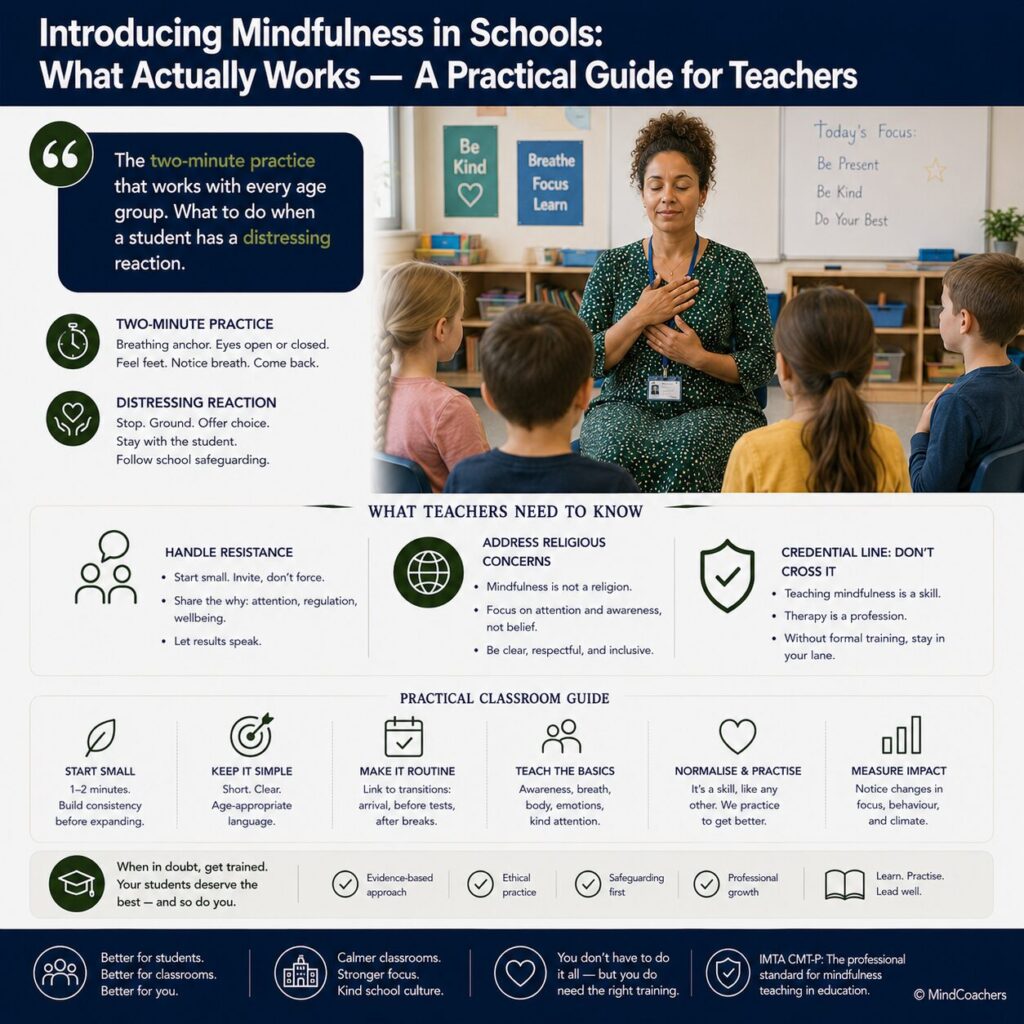
Most teachers who want to introduce mindfulness in schools are not looking for a comprehensive overview of the research base. They are looking for practical guidance: what to say before the first practice, which practices work with which age groups, what to do when someone has a difficult reaction, and how to handle a sceptical class of 14-year-olds who are already checking their phones.
This guide covers all of it — specifically, with examples, and without the assumption that you have completed formal mindfulness teacher training. It is written for classroom teachers who want to begin now, use what they have, and understand clearly where the boundary is between informal classroom practice and formal programme delivery. For the full credential context, see is mindfulness teacher training regulated? What professionals need to know and best IMTA-accredited mindfulness teacher training programmes: 2027 guide.
The MCMI — MindCoachers Certified Mindfulness Instructor is the programme for educators who have moved beyond the informal stage and are ready to formalise their practice at IMTA CMT-P professional level — with trauma-aware protocols, secular framing for diverse school contexts, and a format compatible with a term-time teaching schedule.
Key takeaways
→ A two-minute breath awareness practice with a physical anchor is the most reliable starting point for any age group — short enough not to trigger restlessness, concrete enough to produce a noticeably different physical state.
→ Lead with neuroscience and performance framing, not wellness language, for adolescents. “This is what athletes and surgeons use to perform under pressure” removes the wellness association that triggers adolescent scepticism.
→ Always open mindfulness sessions with an explicit grounding anchor — feet on floor, hands visible, eyes open option — before any internal attention practice. This is the safety protocol that prevents the majority of difficult reactions.
→ The credential threshold is clear: informal classroom practice (a brief practice before a test, a settling exercise after lunch) is within teacher professional scope. Formal programme delivery (a structured 6-session mindfulness programme, staff wellbeing courses, externally commissioned sessions) requires IMTA CMT-P or equivalent.
→ The MCMI — MindCoachers Certified Mindfulness Instructor develops the formal competency this guide points toward — trauma-aware facilitation, secular framing, programme design, and IMTA CMT-P accreditation. Two credentials result: the MCMI certificate (automatic, included in tuition) and the IMTA CMT-P (post-graduation IMTA application, ~€150–250). Distinct steps.
The two-minute practice that works with every age group
The most reliable starting point for classroom mindfulness — across primary, secondary, and sixth form — is a two-minute breath awareness practice with a physical anchor. This format is short enough to complete before restlessness sets in, concrete enough to produce a noticeably different physical state, and sufficiently simple to introduce without extensive explanation.
The practice: “I’d like to try something with you for two minutes. Sit with your feet flat on the floor and your hands in your lap. You can keep your eyes open or let them soften. We’re going to notice three things: the feeling of your feet on the floor, the feeling of your hands in your lap, and whatever is happening with your breathing right now. That’s it — just notice. If you find your mind has wandered somewhere else, that’s completely normal — just bring your attention back. Let’s start.”
Guide in silence for 90 seconds. Then: “And slowly bringing your attention back to the room. What did you notice?” Debrief with open inquiry, not evaluation. The physical anchor (feet and hands) is the safety element — it keeps attention in the present moment and the body without requiring breath-focused attention that can be activating for some students.
For primary age groups: keep the practice to 60 to 90 seconds, use sensory anchors (sounds in the room, the feeling of sitting), and phrase the invitation in concrete rather than abstract language. Teaching mindfulness to teenagers — what changes in delivery covers the adolescent-specific adaptations in detail.
How to frame mindfulness to adolescents who think it is weird
Adolescent scepticism about mindfulness is almost universally triggered by wellness association: meditation is for people who do yoga, or for anxious adults, or for something spiritual that does not belong in a school. The framing that bypasses this response consistently is performance-based and neuroscience-grounded.
Before the first practice: “We are going to do something that athletes, surgeons, and CEOs use to improve their performance under pressure. It takes two minutes and it works by training a specific circuit in your brain — the one that controls how well you focus when something is difficult. You don’t need to believe it works. You don’t need to enjoy it. Just try it for two minutes and notice what, if anything, is different at the end.”
Key elements of this framing:
- Performance context: athletes, surgeons, CEOs — aspirational and performance-oriented, not wellness-adjacent
- Neuroscience grounding: “a specific circuit in your brain” — concrete and scientific, not vague or spiritual
- Two-minute time boundary: manageable and time-bound — reduces the commitment anxiety that produces resistance before the practice begins
- Removal of evaluation pressure: “you don’t need to enjoy it” — eliminates the performance anxiety about doing it right
After the first practice, debrief immediately with observable outcomes. “Who noticed anything different — in their body, their thinking, anything at all?” Direct sensory reporting is more convincing to adolescents than explanations. The experience does more persuasion than any framing.
Classroom setup and practical session structure
Physical setup matters more in school contexts than in adult group settings, because students have less agency over their environment and less established practice routine. A few practical setup decisions that significantly affect session quality:
- Seating arrangement: students sitting at desks is fine for brief practices. For longer practices or inquiry-based sessions, a circle or horseshoe arrangement significantly improves group participation and reduces the hierarchical dynamic that inhibits honest sharing.
- Lighting: dim if possible for body-focused practices, normal for breath-focused and sound-based practices. Bright overhead lighting is the worst setting for body-scan practices — it increases self-consciousness and reduces the capacity for internal attention.
- Technology: phones visibly away (on desk face down, or in bags) before any practice begins. The physical act of putting the phone away is itself a grounding gesture. Do not ask for phones to be switched off — this creates confrontation. Visible and face down is sufficient.
- Entry practice: the most effective timing for brief mindfulness practices is at the transition into a lesson — the two minutes before the lesson content begins. This produces the attentional settling that benefits the lesson, without interrupting content flow.
Practical session structure for a 10-minute standalone mindfulness session:
- 2 minutes: brief framing and physical grounding (feet, hands, optional eyes)
- 5 minutes: guided practice — breath awareness, sound awareness, or body scan above the waist
- 3 minutes: open inquiry debrief — “what did you notice?”
What to do when a student has a distressing reaction
Difficult reactions during mindfulness practices in schools are uncommon but not rare. The appropriate response is specific and important to know before you begin — not improvised in the moment.
In the moment: End the practice calmly and immediately, without drawing the group’s attention to the individual. Transition naturally: “And gently bringing your attention back to the room.” Then attend to the student individually — quietly, after the group has re-engaged with normal activity. Do not process the distress in the group setting — the student needs individual support, not group attention.
Orienting the student: “Open your eyes, feel your feet on the floor, look around the room and name five things you can see.” This grounding sequence re-establishes present-moment orientation and reduces the dissociative or distress response. Allow full re-orientation before any conversation.
Documentation and referral: Document the incident and follow your school’s safeguarding referral process if the response suggests an underlying welfare concern. A distressing reaction to a mindfulness practice may indicate trauma, anxiety, or a mental health presentation that warrants a safeguarding conversation. Do not attempt to process the content of the reaction yourself unless you hold the appropriate clinical qualification.
Differently next time: Always open mindfulness sessions with a grounding anchor (feet on floor, hands visible, eyes open option) before any internal attention practice. Use explicitly invitational language — if you are comfortable, you might notice — rather than instructional language. Provide a visible exit route: students should know they can leave the room if needed without disruption. For students with known trauma histories, trauma-aware practice protocols cover the specific adaptations.
Introducing mindfulness to sceptical staff colleagues
Staff wellbeing mindfulness sessions are the most direct path from informal classroom use to formal staff programme delivery — and the context where the competency gap between informal and formal practice is most visible. A 15-minute staff wellbeing session at the beginning or end of a staff meeting is a manageable and low-risk starting point.
The staff framing that works: “I want to try something brief with you and get your feedback — it is optional, and it takes 15 minutes. I have been using this with students and want to know what it is like as a participant before I develop it further.” Voluntary attendance with a genuine invitation produces better first sessions than compulsory attendance.
Staff session structure (15 minutes):
- 2 minutes: brief framing — performance-based, neuroscience-grounded, explicitly secular
- 8 minutes: guided practice — body scan from feet to shoulders, or open awareness practice
- 5 minutes: open discussion — what did you notice, what was challenging, what might be useful
The most common mistake in staff wellbeing mindfulness is over-explaining before the practice. Staff colleagues do not need a lecture on the evidence base before their first experience. The experience is more persuasive than any argument. Why every mindfulness teacher needs a defined scope of practice covers when informal staff sessions become formal programme delivery requiring a separate credential.
The headteacher conversation: how to address religious concerns
The most common institutional resistance to school mindfulness is the concern that it is religious or spiritual in content — and therefore inappropriate in a secular school, or potentially offensive to families of specific religious backgrounds. This concern is addressable, and the secular framing of evidence-based mindfulness is specifically designed to address it.
Key points for the headteacher conversation:
- Secular grounding: the mindfulness you are delivering is grounded in neuroscience and psychology, not in spiritual tradition. It is the same secular practice taught in NHS NICE-recommended MBCT programmes for depression. It has no religious content — no references to Buddhism, yoga philosophy, or any contemplative tradition.
- DfE policy alignment: the Department for Education’s Wellbeing for Education programme explicitly supports secular mindfulness in schools as part of the school wellbeing curriculum. This is not a fringe initiative — it is aligned with current DfE policy direction.
- Parental transparency: offer to share the session content with parents before their children participate. Transparency about what the sessions involve — brief attention practices grounded in psychology — resolves most parental concerns. An opt-out process respects parents who object on religious grounds without compromising the programme for other students.
If the headteacher remains resistant: offer a staff-only pilot first. A 15-minute staff wellbeing session with senior leadership present is a lower-risk first step that allows the practice to speak for itself before it involves students.
The credential line: when informal classroom practice becomes formal programme delivery
The threshold between informal classroom mindfulness and formal programme delivery requiring a professional credential is clear in principle, and occasionally ambiguous in practice. The principle:
Informal classroom mindfulness — a brief breath awareness practice before an exam, a grounding exercise at the start of a challenging lesson, a two-minute settling practice after lunch — is within a teacher’s professional scope of practice and does not require a separate credential. These are teaching techniques, not formal mindfulness programmes.
Formal programme delivery — running a structured 6-session mindfulness programme for a student group, facilitating staff wellbeing mindfulness courses, delivering mindfulness to external or commissioned audiences — is formal mindfulness teaching. It requires IMTA CMT-P or equivalent. The practical test: if you are charging for the session, if participants are enrolled specifically for mindfulness rather than attending a regular class, or if you are delivering to people outside your established teaching relationship, you need the credential.
The credential threshold matters for two practical reasons: professional liability (standard teacher professional indemnity does not cover standalone mindfulness programme delivery) and programme quality (the MYRIAD trial demonstrates directly that formal training quality determines outcomes). What qualifies you to teach mindfulness in schools covers the specific qualification requirements for different school mindfulness delivery contexts.
Download the MCMI — MindCoachers Certified Mindfulness Instructor — prospectus: full curriculum, faculty profiles, pricing and cohort information.
Further reading and professional resources
Best Mindfulness Teacher Training for Educators and Social Workers: 2027 Comparison
Best IMTA-Accredited Mindfulness Teacher Training Programmes: 2027 Guide
Is Mindfulness Teacher Training Regulated? What Professionals Need to Know
What Qualifies You to Teach Mindfulness in Schools?
Teaching Mindfulness to Teenagers — What Changes in Delivery
Why Every Mindfulness Teacher Needs a Defined Scope of Practice
What Most Mindfulness Training Misses About Trauma-Aware Practice
Why Schools, Hospitals and Corporations Increasingly Require IMTA Accreditation
Next steps
If this guide has moved you toward the boundary of informal classroom practice and you are ready to formalise your mindfulness teaching competency, the MCMI — MindCoachers Certified Mindfulness Instructor is built for educators at exactly this stage — informal mindfulness already in practice, ready to develop IMTA CMT-P level trauma-aware facilitation, secular framing, and programme design competency in a 12-week online format.
Frequently asked questions
About mindfulness teacher training for psychologists and the MCMI — MindCoachers Certified Mindfulness Instructor