
How Long Does It Take to Become a Certified Mindfulness Teacher? (2027)
The honest answer depends on the programme format, the accreditation standard, and what you are actually trying to achieve — not just the number of weeks.
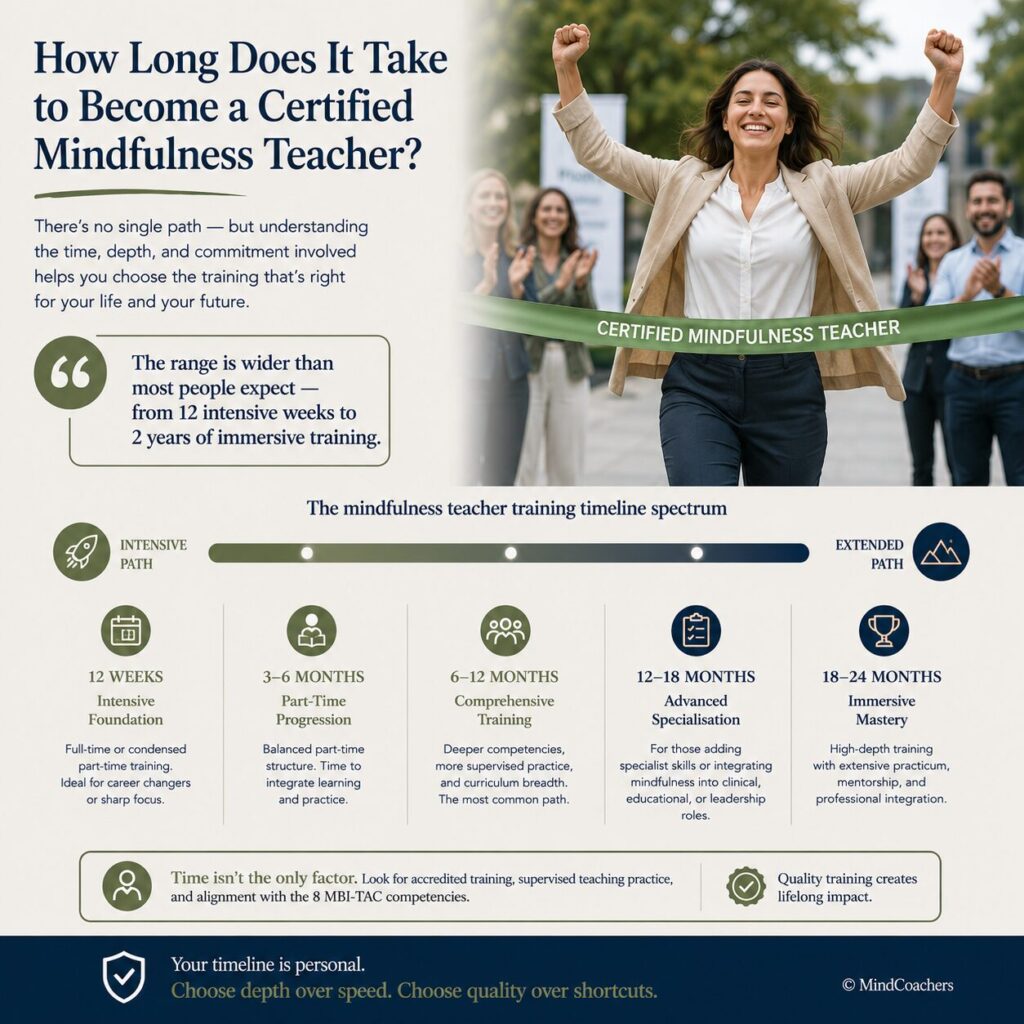
One of the first questions anyone asks when researching mindfulness teacher training is: how long will it take? The answer varies considerably — from twelve-week intensives to two-year part-time programmes — and the variation is not arbitrary. Different formats reflect different approaches to how teaching competence develops, different accreditation requirements, and different practical constraints on the practitioner’s time.
This article gives a realistic account of what different programme lengths actually deliver, how to think about the timeline question for your specific situation, and what the IMTA CMT-P accreditation standard requires in terms of minimum hours — regardless of how those hours are structured. Duration is not a proxy for quality. But it is a meaningful variable, and understanding what different timelines involve helps you make a better decision.
For the full framework for evaluating any programme, see what makes a good mindfulness teacher training? 7 criteria. For format comparisons, see 12-week vs 12-month mindfulness teacher training: which is right for you? and best online mindfulness teacher training programmes: ranked and compared.
Key takeaways
→ IMTA CMT-P accreditation requires a minimum of 200 hours — the format that delivers those hours matters more than how many months it spans.
→ A 12-week intensive can deliver equivalent or superior outcomes to a 12-month programme, provided teaching practice begins early and runs throughout.
→ The timeline to professional practice is not the same as the timeline to programme completion — building a client base takes longer than completing the training.
→ Part-time programmes suit practitioners who cannot commit to intensive formats; intensive programmes suit those who want to enter the market quickly.
→ The post-graduation IMTA CMT-P application adds a separate step after programme completion — typically 4–8 weeks for the application process.
The IMTA 200-hour minimum — what it means for timelines
The International Mindfulness Teachers Association (IMTA) requires a minimum of 200 hours for CMT-P (Certified Mindfulness Teacher – Professional) accreditation. This is a total across all categories — live instruction, supervised teaching practice, concurrent practicum, personal practice, and self-study. The standard does not specify how many months the 200 hours must span.
This means that a rigorous 12-week intensive programme and a rigorous 18-month part-time programme can both meet the IMTA standard — provided the hour composition and concurrent practicum requirement are met. Duration is a delivery mechanism, not a quality indicator. For a full breakdown of what the 200 hours should consist of, see how many teaching practice hours does a mindfulness training actually need?. For what the CMT-P application process involves after completion, see CMT-P certification explained: how to become an IMTA-certified mindfulness teacher.
Programme formats and what they deliver
12-week intensive (online cohort)
A 12-week intensive programme — typically delivered as a weekly live session with asynchronous content and a concurrent practicum running throughout — is the fastest route to IMTA-accredited qualification. The key design question is how the 200 hours are distributed: an intensive that front-loads theory and compresses teaching practice into the final weeks is not equivalent to one where teaching practice begins in week one.
- Timeline to qualification: 12 weeks to programme completion + 4–8 weeks for IMTA CMT-P application processing.
- Best for: Practitioners with clear career intent who want to enter the professional market quickly; those with existing professional networks to leverage immediately on qualification.
- Watch for: Hour composition — verify teaching practice begins early, not just at the end. See why teaching practice from day one makes better mindfulness teachers.
6-month part-time programme
Six-month part-time programmes typically deliver 200 hours across fortnightly or monthly intensive sessions with significant self-study between. The longer span allows more time for personal practice development and integration between sessions, but also creates more risk of momentum loss — particularly in the practicum, where the concurrent teaching requirement needs to be maintained across a longer period.
- Timeline to qualification: 6 months to programme completion + 4–8 weeks for IMTA CMT-P application.
- Best for: Practitioners with busy clinical or professional schedules who cannot commit to weekly intensive sessions; those who benefit from longer integration periods between taught sessions.
- Watch for: Practicum continuity — a concurrent practicum that runs across 6 months needs active management to maintain momentum.
12-month part-time programme
Twelve-month programmes typically span the academic year and are often designed for practitioners who want a more gradual entry into teaching — with more time between taught sessions for personal practice development, peer community building, and supervised teaching integration. The extended timeline is not inherently superior: it depends entirely on how the programme uses the additional months.
- Timeline to qualification: 12 months to programme completion + 4–8 weeks for IMTA CMT-P application.
- Best for: Practitioners who prefer a slower pace of integration; those who want more time for personal practice development alongside the curriculum.
- Watch for: Whether the additional months add substantive content or simply slow the pace of delivery. A 12-month programme with the same contact hours as a 6-month programme is not twice as rigorous — it is the same programme delivered more slowly.
18-month to 2-year extended programmes
Extended programmes at 18 months to 2 years are typically designed for practitioners pursuing clinical mindfulness teaching pathways — MBCT specifically — or for those who want to combine mindfulness teacher training with broader contemplative education. They are not inherently more rigorous than 12-week intensives; they are more appropriate for specific clinical pathways that require extended supervised practice.
- Timeline to qualification: 18–24 months to programme completion + IMTA application processing.
- Best for: Practitioners pursuing MBCT-specific clinical pathways; those combining mindfulness teacher training with broader contemplative or somatic training.
- Watch for: Whether the extended duration reflects genuine curriculum depth or simply a more leisurely pace. For clinicians specifically, see mindfulness teacher training for psychologists.
The timeline to professional practice — different from qualification
Programme completion and IMTA CMT-P qualification are not the same as professional practice readiness. Most practitioners need an additional 6–18 months after qualification to build the client relationships, testimonials, and sector experience that institutional clients require before commissioning.
The timeline to professional practice varies significantly by starting point:
- Practitioners with existing professional networks (coaches, psychologists, HR professionals) can typically access first professional income within 3–6 months of qualification, leveraging existing relationships.
- Practitioners without existing professional networks typically need 12–24 months post-qualification to build the portfolio, testimonials, and sector relationships that institutional clients require.
- Practitioners adding mindfulness teaching to an existing practice (yoga teaching, wellness work, coaching) can typically generate supplementary income from mindfulness teaching within 6 months of qualification.
For the income trajectory question, see mindfulness teacher salary guide: realistic income ranges for Europe. For the demand context, see demand for mindfulness teachers in Europe: 2027–2030 forecast.
What the IMTA CMT-P application process involves
Completing an IMTA-accredited programme is not the same as holding the IMTA CMT-P credential. The CMT-P credential requires a separate post-graduation application to IMTA, with a fee of approximately €150–250 paid directly to IMTA. The application process involves submitting evidence of:
- Completion of an IMTA-accredited programme (verified by the programme provider)
- Teaching practice hours — documented practicum log
- Personal mindfulness practice — documented practice log
- Two references from qualified supervisors or programme faculty
IMTA processes applications within approximately 4–8 weeks. For the full CMT-P application pathway, see CMT-P certification explained: how to become an IMTA-certified mindfulness teacher. For what credentials employers recognise, see mindfulness teacher certification: which credentials actually matter to employers?.
How to choose the right timeline for your situation
The right programme length depends on three variables:
- Your schedule constraints: Can you commit to weekly live sessions for 12 weeks? If not, a part-time format is more realistic than forcing an intensive format around a full clinical or professional schedule.
- Your career intent: If you are targeting the professional institutional market and want to enter it quickly, an intensive format is more efficient. If you are adding mindfulness teaching gradually to an existing practice, a part-time format suits that trajectory better.
- Your learning style: Some practitioners benefit from intensive immersion — the cohort dynamic, the momentum, the concentrated focus. Others need more time between sessions for integration. Neither preference is wrong; the question is which format genuinely suits how you learn.
For a direct format comparison, see 12-week vs 12-month mindfulness teacher training: which is right for you?. For online vs in-person considerations, see best online mindfulness teacher training programmes: ranked and compared. For the best current IMTA-accredited options, see best IMTA-accredited mindfulness teacher training programmes: 2027 guide.
Download the MCMI — MindCoachers Certified Mindfulness Instructor — prospectus: full curriculum, faculty profiles, pricing and cohort information.
Further reading and professional resources
↗ 12-week vs 12-month mindfulness teacher training: which is right for you?
↗ How many teaching practice hours does a mindfulness training actually need?
↗ Why teaching practice from day one makes better mindfulness teachers
↗ CMT-P certification explained: how to become an IMTA-certified mindfulness teacher
↗ Best IMTA-accredited mindfulness teacher training programmes: 2027 guide
Next steps
The MCMI — MindCoachers Certified Mindfulness Instructor is a 12-week intensive cohort programme — IMTA-accredited at CMT-P level, with teaching practice beginning in week one and the 35-hour concurrent practicum running across the full twelve weeks. The intensive format is designed for practitioners who want to enter the professional market without spending a year in training. Graduates are positioned to begin building professional practice immediately on completion.
Frequently asked questions
About mindfulness teacher training for psychologists and the MCMI — MindCoachers Certified Mindfulness Instructor