
12-Week vs 12-Month Mindfulness Teacher Training: Which Is Right for You? (2027)
Duration is not a quality signal. Here is what actually differs between intensive and extended formats — and how to choose based on your professional situation.
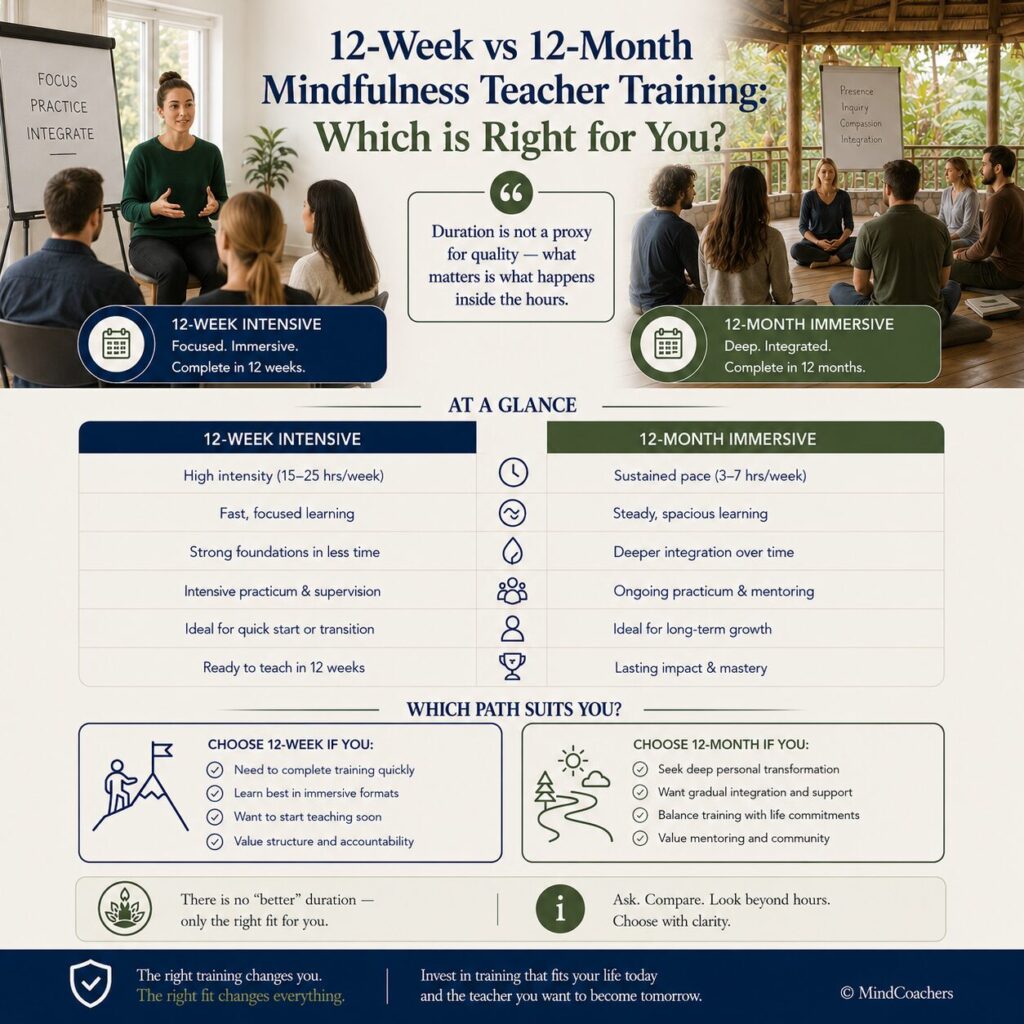
The comparison between 12-week and 12-month mindfulness teacher training programmes is one of the most common questions prospective students ask — and one of the most poorly framed. The instinct to assume that longer means better is understandable. In most professional education contexts, extended programmes represent more thorough preparation. In mindfulness teacher training, the relationship between duration and quality is significantly more complicated.
A 12-week programme built around live cohort sessions, teaching practice from week one, and a concurrent practicum running throughout is not a compressed version of a 12-month programme. It is a structurally different experience with different pedagogical logic. A 12-month programme built around monthly intensive sessions with extensive self-study between is not a more thorough version of a 12-week programme. It is a different format with different strengths and different limitations.
This article gives you a precise account of what actually differs between intensive and extended formats, and a decision framework for choosing between them based on your professional situation, learning style, and career intent. For the full evaluation framework, see what makes a good mindfulness teacher training? 7 criteria. For timeline context, see how long does it take to become a certified mindfulness teacher?
Key takeaways
→ Duration is not a proxy for quality — a 12-week intensive can deliver equivalent or superior outcomes to a 12-month programme provided the structural features are right.
→ The key structural variable is not length but the ratio of live instruction to asynchronous content and when teaching practice begins.
→ 12-week intensives suit practitioners who want to enter the professional market quickly and can commit to a weekly schedule.
→ Extended formats suit practitioners with complex schedules who need longer integration time between sessions.
→ Both formats can be IMTA-accredited at CMT-P level — the standard is defined by hour composition, not programme duration.
What duration actually tells you — and what it does not
Programme duration tells you one thing reliably: how long the programme takes to complete. It does not tell you how many hours are live and synchronous, when teaching practice begins, how rigorous the concurrent practicum is, or how much structured feedback you will receive on your teaching. These are the variables that actually determine outcomes — and they are independent of duration.
Two programmes can both be 12 weeks long while offering radically different amounts of live instruction, teaching practice, and feedback. Two programmes can both be 12 months long while delivering very different practicum models. For the full breakdown of what hours should consist of, see how many teaching practice hours does a mindfulness training actually need? and 200-hour mindfulness teacher training: what you actually get for the hours.
The blog post why 12 weeks produces what an 8-week programme cannot explains why the cohort dynamic across a sustained period matters more than total programme length.
The 12-week intensive: what it delivers and for whom
Structure
A 12-week intensive typically delivers one live session per week — 90 to 180 minutes — plus asynchronous content between sessions, and a concurrent practicum running from the first week. The total weekly commitment is typically 8–12 hours including the practicum, self-study, and the live session. Over 12 weeks, this produces approximately 100–140 hours of structured activity, with the remainder of the 200-hour IMTA requirement met through practicum hours, personal practice, and documented self-study.
Pedagogical strengths
- Momentum: The weekly rhythm creates a tight feedback loop between what you learn and what you practise. What you cover in Tuesday’s session is tested in your practicum on Thursday and brought back into the following Tuesday’s session with direct relevance.
- Cohort continuity: Twelve weeks is long enough to develop meaningful peer relationships and to observe your cohort’s development over time — the foundation of the peer teaching and feedback dynamic that deliberate practice research identifies as a primary driver of competence development. See why cohort learning produces better teachers than solo study.
- Speed to qualification: Programme completion and the CMT-P application pathway are reachable within approximately four months. For practitioners who want to enter the professional market quickly, this is the decisive advantage.
Limitations
- Schedule commitment: A weekly live session is a non-negotiable commitment. Practitioners with unpredictable clinical or professional schedules, or those who travel frequently, may find the weekly rhythm difficult to maintain.
- Integration time: Twelve weeks does not provide extensive time between sessions for personal practice development and reflection. Practitioners who benefit from longer integration periods may find the pace challenging.
Who the 12-week intensive suits
- Practitioners with clear professional intent who want to enter the market quickly
- Those with existing professional networks to leverage immediately on qualification
- Practitioners who learn well in intensive, immersive formats
- Those who can commit to a fixed weekly schedule for three months
For practitioners asking whether intensive formats suit their professional context specifically, see mindfulness teacher training for psychologists, mindfulness teacher training for executive and leadership coaches, and mindfulness teacher training for yoga teachers. The video why mindfulness teacher certification doesn’t require a career pause addresses the schedule question directly.
The 12-month extended programme: what it delivers and for whom
Structure
A 12-month programme typically delivers monthly or fortnightly intensive sessions — full days or half days — with significant self-study between. The longer intervals between sessions allow more time for personal practice development, reflection, and integration of curriculum content. The concurrent practicum runs across the full year, which theoretically allows more teaching practice time — but also requires sustained motivation to maintain momentum across a longer period.
Pedagogical strengths
- Integration time: Monthly sessions allow practitioners to develop their personal practice more gradually, integrate curriculum content between sessions, and bring accumulated experience back into each session.
- Schedule flexibility: Monthly intensive sessions are easier to accommodate around complex clinical or professional schedules than weekly commitments.
- Personal practice development: A longer programme allows more time for the personal mindfulness practice that is both an IMTA requirement and the foundation of credible teaching.
Limitations
- Momentum: Monthly intervals between sessions create a looser feedback loop between instruction and practice. What you learn in January is applied in February and reviewed in March — by which point the direct connection between error and correction has often weakened.
- Cohort continuity: Twelve months of monthly sessions is a long time to maintain the peer relationships and group dynamic that produce meaningful peer feedback. Drop-out rates in extended programmes are typically higher than in intensive formats, which affects cohort continuity.
- Speed to qualification: Programme completion takes a year, with the CMT-P application pathway adding a further 4–8 weeks. For practitioners with near-term career intent, this timeline may not suit.
Who the 12-month extended format suits
- Practitioners with complex or unpredictable schedules who cannot commit to weekly sessions
- Those who benefit from longer integration periods between taught sessions
- Practitioners adding mindfulness teaching gradually to an existing practice rather than building it as a primary focus
- Those who prefer a slower pace of personal practice development alongside the curriculum
The decision framework: five questions
Use these five questions to identify which format is genuinely right for your situation:
- Can you commit to a fixed weekly session for 12 weeks? If yes, the intensive format is available to you. If not — because of clinical commitments, travel, or schedule unpredictability — an extended format is more realistic.
- How quickly do you need to qualify? If you have professional intent that is time-sensitive — a coaching client base ready to receive mindfulness services, a corporate client relationship that needs a credentialled practitioner — the intensive format’s four-month timeline is a significant advantage.
- Do you learn better in intensive immersion or gradual integration? This is a genuine learning style question, not a quality question. Some practitioners thrive in intensive formats; others produce better outcomes with longer integration periods. Be honest about which describes you.
- What does your personal practice look like? IMTA requires evidence of personal practice as part of the CMT-P application. If your personal practice is well-established, the intensive format is appropriate. If you are still developing consistency in your personal practice, a longer format may serve that development better.
- What is your career intent? If you are building mindfulness teaching as a primary professional focus, the intensive format positions you in the professional market sooner. If you are adding mindfulness teaching as a supplementary service to an existing practice, the extended format may align better with the pace of that integration. For the career context, see is mindfulness teaching a viable career in 2027? and the long-term view in the 3-year career impact of your mindfulness training choice.
What both formats require equally
Regardless of duration, any rigorous mindfulness teacher training must provide:
- IMTA accreditation at CMT-P level — verified on the IMTA accredited programmes list
- A concurrent practicum that begins early and runs throughout the programme
- Structured peer feedback on teaching, documented against competency criteria
- Faculty with relevant clinical, academic, or professional credentials
- A curriculum that is publicly available before enrolment
For the full evaluation criteria that apply to both formats equally, see what makes a good mindfulness teacher training? 7 criteria. For how to read a curriculum regardless of format, see how to read a mindfulness teacher training curriculum before you enrol. For the best current IMTA-accredited options in both formats, see best IMTA-accredited mindfulness teacher training programmes: 2027 guide.
Download the MCMI — MindCoachers Certified Mindfulness Instructor — prospectus: full curriculum, faculty profiles, pricing and cohort information.
Further reading and professional resources
↗ How long does it take to become a certified mindfulness teacher?
↗ How many teaching practice hours does a mindfulness training actually need?
↗ Why teaching practice from day one makes better mindfulness teachers
↗ 200-hour mindfulness teacher training: what you actually get for the hours
↗ Best IMTA-accredited mindfulness teacher training programmes: 2027 guide
↗ Online vs in-person mindfulness teacher training: what the evidence says
↗ Why cohort learning produces better teachers than solo study
Next steps
The MCMI — MindCoachers Certified Mindfulness Instructor is a 12-week intensive cohort programme — IMTA-accredited at CMT-P level, with weekly live sessions, teaching practice from session one, and a 35-hour concurrent practicum running across all twelve weeks. For practitioners who want the intensive format’s speed and cohort dynamic, and can commit to a weekly schedule, the MCMI positions you in the professional market within four months of starting.
Frequently asked questions
About mindfulness teacher training for psychologists and the MCMI — MindCoachers Certified Mindfulness Instructor