
From Yoga Teacher to Certified Mindfulness Instructor: The Honest Career Transition Guide
What the transition actually involves, how long it realistically takes, and how to manage a yoga practice and a mindfulness teaching practice at the same time.
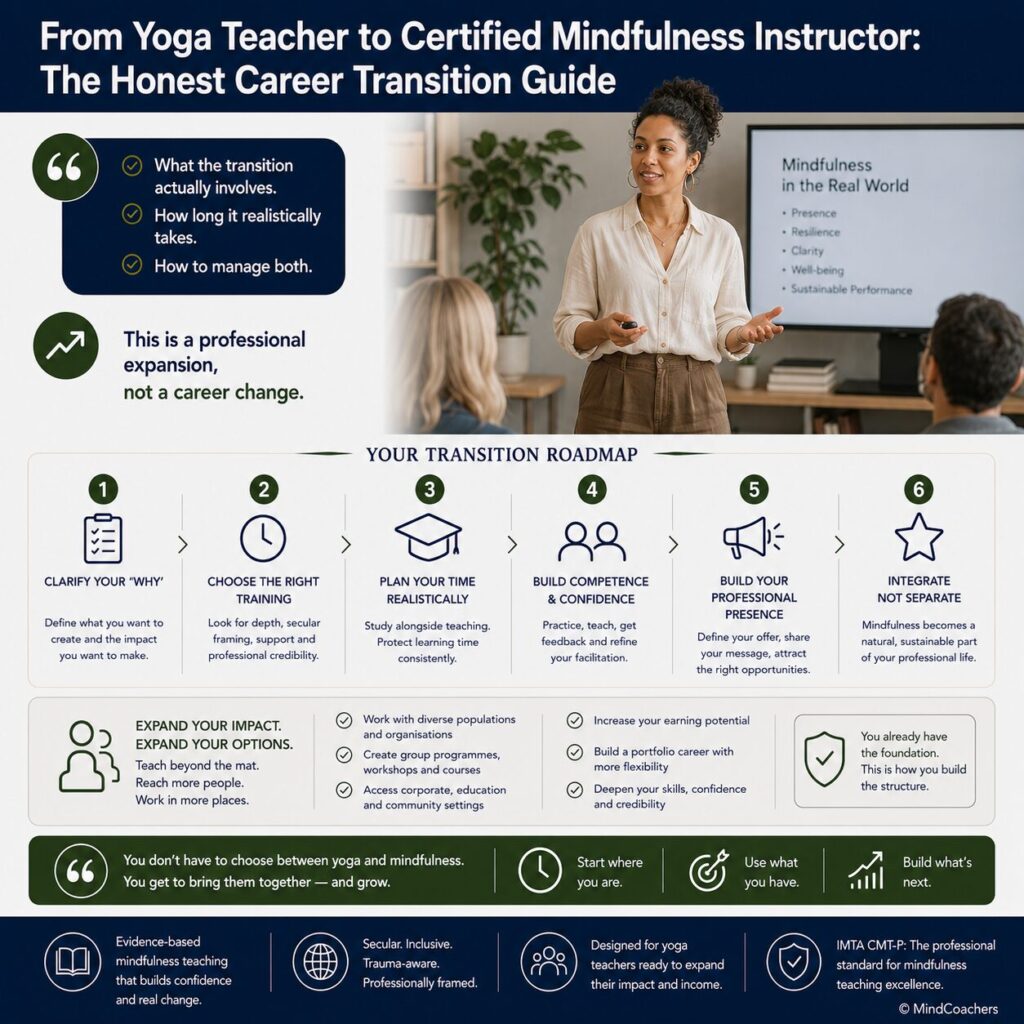
Most articles about transitioning from yoga teaching to mindfulness instruction are written from a position of enthusiasm rather than honesty. They describe the opportunity without the timeline, the credential without the income ramp, the professional expansion without the practical scheduling challenge. This guide is different.
It is written for yoga teachers with an established teaching practice — typically five or more years of experience, a stable class schedule, and a student base that already trusts them. The question these teachers are asking is not whether mindfulness teaching is a good idea. It is whether the transition is worth the disruption, how long it takes before it pays, and how to manage two professional identities without losing quality in either.
For the programme comparison and credential context, see the best mindfulness teacher training for yoga teachers: 2027 comparison and the mindfulness teacher training for yoga teachers: bridging practice and formal instruction segment guide. This article addresses the practical transition questions that come before and after those decisions.
Key takeaways
→ This is a professional expansion, not a career change. Most yoga teachers who add IMTA CMT-P training maintain their yoga practice and build mindfulness teaching alongside it — the two are complementary and commercially synergistic.
→ The realistic timeline from starting IMTA-accredited training to generating meaningful mindfulness teaching income is 12 to 18 months: 3 months training, 3 months qualification and first programme launch, 6 to 12 months to build a reliable second income stream.
→ A 12-week intensive requires one live session per week alongside your existing teaching schedule. The practicum can often be integrated with existing student relationships, minimising disruption to current income.
→ The income trajectory from IMTA CMT-P is positive over 2 to 3 years for practitioners who access institutional markets — corporate wellbeing, EAP commissions, educational settings — at rate structures significantly above yoga class rates.
→ The MCMI — MindCoachers Certified Mindfulness Instructor is designed for practitioners with existing teaching experience who need format compatibility with an active teaching schedule. Two credentials result: the MCMI certificate (automatic, included in tuition) and the IMTA CMT-P (post-graduation IMTA application, ~€150–250). Distinct steps.
Why this is a professional expansion, not a career change
The framing matters practically, not just psychologically. If you approach this as a career change — abandoning yoga for mindfulness — you create a false choice that most yoga teachers correctly reject. If you approach it as a professional expansion — adding a distinct and complementary professional capability alongside an existing practice — the decision calculus is entirely different.
The yoga teaching identity and the mindfulness teaching identity are professionally complementary in several ways:
- Your yoga student base is a warm recruitment pool for mindfulness programmes — people who already trust your teaching and who are predisposed to exploring mindfulness practice
- Yoga teaching maintains a reliable income base while mindfulness teaching income is being built — the financial risk of the expansion is low because the existing practice remains
- The embodiment and somatic awareness that yoga teaching develops is a genuine competitive advantage in mindfulness teaching, particularly for body-scan and somatic awareness practices
- Yoga and mindfulness often serve the same participant population at different stages of their practice development — creating natural referral and continuation pathways between the two offerings
The identity shift from practising mindfulness to teaching it professionally describes the internal professional identity work this transition requires — which is real, but more manageable than a full career change because the foundational identity (experienced teacher, facilitation practitioner) does not change.
The realistic timeline: training, qualification, and first income
The honest timeline for a yoga teacher moving from decision to meaningful mindfulness teaching income:
- Months 1 to 3 — Training: 12-week IMTA-accredited intensive, one live session per week, concurrent practicum delivering 35 hours of supervised teaching from Week 1. Existing yoga teaching schedule maintained throughout.
- Months 3 to 6 — Qualification and first programme launch: IMTA CMT-P application submitted post-graduation (independent process, approximately 4 to 8 weeks for credential issuance). First paid mindfulness programme announced to existing yoga student base. First cohort typically 6 to 12 participants at introductory pricing.
- Months 6 to 12 — Building the mindfulness teaching practice: second and third programme cohorts. Development of corporate or institutional relationships for higher-rate facilitation work. Income from mindfulness teaching becomes a meaningful secondary stream.
- Months 12 to 24 — Institutional development: if pursuing corporate, EAP, or NHS-adjacent markets, the relationship development required typically takes 12 to 18 months from qualification. This is the phase where the income differential between yoga teaching and institutional mindfulness facilitation becomes material.
For a realistic picture of income ranges at each stage, the mindfulness teacher salary guide: realistic income ranges for Europe provides the specific numbers. The short version: a six-session mindfulness programme at reasonable European rates with 8 to 12 participants generates meaningful per-cohort income run two to three times per year alongside an existing yoga practice.
How to fit formal training into a 15-class-a-week teaching schedule
The format question is the most practically important for yoga teachers with full teaching schedules. The MCMI addresses this directly: one live online session per week (2.5 to 3 hours), self-study between sessions, and a concurrent 35-hour practicum that can be integrated with existing student relationships.
The scheduling approach that works for most yoga teachers:
- Designate one weekday morning or evening as the training session — treat it with the same protection as a teaching commitment
- Use existing yoga students who express interest as practicum participants where possible, with explicit consent that the session is a mindfulness teaching session distinct from their yoga class
- Schedule self-study in commute time, preparation time already in the schedule, or a dedicated 30-minute daily window — the content is engaging enough that most practitioners report this as restorative rather than burdensome
- Do not reduce yoga classes during training unless the schedule is already overextended — the income maintenance is important, and the teaching practice itself is a competency asset
The practicum is the most important scheduling consideration. Why the MCMI has you teaching mindfulness from Week 1 covers why early teaching experience is pedagogically central — and why the 35-hour concurrent practicum is a feature of the training, not a burden to be managed.
What to tell your yoga students — and when
The communication question has a clear answer: tell them early, tell them honestly, and position it as additive rather than transitional.
The timing: announce your mindfulness training at the start of the programme, not at the end. Your yoga students will be your first mindfulness programme audience — they need time to develop interest in the new offering before it launches.
The framing: “I am completing formal IMTA-accredited mindfulness teacher training over the next three months. I will be launching a dedicated mindfulness programme alongside my yoga teaching later in the year — different sessions, different structure, for people who want to develop a seated mindfulness practice. If you are interested, I will let you know when bookings open.”
What not to say: do not frame it as “branching out” or “moving into a new area” — these phrases imply your yoga teaching is becoming less central, which is not the message. Frame the mindfulness offering as additional, not alternative.
Your from yoga teacher to certified mindfulness instructor blog post covers the communication strategy for each student segment in your existing base — those who are interested in mindfulness, those who are not, and those who might follow you into both offerings.
Dual practice economics: how the income balance shifts over time
The income economics of running yoga teaching and mindfulness teaching in parallel are favourable for practitioners who build the dual practice thoughtfully.
In the first year post-qualification, yoga teaching typically remains the primary income source. Mindfulness teaching generates supplementary income from two to three programme cohorts per year and, if institutional relationships are being built, from individual corporate sessions or workshops.
By years two to three, for practitioners who have developed institutional relationships, the income balance begins to shift. Corporate mindfulness facilitation at institutional rates generates significantly more income per hour than yoga class rates. A single corporate half-day generates more than a full week of yoga classes for many practitioners. The dual practice becomes economically superior to either practice alone.
The practitioners who achieve this trajectory are those who build institutional relationships proactively from the point of qualification — not waiting for corporate clients to find them, but actively developing relationships with HR contacts, L&D professionals, and EAP providers. The first six months after mindfulness certification covers the practical business development steps in detail.
What experienced yoga teachers find hardest — and easiest — in formal training
Based on the consistent experience of yoga teachers completing IMTA-accredited mindfulness teacher training, the pattern is clear:
What experienced yoga teachers find hardest:
- Secular psychological framing — the language of ACT, cognitive science, and secular mindfulness mechanisms is genuinely new for most yoga teachers. The contemplative and somatic language of yoga does not translate directly, and developing fluency in secular framing takes deliberate practice
- Verbal inquiry facilitation — yoga teaching is largely directive and physical. Mindfulness inquiry is non-directive, verbal, and psychologically oriented. The facilitation style is categorically different and requires specific development
- Sitting with silence — yoga classes are typically movement-rich and energetically active. Mindfulness sessions have long periods of silence, stillness, and internal focus. The pace is genuinely different and takes adjustment
What experienced yoga teachers find easiest:
- Group facilitation and holding a room — yoga teachers have typically developed strong group presence and the capacity to hold diverse groups through challenging experiences. These skills transfer immediately to mindfulness facilitation
- Personal practice development — yoga teachers with established somatic and breath awareness practices develop mindfulness practice depth quickly, because the foundational attentional and embodied awareness is already developed
- Teaching authenticity — yoga teachers who genuinely practise what they teach bring an embodied quality to mindfulness facilitation that practitioners without somatic practice depth often lack
The net assessment: experienced yoga teachers are among the fastest and most effective IMTA-accredited mindfulness teacher training participants, precisely because what is hardest for them is specifically what the training develops. If you are wondering whether you are ready to teach mindfulness addresses the readiness question directly for experienced teachers.
Download the MCMI — MindCoachers Certified Mindfulness Instructor — prospectus: full curriculum, faculty profiles, pricing and cohort information.
Further reading and professional resources
Best Mindfulness Teacher Training for Yoga Teachers: 2027 Comparison
Mindfulness Teacher Training for Yoga Teachers: Bridging Practice and Formal Instruction (2027)
Mindfulness Teacher Salary Guide: Realistic Income Ranges for Europe (2027)
From Yoga Teacher to Certified Mindfulness Instructor
The First Six Months After Mindfulness Certification
The Identity Shift From Practising Mindfulness to Teaching It Professionally
If You’re Wondering Whether You’re Ready to Teach Mindfulness, You Probably Are
Next steps
If this guide describes where you are in your yoga teaching practice, the MCMI — MindCoachers Certified Mindfulness Instructor is designed for practitioners at exactly this stage — established teaching experience, active schedule to work around, and ready to build IMTA CMT-P qualified mindfulness teaching alongside an existing yoga practice.
Frequently asked questions
About mindfulness teacher training for psychologists and the MCMI — MindCoachers Certified Mindfulness Instructor