
Best Mindfulness Teacher Training for Educators and Social Workers: 2027 Comparison
Which programmes serve teachers, school staff, and community practitioners — evaluated against school-specific credentialling, HCPC CPD recognition, community population adaptations, and format suitability for public sector professionals.
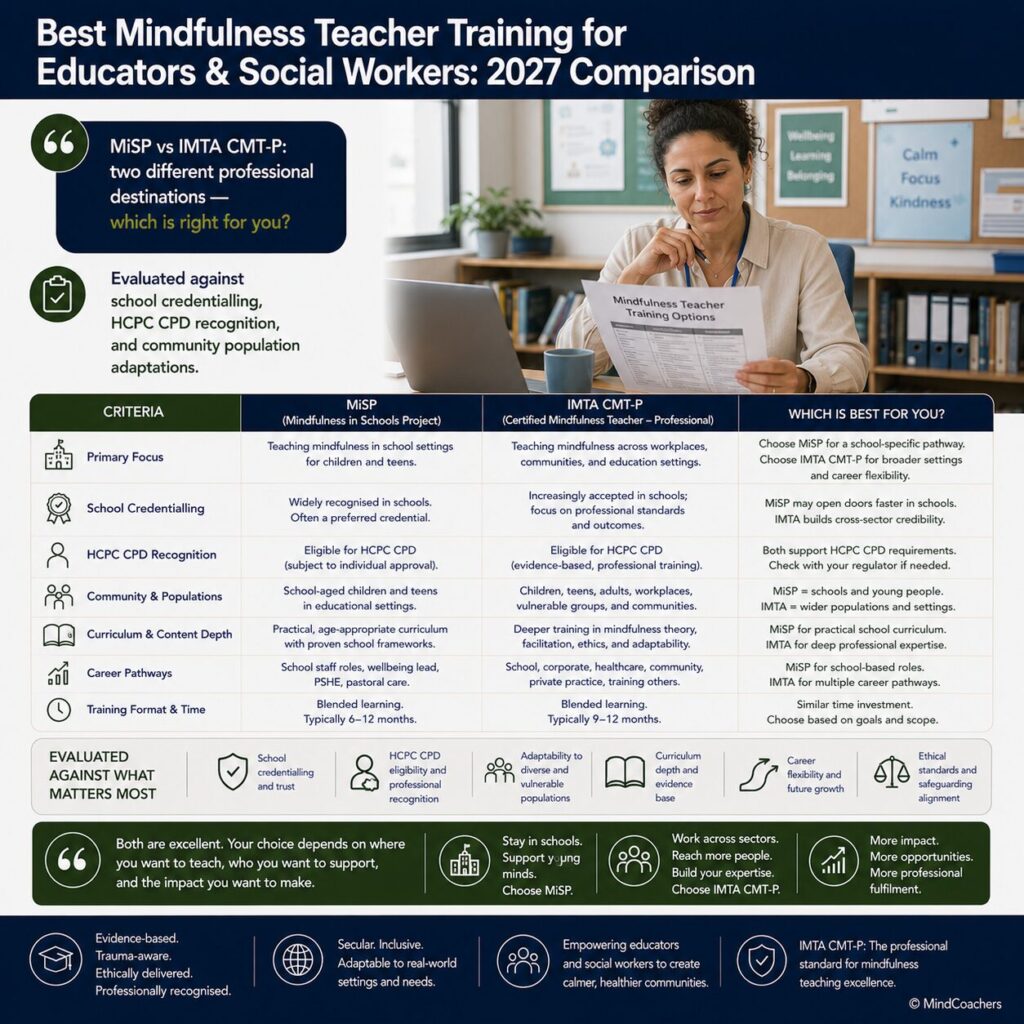
Educators and social workers evaluating mindfulness teacher training face a set of criteria that most general comparison articles do not address: school-specific credentialling versus general professional mindfulness teaching credentials, HCPC CPD recognition for registered social workers, community population adaptations for complex needs and disadvantaged populations, and the budget and scheduling realities of public sector CPD. This comparison was built for this segment specifically.
The central distinction for educators — between MiSP training and IMTA CMT-P — is worth naming at the outset. These are not competing options for the same professional destination. They serve different purposes, and many educators benefit from both. The comparison below acknowledges this directly and explains clearly when each is the appropriate choice. For the broader context on mindfulness teacher training regulation and credential requirements, see is mindfulness teacher training regulated? What professionals need to know and mindfulness teacher certification: which credentials actually matter to employers.
The five programmes reviewed are those most frequently encountered by educators and social workers: the MCMI — MindCoachers Certified Mindfulness Instructor, MiSP (.b / Paws b), Breathworks, Oxford Mindfulness Centre Professional Programme, and Sounds True MMTCP.
Key takeaways
→ MiSP training qualifies educators to deliver the specific MiSP classroom curriculum (.b, Paws b). IMTA CMT-P qualifies practitioners to teach mindfulness broadly — staff wellbeing, community programmes, external commissioned services. These are different professional destinations. Many educators benefit from both.
→ The MYRIAD trial (Kuyken et al., 2022) found that mindfulness programmes delivered by formally trained, credentialled instructors consistently produce better outcomes than those delivered by briefly trained classroom teachers. This finding directly supports IMTA CMT-P investment for educators who want to deliver effective programmes.
→ IMTA CMT-P counts toward HCPC CPD for social workers. When recording: “Completed IMTA-accredited professional mindfulness teacher training (200 hours, CMT-P level) developing evidence-based mindfulness facilitation competency for use with community and clinical populations.”
→ The MCMI — MindCoachers Certified Mindfulness Instructor is the strongest option for educators and social workers who want full IMTA CMT-P depth — with trauma-aware protocols relevant to complex populations, secular framing for diverse community contexts, and a format compatible with demanding public sector schedules.
→ Two credentials result from the MCMI: the MCMI certificate (automatic on completion, included in tuition) and the IMTA CMT-P (post-graduation IMTA application, independent fee ~€150–250). They are distinct steps — never presented as one.
How this comparison was built — and what makes it specific to educators and social workers
Most mindfulness teacher training comparisons evaluate programmes against criteria relevant to private practice practitioners: contemplative depth, personal development emphasis, retreat access, format flexibility. These criteria are largely irrelevant to educators and social workers, who need to know: does this credential satisfy my school’s requirement for formal mindfulness teaching? Will this count toward HCPC CPD? Does the programme address trauma-aware facilitation for the populations I work with? Can I complete this on a teacher’s schedule and a public sector CPD budget?
This comparison applies six criteria specific to the public sector professional context. We also address directly the MiSP versus IMTA CMT-P distinction — because this is the question educators most frequently ask, and most comparison articles either ignore it or conflate the two. What qualifies you to teach mindfulness in schools provides the detailed credential guidance for school-specific contexts. Do you need a mindfulness teaching certification — or can you teach without one addresses the scope-of-practice question that precedes this comparison for many practitioners.
MiSP vs IMTA CMT-P: two different professional destinations
The most important distinction in this comparison is not between individual programmes — it is between two credential types that serve fundamentally different professional purposes.
undefined (.b for secondary, Paws b for primary, .breathworks for sixth form and adult) qualifies educators to deliver the specific MiSP curriculum in school settings. The training is curriculum-specific: it equips teachers to deliver MiSP’s structured classroom programmes to students. It does not qualify the holder to teach mindfulness in general professional contexts — staff wellbeing, community groups, external commissioned services, or professional CPD outside the MiSP curriculum. MiSP training is the right choice when the objective is classroom curriculum delivery of the MiSP programme specifically.
undefined is the international professional standard for secular mindfulness teachers. It qualifies the holder to teach mindfulness across multiple contexts and populations — not just within a specific curriculum or school setting. For educators who want to deliver staff wellbeing mindfulness programmes, community group interventions, externally commissioned services, or professional CPD alongside their school role, IMTA CMT-P is the appropriate credential. It also satisfies HCPC CPD requirements for social workers and is recognised by institutional commissioners outside the school context.
Many educators hold both. MiSP for classroom delivery; IMTA CMT-P for broader professional capability. These are complementary, not competing. The decision framework: if your objective is classroom programme delivery only, MiSP is the targeted investment. If your objective is broader professional mindfulness teaching capability, IMTA CMT-P is the appropriate standard.
The evaluation criteria for educators and social workers
Six criteria were applied, each specific to the public sector professional context:
- School/institutional credentialling — does the credential satisfy school requirements for formal mindfulness teaching, and can it be cited in a professional context as evidence of teaching qualification?
- HCPC CPD recognition — does the training satisfy HCPC CPD requirements for registered social workers, educational psychologists, and allied health professionals?
- Community population adaptations — does the curriculum address teaching mindfulness to complex needs populations, disadvantaged communities, and diverse participant backgrounds? See AI in schools — qualified mindfulness teachers needed now for the emerging demand context.
- Trauma-aware depth for public sector contexts — does the trauma-aware content cover seated mindfulness practice risks (dissociation, PTSD arousal) relevant to school, social care, and community populations?
- Format compatibility — is the programme deliverable on a teacher’s or social worker’s schedule, within typical public sector CPD budget constraints?
- IMTA CMT-P accreditation — does the programme satisfy IMTA requirements for CMT-P accreditation? This is the binary question for external market access and institutional credentialling.
Comparison at a glance: mindfulness teacher training for educators and social workers
| Programme | Accreditation | School/HCPC CPD | Community populations | Trauma-aware depth | Format | Duration |
| MCMI — MindCoachers | IMTA CMT-P | Yes — full CPD | Addressed explicitly | Yes — MBI-specific | Online cohort | 12 wks / 200h |
| MiSP (.b / Paws b) | MiSP certificate | School curriculum only | Students — curriculum specific | Limited | In-person retreat | ~2.5–4 days |
| Breathworks | Breathworks cert | As CPD evidence | Chronic pain / compassion | Partial — physical focus | Online / in-person | ~120h |
| Oxford Mindfulness — Professional | Oxford cert | As CPD evidence | Clinical focus | MBCT protocol | In-person/online | Variable |
| MMTCP (Sounds True) | None (dharma) | Limited CPD case | Not addressed | Minimal | Online, 2 years | ~150h |
What the MYRIAD trial means for mindfulness teacher training decisions
The MYRIAD trial (Kuyken et al., 2022) is the most significant piece of school mindfulness research in the past decade — and the most frequently misread. Many educators encountering the trial’s headline finding — that school mindfulness programmes produced no significant beneficial effects — conclude that school mindfulness does not work. This is a misreading. The trial’s actual finding is more specific and more relevant to training decisions.
The MYRIAD trial found that universal mindfulness programmes delivered by briefly trained classroom teachers produced no significant beneficial effects and some non-beneficial effects in vulnerable student subgroups. The key variable was teacher training quality. Programmes delivered by formally trained, credentialled instructors consistently produced better outcomes than those delivered by minimally trained teachers. The trial is not an argument against school mindfulness — it is a direct argument for teacher training quality.
For educators evaluating formal mindfulness teacher training, the MYRIAD finding is the central evidence argument: the difference between informal mindfulness use and formally trained, credentialled delivery is not marginal — it is the difference between ineffective and effective. Investment in IMTA CMT-P level training is supported by the trial’s findings, not contradicted by them.
What the MCMI — MindCoachers Certified Mindfulness Instructor offers educators and social workers specifically
The MCMI — MindCoachers Certified Mindfulness Instructor is the programme in this comparison with the combination of IMTA CMT-P accreditation, explicit trauma-aware protocols relevant to public sector populations, secular framing for diverse community contexts, and a format designed for practitioners with demanding professional schedules.
For educators and social workers, three features are directly relevant:
undefined. The MCMI curriculum includes content on adapting secular mindfulness facilitation for participants with complex histories — adverse childhood experiences, trauma, disadvantaged backgrounds, and mental health vulnerability. This is the population adaptation depth that educators and social workers most need and that most general mindfulness teacher training programmes do not provide at this level.
undefined. The MCMI’s trauma-aware content addresses the specific risks of body scan and breath-focused practices in populations where trauma prevalence is higher — including school populations and community social care groups. This is distinct from trauma-sensitive yoga protocols and is the clinical competency depth required for safe practice in public sector contexts.
undefined. Fully online, one live session per week over 12 weeks, with a concurrent 35-hour practicum. Educators can use staff wellbeing sessions, school community groups, or existing professional development contexts as practicum settings. The schedule is designed for practitioners who cannot attend multi-day residentials without significant professional disruption.
The MCMI produces two credentials. The MCMI certificate is awarded automatically on completion and is included in tuition. The IMTA CMT-P is obtained through a post-graduation application to IMTA, with an independent fee of approximately €150–250 paid directly to IMTA. These are two distinct steps.
What the alternatives offer educators — and when they are the better choice
MiSP — Mindfulness in Schools Project (.b and Paws b)
MiSP training is the appropriate credential for educators whose specific objective is delivering the MiSP curriculum to students within school settings. The .b programme (secondary) and Paws b programme (primary) are structured, evidence-informed classroom curricula with specific teacher training requirements. MiSP training is efficient, school-specific, and directly applicable. It is not a general professional mindfulness teaching credential — it qualifies the holder to deliver MiSP’s specific curricula, not to teach mindfulness in other professional contexts. For educators who want classroom programme delivery specifically, MiSP is the targeted and appropriate first investment. For broader professional capability, IMTA CMT-P is the complement.
Breathworks
Breathworks is a well-regarded programme with a specific focus on chronic pain and compassion-based mindfulness. For educators and social workers working specifically with chronic pain, illness, or palliative care populations, Breathworks provides directly relevant specialist content. It does not produce IMTA CMT-P and is not recognised as a general professional mindfulness teaching credential. It is best suited to practitioners whose community practice is specifically oriented toward these populations.
Oxford Mindfulness Centre — Professional Programme
Oxford Mindfulness is primarily oriented toward clinical and research contexts. For educational psychologists, school counsellors, or social workers in NHS-adjacent roles where Oxford’s MBCT research depth is directly relevant, the professional programme provides genuine clinical rigour. For classroom teachers or community practitioners whose context is not primarily clinical, the programme’s framing is a mismatch. For educators who want MBCT-specific clinical depth, Oxford is appropriate. For broader professional mindfulness teaching, IMTA CMT-P is the more applicable credential.
MMTCP — Sounds True
MMTCP provides deep dharma and contemplative practice development — genuinely valuable for educators whose personal practice and teaching vocation is contemplatively oriented. It does not produce IMTA CMT-P, does not address secular framing for institutional contexts, and is not matched to the professional credential requirements of most public sector educators. It is the right choice for educators whose primary motivation is contemplative deepening rather than professional institutional credentialling.
How to choose: a decision framework for public sector professionals
Use this framework based on professional destination:
- If your goal is classroom curriculum delivery of the MiSP programme: MiSP .b or Paws b training is the targeted and appropriate credential.
- If your goal is staff wellbeing programmes, community group facilitation, externally commissioned services, or professional CPD beyond the classroom curriculum: IMTA CMT-P is the appropriate credential. The MCMI is the strongest option in this comparison for educators and social workers, combining IMTA accreditation, community population adaptations, and a format compatible with public sector schedules.
- If your goal is MBCT-specific delivery in NHS-adjacent clinical education settings: Oxford Mindfulness Centre is the appropriate specialist route.
- If your goal is working specifically with chronic pain or palliative care populations: Breathworks provides directly relevant specialist content within its protocol framework.
For educators asking whether formal training is necessary at all, what hospitals and schools actually check before hiring a mindfulness teacher provides the institutional standard that schools and public sector organisations are increasingly applying.
Download the MCMI — MindCoachers Certified Mindfulness Instructor — prospectus: full curriculum, faculty profiles, pricing and cohort information.
Further reading and professional resources
What Qualifies You to Teach Mindfulness in Schools?
Do You Need a Mindfulness Teaching Certification — Or Can You Teach Without One?
Is Mindfulness Teacher Training Regulated? What Professionals Need to Know
Mindfulness Teacher Certification: Which Credentials Actually Matter to Employers? (2027)
AI in Schools — Qualified Mindfulness Teachers Needed Now
What Hospitals and Schools Actually Check Before Hiring a Mindfulness Teacher
Why Schools, Hospitals and Corporations Increasingly Require IMTA Accreditation
Next steps
If you are an educator or social worker ready to develop formal mindfulness teaching competency at IMTA CMT-P professional level, the MCMI — MindCoachers Certified Mindfulness Instructor is built for public sector practitioners — trauma-aware protocols for complex populations, secular framing for diverse community contexts, and a 12-week online format compatible with demanding professional schedules.
Frequently asked questions
About mindfulness teacher training for psychologists and the MCMI — MindCoachers Certified Mindfulness Instructor