
Best IMTA-Accredited Mindfulness Teacher Training Programmes: 2027 Guide
What IMTA-accredited programmes are available, what distinguishes them from each other, and how to choose between them using criteria that actually matter.
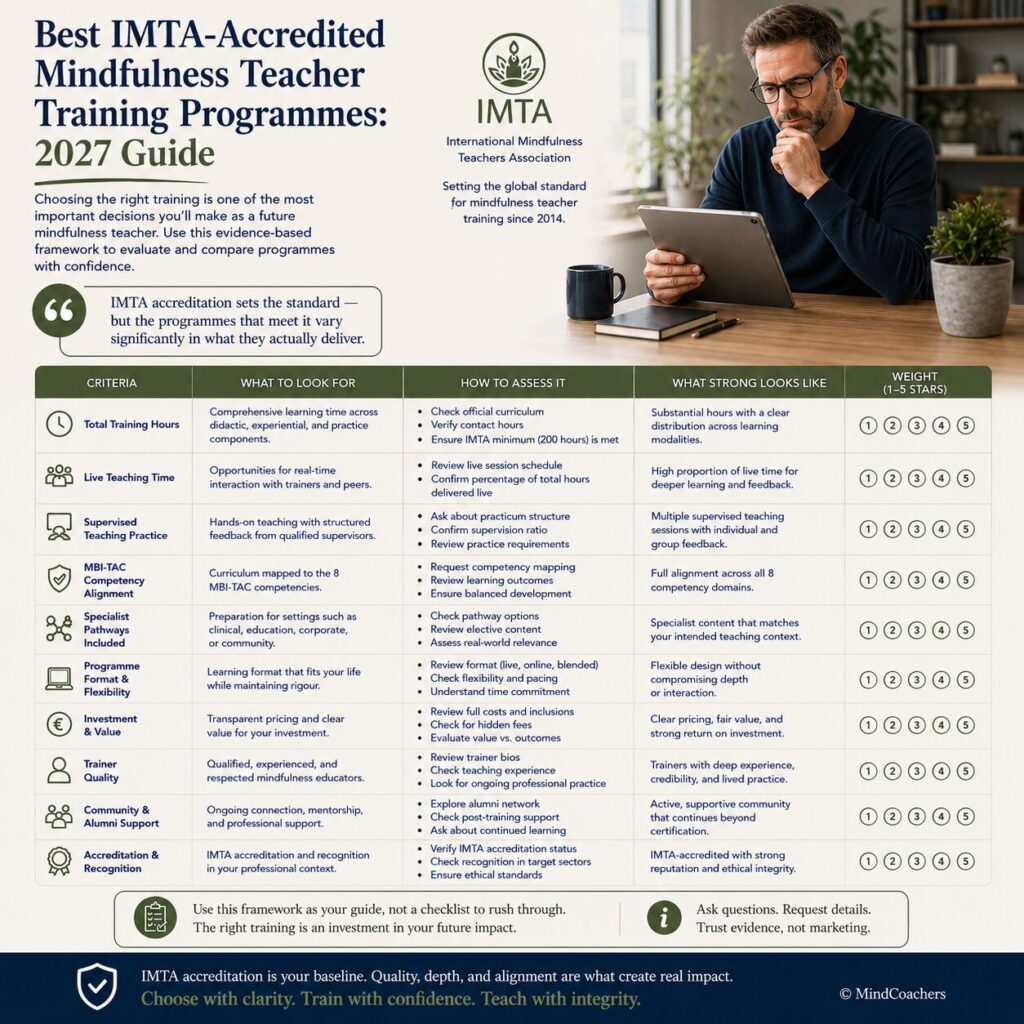
IMTA accreditation is the starting point for any serious evaluation of a mindfulness teacher training programme — not the endpoint. Once you have confirmed that a programme appears on the IMTA accredited programmes list, the more important question becomes: which IMTA-accredited programme is right for you?
The IMTA standard sets a minimum. It requires 200 hours, a concurrent practicum, supervised teaching practice, ethics content, and faculty credential review. But IMTA-accredited programmes can and do vary significantly in how they meet that standard — in format, faculty, curriculum depth, geographic focus, and the ratio of live instruction to asynchronous content.
This guide applies the seven-criteria evaluation framework from what makes a good mindfulness teacher training? to the IMTA-accredited landscape, gives you the questions to ask each programme, and explains what distinguishes programmes at the quality ceiling from those that meet the standard and nothing more. For context on why accreditation itself matters, see what is IMTA accreditation for mindfulness teachers — and does it matter?.
Key takeaways
→ IMTA accreditation confirms a programme meets a professional floor — it does not identify the best programme for your specific professional context.
→ The most important differentiators between IMTA-accredited programmes are: when teaching practice begins, faculty credentials, format (intensive vs extended), and curriculum depth beyond the IMTA minimum.
→ For clinical professionals, ACT integration and trauma-aware depth are the decisive differentiating factors.
→ For coaches and corporate practitioners, faculty credibility in those sectors and curriculum treatment of professional positioning matter most.
→ The IMTA accredited programmes list is the only authoritative source — if a programme is not on it, its accreditation claim is unverified.
How to use this guide
This guide is structured around the seven criteria for evaluating any mindfulness teacher training. Rather than ranking programmes — which would require subjective weighting — it gives you the framework to evaluate any IMTA-accredited programme against criteria that reflect your specific professional context.
Before reading further, confirm your starting point: what is your professional background, and what are you primarily trying to achieve? The right programme for a psychologist formalising clinical practice is different from the right programme for an executive coach building a new service line. For segment-specific guidance, see mindfulness teacher training for psychologists, mindfulness teacher training for executive and leadership coaches, mindfulness teacher training for yoga teachers, and mindfulness in the workplace: what qualifications do corporate facilitators need?.
Criterion 1: Verify accreditation before evaluating anything else
Before comparing any programme on any other criterion, verify its IMTA accreditation status directly at imta.org/accredited-programs. The IMTA maintains a live, searchable list. If a programme does not appear on it, its accreditation claim is unverified — regardless of what its marketing page says.
Some programmes claim to be “designed to meet IMTA standards” or “preparing students for IMTA accreditation” without having been assessed and approved. These claims are not equivalent to accreditation. Some programmes have allowed their accreditation to lapse. The list is the only authoritative source.
For a full explanation of what IMTA accreditation requires and what it signals, see what is IMTA accreditation for mindfulness teachers — and does it matter?. For the comparison with other accreditation bodies, see IMTA vs Yoga Alliance vs IMMA: mindfulness teacher accreditation compared. And for what employers and institutions actually check, see mindfulness teacher certification: which credentials actually matter to employers?.
Criterion 2: When does teaching practice begin?
This is the single most important differentiating question between IMTA-accredited programmes. IMTA requires a concurrent practicum — but programmes interpret this requirement differently. A programme where supervised teaching practice begins in week one, with structured peer feedback throughout, produces a different outcome from one where the practicum is introduced in the final third of the curriculum.
Ask each programme specifically: in which week does the first supervised teaching practice session occur? Is this peer teaching within the cohort, or external teaching with real participants? The answer tells you more about programme quality than the total hour count. For the full evidence on why early practice matters, see why teaching practice from day one makes better mindfulness teachers. For what 200 hours should actually consist of, see 200-hour mindfulness teacher training: what you actually get for the hours.
The blog post 5 questions that reveal a professional mindfulness training gives you a practical checklist to use directly when speaking to any programme.
Criterion 3: Format — intensive vs extended
IMTA-accredited programmes span formats from 12-week intensives to 18-month part-time programmes. Neither format is inherently superior — the question is which format suits your learning style, schedule, and professional timeline.
12-week intensive programmes
Deliver the full 200-hour curriculum over a concentrated period, typically with weekly live sessions and a concurrent practicum running throughout. The advantages are speed to qualification, cohort momentum, and the tight feedback loop between teaching practice and curriculum instruction. For practitioners who want to enter the professional market quickly and can commit to the weekly schedule, this is the most efficient route. For a direct comparison, see 12-week vs 12-month mindfulness teacher training: which is right for you?.
Extended part-time programmes
Spread the curriculum over 6–18 months, typically with monthly or fortnightly intensive sessions and self-study between. The advantages are schedule flexibility and more integration time between sessions. For practitioners with complex clinical or professional schedules who cannot commit to weekly sessions, this may be the more realistic format. The risk is practicum momentum — a concurrent practicum running across 12+ months requires active management to maintain continuity.
For the format question from a career timeline perspective, see how long does it take to become a certified mindfulness teacher?. For online vs in-person considerations, see online vs in-person mindfulness teacher training: what the evidence says and best online mindfulness teacher training programmes: ranked and compared.
Criterion 4: Faculty credentials
IMTA reviews faculty credentials as part of its accreditation process — which means all IMTA-accredited programmes have cleared a minimum faculty threshold. The question is what the faculty bring beyond that minimum.
For programmes targeting clinical professionals, the decisive credential question is whether the faculty have doctorate-level training in clinical psychology, third-wave CBT, or trauma-informed approaches — not just mindfulness teaching experience. A programme with a strong MBSR lineage but no clinical faculty depth will not serve a psychologist or therapist as well as one with faculty who are both credentialed mindfulness teachers and clinical specialists.
For programmes targeting coaches and corporate practitioners, the relevant faculty credential is demonstrated experience in those sectors — the ability to teach mindfulness in performance-relevant language and hold the dynamics of professional rather than clinical groups. For how to evaluate faculty specifically, see how to evaluate a mindfulness teacher training’s faculty. For the curriculum depth question, see how to read a mindfulness teacher training curriculum before you enrol.
Criterion 5: Curriculum depth beyond the IMTA minimum
IMTA sets a curriculum floor — ethics content, trauma awareness, teaching methodology, theoretical foundations. The most differentiating curriculum question is what programmes do beyond that floor.
ACT and third-wave CBT integration
Acceptance and Commitment Therapy is the most clinically relevant development in applied mindfulness over the last two decades. A curriculum that integrates ACT — not as an optional module but as a substantive theoretical thread — is providing content that clinical professionals and coaches can immediately apply in their professional contexts. For what ACT integration in a curriculum actually looks like, see how to read a mindfulness teacher training curriculum before you enrol.
Trauma-aware protocols
IMTA requires trauma awareness content — but the standard allows significant variation in depth. A programme that covers trauma awareness in a single session is structurally different from one that integrates trauma-sensitive protocols throughout the curriculum. For practitioners working with clinical or complex populations, this distinction is professionally significant. The video what most mindfulness training misses about trauma-aware practice explains what genuine trauma-aware depth looks like.
Scope of practice clarity
This is the ethical core that distinguishes programmes built for professionals from those built for general practitioners. Scope of practice — what a mindfulness teacher is and is not qualified to do — should be addressed explicitly and practically, not as a theoretical module but as a recurring thread that shapes how all other content is contextualised.
Criterion 6: Geographic focus and delivery context
IMTA-accredited programmes vary in their geographic focus. Some are built for the UK and European professional market — with curriculum content that addresses the NICE evidence base, NHS commissioning context, and European professional association frameworks. Others are built for North American markets, with curriculum assumptions that do not always translate directly to European institutional contexts.
For practitioners intending to work in European corporate or clinical contexts, the programme’s geographic orientation is a practical question: does it address the specific commissioning landscape, professional liability frameworks, and credential recognition patterns of the markets you intend to serve? For the European demand context, see demand for mindfulness teachers in Europe: 2027–2030 forecast and is mindfulness teaching a viable career in 2027?.
Criterion 7: Cohort model and peer learning
IMTA-accredited programmes range from fully self-paced online formats to live cohort programmes with fixed weekly sessions. The cohort model — where you progress alongside the same group of practitioners — produces the peer teaching dynamics that develop the relational competencies mindfulness teaching requires.
A self-paced programme can deliver curriculum content. It cannot replicate the experience of teaching the same people week after week, receiving structured feedback on your teaching from practitioners who have seen your development across the programme, and holding a group dynamic that mirrors professional teaching contexts. For the evidence on why cohort learning matters, see the video why learning to teach mindfulness alone misses the point.
Questions to ask any IMTA-accredited programme
- Is the programme on the IMTA accredited programmes list? (Check directly at imta.org — do not rely on programme self-reporting.)
- In which week does supervised teaching practice first begin?
- What is the full hour breakdown by category: live instruction, supervised teaching practice, practicum, and self-study?
- What are the faculty credentials? Do they include doctorate-level clinical specialists?
- Is the curriculum publicly available before enrolment? (If not, ask why.)
- Does the curriculum include ACT integration as a substantive thread or as an optional module?
- Is the programme cohort-based with fixed live sessions, or self-paced?
- What is the geographic focus — UK/European market or North American market?
The blog post red flags in mindfulness teacher training programmes covers the warning signs to watch for in any programme’s response to these questions. For what the cheapest options actually cost professionally, see the real cost of the cheapest mindfulness certification. For certificate mills vs genuinely accredited programmes, see certificate mills vs accredited programmes — how to tell.
The MCMI — MindCoachers Certified Mindfulness Instructor
The MCMI — MindCoachers Certified Mindfulness Instructor is a 12-week intensive cohort programme, IMTA-accredited at CMT-P level, built specifically for established professionals — coaches, psychologists, HR practitioners, yoga teachers, and wellness practitioners — who are formalising existing practice rather than starting from zero.
Against the seven criteria:
- Accreditation: IMTA CMT-P — confirmed and verifiable on the IMTA accredited programmes list.
- Teaching practice: Begins in workshop one. Peer teaching from week one; 35-hour concurrent practicum launched in session one.
- Format: 12-week intensive cohort — weekly live sessions, fixed schedule, concurrent practicum throughout.
- Faculty: Doctorate-level specialists across clinical psychology (3rd-wave CBT/MBCT), trauma-informed practice, and community/Buddhist psychology. All faculty credentials are publicly listed.
- Curriculum depth: ACT integrated as theoretical thread across all twelve modules. Trauma-aware protocols as a substantive curriculum element, not a single session. Scope of practice addressed from week one.
- Geographic focus: UK and European professional market — curriculum addresses NHS commissioning context, European professional association frameworks, and the specific credential recognition landscape of the markets the programme serves.
- Cohort model: Fixed weekly cohort — same group of practitioners across all twelve weeks, with structured peer feedback on teaching throughout.
The full curriculum is publicly available before enrolment at mindcoachers.com/en/mtt-mindfulness-teacher-training-curriculum/.
Download the MCMI — MindCoachers Certified Mindfulness Instructor — prospectus: full curriculum, faculty profiles, pricing and cohort information.
Further reading and professional resources
↗ What makes a good mindfulness teacher training? 7 criteria
↗ What is IMTA accreditation for mindfulness teachers — and does it matter?
↗ IMTA vs Yoga Alliance vs IMMA: mindfulness teacher accreditation compared
↗ 12-week vs 12-month mindfulness teacher training: which is right for you?
↗ 200-hour mindfulness teacher training: what you actually get for the hours
↗ How to read a mindfulness teacher training curriculum before you enrol
↗ 5 questions that reveal a professional mindfulness training
↗ Red flags in mindfulness teacher training programmes
Next steps
The MCMI — MindCoachers Certified Mindfulness Instructor is IMTA-accredited at CMT-P level, publicly listed on the IMTA accredited programmes list, and built for the professional contexts where mindfulness teaching generates sustainable, credentialed income. The full curriculum, faculty profiles, and programme structure are available before enrolment — no sales conversation required.
Frequently asked questions
About mindfulness teacher training for psychologists and the MCMI — MindCoachers Certified Mindfulness Instructor