
What Is IMTA Accreditation for Mindfulness Teachers — And Does It Matter?
A factual account of what IMTA accreditation requires, what the CMT-P credential signals, and whether the standard actually matters in the professional market.
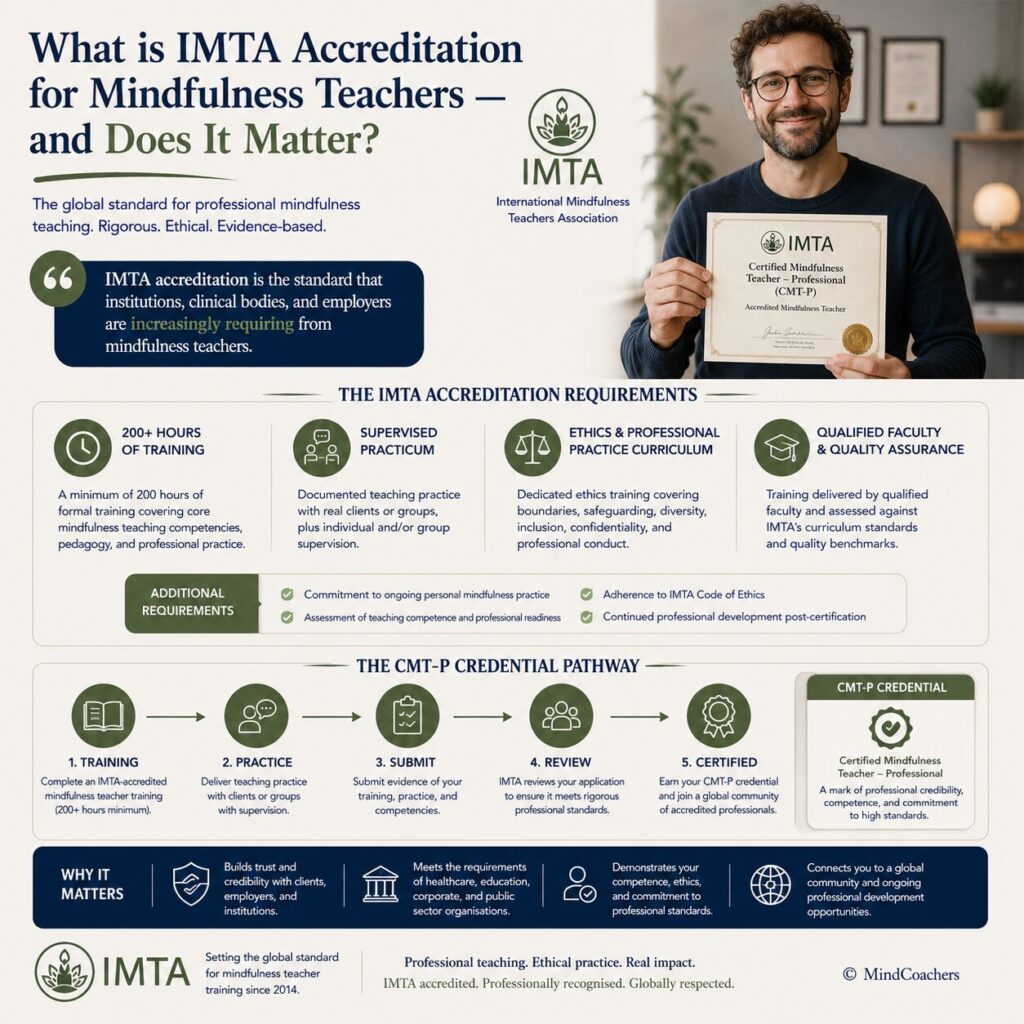
IMTA — the International Mindfulness Teachers Association — is the accreditation body that has produced the most rigorous professional standard for mindfulness teaching currently available. Its CMT-P (Certified Mindfulness Teacher – Professional) credential is increasingly referenced by corporate employers, NHS commissioners, and professional associations when specifying the qualifications they require from mindfulness facilitators.
But IMTA accreditation is also frequently misrepresented — by programmes that claim it without appearing on the IMTA accredited programmes list, by practitioners who present the programme completion certificate as equivalent to the CMT-P credential, and by marketing that implies IMTA recognition confers a guaranteed professional outcome rather than confirming a minimum professional standard.
This article gives a precise, factual account of what IMTA accreditation actually requires, what the CMT-P credential does and does not signal, and whether it matters in the professional contexts where mindfulness teachers actually work. For the full programme evaluation framework that accreditation sits within, see what makes a good mindfulness teacher training? 7 criteria. For the comparison with other accreditation bodies, see IMTA vs Yoga Alliance vs IMMA: mindfulness teacher accreditation compared.
Key takeaways
→ IMTA accreditation requires a minimum of 200 hours including a concurrent practicum, supervised teaching practice, ethics content, and faculty credential review — independently assessed by IMTA.
→ The CMT-P credential is not automatic on programme completion — it requires a separate post-graduation application to IMTA with evidence of teaching practice hours and personal practice.
→ IMTA accreditation and the CMT-P credential are distinct — the programme completion certificate and the independently awarded CMT-P must always be presented separately.
→ IMTA is the standard that NHS commissioners, corporate L&D departments, and EAP providers are beginning to specify — not Yoga Alliance or lighter accreditation frameworks.
→ The IMTA accredited programmes list at imta.org is the only authoritative source — any programme not on it has unverified accreditation claims.
What IMTA is and where it comes from
The International Mindfulness Teachers Association was established to address a specific gap in the mindfulness teaching landscape: the absence of a rigorous, independently assessed professional standard that could serve as the credential benchmark for mindfulness teachers working in institutional contexts. Prior to IMTA, the mindfulness teaching field had no equivalent of the ICF (coaching), BACP (counselling), or BPS (psychology) — no body that set curriculum requirements, assessed programmes independently, and awarded a credential that employers and commissioners could recognise.
IMTA fills this gap. Its CMT-P standard is the most comprehensive mindfulness teacher training standard currently available in terms of hour requirements, concurrent practicum mandate, faculty credential review, and post-graduation independent credential assessment. For context on why this matters now, see demand for mindfulness teachers in Europe: 2027–2030 forecast and the video why schools, hospitals and corporations increasingly require IMTA accreditation.
What IMTA accreditation actually requires
For a programme to appear on the IMTA accredited programmes list, it must meet the following requirements:
1. 200-hour minimum
A minimum of 200 hours across all categories: live instruction, supervised teaching practice, concurrent practicum, personal mindfulness practice, and self-study. The 200-hour minimum is a floor — programmes can and do exceed it. What matters is the composition of those hours, not just the total. For a full breakdown of what the hour categories mean, see how many teaching practice hours does a mindfulness training actually need? and 200-hour mindfulness teacher training: what you actually get for the hours.
2. Concurrent practicum
IMTA requires a concurrent practicum — a period of supervised real-world teaching that runs alongside the taught curriculum, not after it. This is one of the most structurally significant requirements in the standard, because it forces programmes to begin teaching practice early rather than deferring it to the end. For the full case on why concurrent timing matters, see why teaching practice from day one makes better mindfulness teachers.
3. Supervised teaching practice
Distinct from the external practicum, IMTA requires supervised teaching practice within the programme itself — hours specifically dedicated to guiding mindfulness practices under qualified supervision, with structured feedback. This is the in-programme equivalent of the external practicum, and it creates the tight feedback loop between instruction and practice that deliberate practice research identifies as the primary driver of competence development.
4. Ethics and scope of practice content
IMTA requires substantive ethics content — not a token module, but sufficient coverage to address the professional liability, scope-of-practice, and participant safeguarding questions that arise in mindfulness teaching contexts. For the regulatory context that makes ethics content essential, see is mindfulness teacher training regulated? What professionals need to know.
5. Trauma awareness content
IMTA requires evidence-based trauma awareness content as part of the curriculum. The standard does not specify a particular trauma framework, but it requires that programmes address what happens when mindfulness practice surfaces trauma responses — and what a teacher’s professional responsibility is in those situations.
6. Faculty credential review
IMTA reviews the qualifications of programme faculty as part of the accreditation process. This is one of the most significant differentiators between IMTA and lighter accreditation bodies — IMTA does not simply accept a programme’s self-reported faculty credentials. It independently assesses whether the faculty have the training and experience to deliver the curriculum at the standard the programme claims. For how to evaluate faculty credentials yourself, see how to read a mindfulness teacher training curriculum before you enrol.
What IMTA accreditation does not guarantee
IMTA accreditation confirms that a programme meets a professional baseline. It does not guarantee:
- That the programme is the best available. Two programmes can both be IMTA-accredited while delivering very different quality of live instruction, peer feedback, and curriculum depth. See best IMTA-accredited mindfulness teacher training programmes: 2027 guide for how to differentiate between accredited programmes.
- That teaching practice begins early. IMTA requires a concurrent practicum, but programmes interpret this requirement differently. An accredited programme where the practicum begins in week ten is structurally different from one where it begins in week one.
- That the curriculum is publicly available. IMTA reviews curriculum content as part of accreditation, but does not require programmes to publish their full curriculum before enrolment. Programmes that gate curriculum behind enrolment are within the standard.
- That the CMT-P credential is automatic. This is the most commonly misunderstood aspect of IMTA accreditation. Completing an IMTA-accredited programme qualifies you to apply for the CMT-P — it does not award it automatically.
The CMT-P credential: what it is and how to obtain it
The CMT-P (Certified Mindfulness Teacher – Professional) is the IMTA credential awarded to individual practitioners who have completed an IMTA-accredited programme and met the post-graduation application requirements. It is distinct from the programme completion certificate — which is issued by the training provider — and is awarded independently by IMTA.
The CMT-P application requires:
- Completion of an IMTA-accredited programme (verified by the programme provider)
- Documented teaching practice hours — practicum log with session records
- Documented personal mindfulness practice — practice log across the programme period
- Two professional references from qualified supervisors or programme faculty
- A separate application fee of approximately €150–250 paid directly to IMTA
IMTA processes applications within approximately 4–8 weeks. The CMT-P is then held by the individual practitioner and is not linked to any specific programme or employer. For the full application pathway, see CMT-P certification explained: how to become an IMTA-certified mindfulness teacher.
Does IMTA accreditation actually matter in the professional market?
Yes — and the evidence for this is the direction of travel in institutional procurement, not marketing claims. The following patterns are observable in the European professional mindfulness teaching market as of 2027:
- NHS and clinical commissioning: NHS trusts and IAPT services commissioning mindfulness facilitation are increasingly specifying IMTA CMT-P or equivalent. Clinical context requires the highest credential threshold, and IMTA is the standard most consistent with the NICE evidence base for MBCT.
- Corporate L&D procurement: Corporate L&D departments and HR functions applying credential checks before commissioning mindfulness facilitators are increasingly recognising IMTA CMT-P as the benchmark standard. For the corporate context specifically, see mindfulness in the workplace: what qualifications do corporate facilitators need?.
- EAP provider panels: Employee Assistance Programme providers in the UK and Europe are beginning to specify IMTA accreditation as a condition of panel membership. The credential provides the liability evidence that EAP providers require when commissioning external facilitators.
- Professional coaching context: ICF-credentialed coaches and professional coaching associations are increasingly treating IMTA CMT-P as the benchmark for mindfulness teaching within coaching practice. For coaches specifically, see mindfulness teacher training for executive and leadership coaches.
The broader market context is professionalisation: the mindfulness teaching field is following the same trajectory as coaching and counselling, where voluntary professional standards become de facto requirements over a 5–10 year period. Practitioners who achieve IMTA CMT-P now are entering the market ahead of the threshold becoming universal. For the full professionalisation context, see is mindfulness teaching a viable career in 2027?. The video why the IMTA mindfulness teaching credential compounds in value over time explains the early-mover dynamic in detail.
How to verify IMTA accreditation
The only authoritative source for IMTA accreditation status is the IMTA accredited programmes list at imta.org. This list is maintained and updated by IMTA. If a programme claims IMTA accreditation but does not appear on this list, the claim is unverified.
Specific situations to watch for:
- Lapsed accreditation: Some programmes have held IMTA accreditation in the past but have allowed it to lapse. Historical accreditation does not mean current accreditation.
- Pending accreditation: Some programmes describe themselves as “applying for” or “working toward” IMTA accreditation. These claims indicate a programme has not yet been accredited — they are not equivalent to confirmed accreditation.
- Designed to meet IMTA standards: Some programmes claim their curriculum meets IMTA standards without having been submitted for assessment. An unassessed programme is not an accredited programme.
For how to evaluate a programme’s claims more broadly, see the blog post IMTA vs other mindfulness accreditations — what matters and the video what the IMTA accreditation means for mindfulness teacher training.
Download the MCMI — MindCoachers Certified Mindfulness Instructor — prospectus: full curriculum, faculty profiles, pricing and cohort information.
Further reading and professional resources
↗ IMTA vs Yoga Alliance vs IMMA: mindfulness teacher accreditation compared
↗ CMT-P certification explained: how to become an IMTA-certified mindfulness teacher
↗ Mindfulness teacher certification: which credentials actually matter to employers?
↗ Best IMTA-accredited mindfulness teacher training programmes: 2027 guide
↗ What makes a good mindfulness teacher training? 7 criteria
↗ Is mindfulness teaching a viable career in 2027?
↗ IMTA accredited programmes list
Next steps
The MCMI — MindCoachers Certified Mindfulness Instructor is IMTA-accredited at CMT-P level. Accreditation is confirmed and verifiable on the IMTA accredited programmes list. The programme completion certificate is issued automatically on completion. The IMTA CMT-P credential requires a separate post-graduation application to IMTA — the fee (approximately €150–250) is paid directly to IMTA and is not included in MCMI tuition. Both credentials are presented separately and accurately in all MCMI materials.
Frequently asked questions
About mindfulness teacher training for psychologists and the MCMI — MindCoachers Certified Mindfulness Instructor