
Mindfulness in the Workplace: What Qualifications Do Corporate Facilitators Need?
What HR departments, L&D teams and EAP providers actually require — and what practitioners need in place before approaching the corporate mindfulness market.
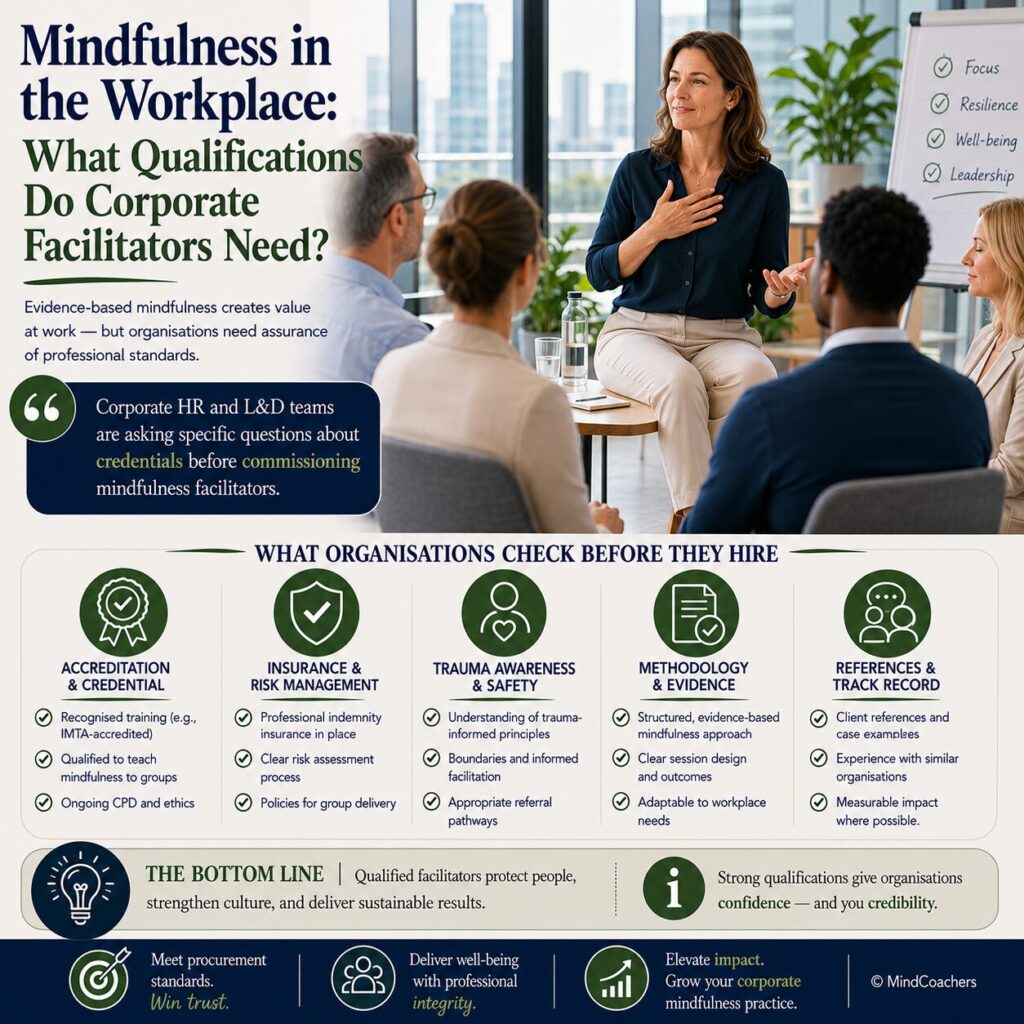
Corporate mindfulness facilitation is the fastest-growing and highest-paying segment of the professional mindfulness teaching market. It is also the segment with the most structured qualification requirements — requirements that have tightened significantly since 2020 as organisations have moved from ad hoc mindfulness initiatives to structured wellbeing programmes with measurable outcomes and formal procurement processes.
Most practitioners who want to enter the corporate mindfulness market underestimate what is required to get through the door. The qualification question is not just about the IMTA CMT-P credential — though that is increasingly the baseline. It is about a combination of credential, insurance, sector experience, and the ability to speak in language that resonates with L&D and HR decision-makers. Practitioners who have only the credential but lack the other elements typically fail at the procurement stage regardless of their teaching quality.
This article gives a precise account of what the corporate mindfulness facilitation market requires from practitioners who want to access it, broken down by procurement context. For the broader career context, see is mindfulness teaching a viable career in 2027?. For income benchmarks by context, see mindfulness teacher salary guide: realistic income ranges for Europe.
Key takeaways
→ Corporate mindfulness facilitation requires a combination of four elements: IMTA CMT-P credential, professional liability insurance, demonstrable sector experience, and corporate-register communication skills.
→ IMTA CMT-P is the credential increasingly specified in formal corporate procurement — Yoga Alliance and lighter accreditation frameworks do not satisfy this requirement.
→ EAP provider panels are the most systematised route to regular corporate mindfulness work — and they have the most explicit qualification requirements.
→ HR and L&D decision-makers respond to business-language framing of mindfulness benefits — not wellness or contemplative language.
→ Outcome measurement is becoming a procurement requirement for ongoing contracts — practitioners who cannot demonstrate measurable results are not renewed.
The corporate mindfulness procurement landscape
Corporate mindfulness facilitation is commissioned through several distinct channels, each with different qualification requirements:
Direct L&D procurement
Large organisations with active L&D functions commission mindfulness facilitation directly — typically through a request for proposal (RFP) process or via an approved supplier list. The qualification threshold for direct L&D procurement in large organisations (500+ employees) in the UK and Northern Europe is increasingly: IMTA CMT-P or equivalent, professional liability insurance, a portfolio of similar organisational work, and measurable outcomes evidence from previous engagements.
Smaller organisations (under 200 employees) typically apply less rigorous procurement processes and may commission based on referral and a credible professional profile without formal RFP. The qualification threshold is lower, but the rates are also lower. The video why schools, hospitals and corporations increasingly require IMTA accreditation gives the procurement perspective directly.
EAP provider panels
Employee Assistance Programme (EAP) providers — organisations like Bupa, Vitality, Cigna, and Optum that manage employee wellbeing services for corporate clients — operate approved practitioner panels. Practitioners who join an EAP panel receive referrals from the EAP’s corporate clients without having to market directly to those clients. EAP panels are the most systematised route to regular corporate mindfulness work, and they have the most explicit and standardised qualification requirements.
EAP panel membership typically requires: IMTA CMT-P or equivalent credential, current professional liability insurance (minimum £1–2M coverage), DBS clearance (UK), and a structured application process including a professional statement and references. The blog post why HR professionals need a mindfulness teaching credential gives the HR perspective on these requirements.
Corporate wellness brokers and intermediaries
A growing category of corporate wellness intermediaries — platforms and brokers that connect organisations with wellbeing practitioners — operate between the EAP model and direct procurement. Examples include Unmind, Headspace for Work partnerships, and corporate wellness management platforms. These intermediaries typically have their own qualification requirements, which vary but generally converge on IMTA CMT-P or equivalent.
HR and wellbeing consultancy referrals
Many corporate mindfulness facilitation engagements are generated through referral from HR consultancies, wellbeing strategy firms, and occupational health providers. These referral sources apply their own informal qualification checks — typically credential verification and a professional conversation — before referring to their corporate clients. Building relationships with HR consultancies and OHPs is one of the most effective routes to corporate mindfulness work for practitioners without an established direct corporate network.
The four qualification requirements in detail
1. IMTA CMT-P credential
IMTA CMT-P is the credential that most corporate procurement processes now reference when specifying mindfulness facilitator qualifications. It satisfies two procurement needs simultaneously: it demonstrates that the practitioner has met a formal professional standard (independently assessed by a recognised body), and it provides a verifiable credential that procurement managers can check directly on the IMTA accredited programmes list.
Yoga Alliance credentials, short online certificates, and provider-issued completion certificates from non-IMTA-accredited programmes do not satisfy the IMTA CMT-P requirement in formal procurement processes. For the full credential comparison, see IMTA vs Yoga Alliance vs IMMA: mindfulness teacher accreditation compared. For what employers check specifically, see which credentials actually matter to employers?.
2. Professional liability insurance
Professional liability (PI) insurance is a standard condition of corporate mindfulness facilitation commissioning. Most corporate clients require a minimum of £1–2M PI coverage for individual practitioners; EAP panels typically require £2–5M. The insurance must specifically cover mindfulness teaching as a professional activity — general business insurance or coaching PI that does not list mindfulness teaching is typically not accepted.
Practitioners should obtain mindfulness teaching PI before beginning any corporate facilitation work, including practicum sessions with corporate participants. Premium rates for mindfulness teaching PI in the UK and Europe are typically £150–400 per year for basic coverage, with IMTA CMT-P credential evidence typically required by insurers before issuance. For the regulatory and liability context, see is mindfulness teacher training regulated? What professionals need to know.
3. Demonstrable sector experience
Credential and insurance get a practitioner into a procurement process. Demonstrable sector experience — documented previous work with comparable organisational clients — is what closes it. Corporate L&D procurement managers and EAP panel administrators typically require: a portfolio of previous organisational clients (anonymised if necessary), participant feedback data from previous mindfulness programmes, and ideally measurable outcomes evidence (wellbeing metric changes, attendance data, or qualitative impact reports).
For practitioners entering the corporate market without existing sector experience, the practicum period of IMTA-accredited training is the most strategically important phase: using corporate pilot sessions, team tasters, or L&D introductory workshops as practicum material produces both the teaching hours required for IMTA CMT-P and the experience portfolio required for corporate procurement. The blog post why mindfulness programmes fail in organisations — and how to prevent it is useful for understanding what corporate clients want from a practitioner beyond the credential.
4. Corporate-register communication skills
The qualification that practitioners most consistently underestimate is the ability to frame mindfulness in language that resonates with L&D and HR decision-makers. Corporate clients are not buying mindfulness; they are buying measurable outcomes — reduced absenteeism, improved concentration, better stress management scores, higher retention. A practitioner who presents mindfulness using wellness or contemplative language in a corporate procurement conversation is typically screened out at the first meeting, regardless of credential status.
The communication skills required are learnable and specific: translating mindfulness benefits into business outcomes language, designing programmes with measurable impact metrics, and holding the commercial conversation about ROI with confidence. The blog posts corporate mindfulness language — how to open budgets and what HR directors find after AI rollouts — a wellbeing gap give the practical framing for these conversations.
What corporate clients are actually buying
Understanding what corporate clients are commissioning helps practitioners position their offering effectively. The corporate mindfulness facilitation market has two primary procurement drivers in 2027:
Burnout and stress management post-AI transition
The most significant emerging driver of corporate mindfulness demand is the organisational disruption caused by AI adoption. AI rollouts are creating new forms of workplace stress — cognitive overload from human-AI collaboration, anxiety about role displacement, and the attentional fragmentation that comes from working alongside AI tools. HR directors who have managed AI transitions report that mindfulness-based stress management interventions are among the most effective responses to post-AI wellbeing gaps. For this context, see what HR directors find after AI rollouts — a wellbeing gap.
Leadership performance and presence
Senior leaders and high-potential talent programmes are the highest-value corporate mindfulness facilitation context. Organisations investing in leadership development increasingly include mindfulness as a component of presence, emotional regulation, and decision-making under pressure. This is the context where executive coaches with IMTA CMT-P are best positioned — their coaching credibility opens the leadership development market that pure mindfulness facilitators find harder to access. For coaches specifically, see mindfulness teacher training for executive and leadership coaches.
Outcome measurement: the emerging requirement
The corporate mindfulness facilitation market is increasingly requiring practitioners to demonstrate measurable programme outcomes as a condition of contract renewal. Practitioners who deliver a programme but cannot evidence its impact are not recommissioned. The measurement frameworks that corporate clients use include:
- Wellbeing survey scores: Pre/post programme wellbeing assessments using validated instruments (Warwick-Edinburgh, PHQ-4, or organisational internal instruments).
- Attendance and engagement metrics: Session attendance rates, drop-out rates, and programme completion data.
- Manager and participant feedback: Structured feedback at session and programme level, with standardised questions that allow comparison across cohorts.
- Absenteeism and presenteeism indicators: For longer-term programmes, some corporate clients track HR-level metrics alongside the mindfulness programme.
Building outcome measurement into programme design from the outset is increasingly a differentiator in corporate mindfulness facilitation. For the practical measurement question, see how to measure whether your mindfulness programme works.
Download the MCMI — MindCoachers Certified Mindfulness Instructor — prospectus: full curriculum, faculty profiles, pricing and cohort information.
Further reading and professional resources
↗ Mindfulness teacher training for executive and leadership coaches
↗ Adding mindfulness certification to your coaching practice: a practical guide
↗ Mindfulness teacher certification: which credentials actually matter to employers?
↗ Is mindfulness teacher training regulated? What professionals need to know
↗ Is mindfulness teaching a viable career in 2027?
↗ Demand for mindfulness teachers in Europe: 2027–2030 forecast
Next steps
The MCMI — MindCoachers Certified Mindfulness Instructor is the pathway to the IMTA CMT-P credential that corporate procurement processes are increasingly specifying. The curriculum addresses corporate mindfulness facilitation specifically — including language for organisational contexts, programme design for workplace settings, and outcome measurement frameworks. IMTA accreditation is confirmed at CMT-P level. The cohort format includes practitioners from coaching, HR, and clinical backgrounds who form the professional network that corporate referrals flow through.
Frequently asked questions
About mindfulness teacher training for psychologists and the MCMI — MindCoachers Certified Mindfulness Instructor