
Mindfulness in Therapy Sessions: A Step-by-Step Clinical Guide
What to say, how to guide, and what to do when it goes wrong — a step-by-step resource for clinicians who want to move beyond informal mindfulness use.
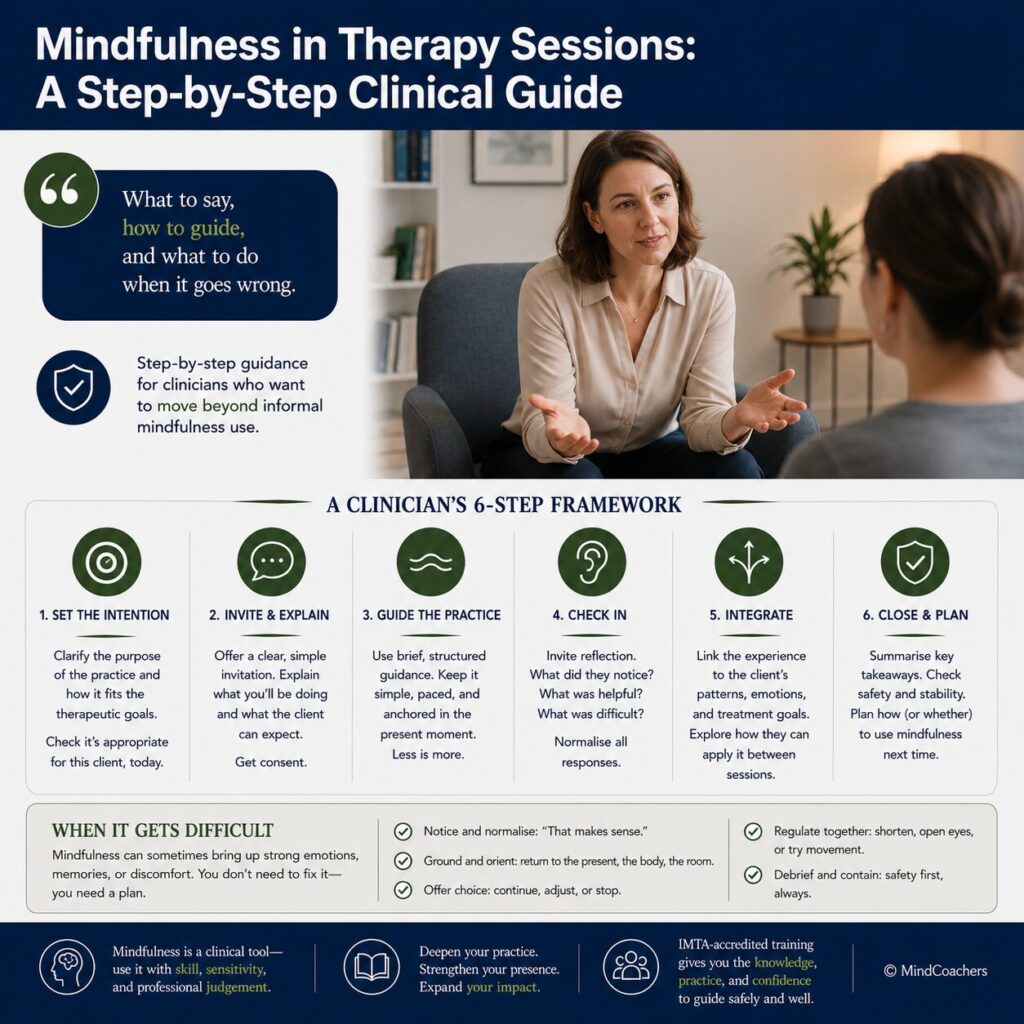
Most therapists who integrate mindfulness into their work do so informally — introducing a brief body scan here, guiding a breath awareness exercise there, referencing present-moment attention in psychoeducation. It works, to a point. But at some stage, informal integration reaches its limits: the client who dissociates during a body scan, the practice that falls flat because the framing was too clinical, the group context where something goes wrong and the therapist is not sure what to do next.
This guide is for clinicians who want to move beyond the informal stage — to integrate mindfulness in therapy sessions with more precision, more confidence, and a clearer sense of when formal teacher training becomes the necessary next step. It covers assessment, framing, practice selection, in-session versus homework decisions, and the specific clinical risks that therapists integrating mindfulness need to manage.
For therapists who have already concluded that informal integration is not enough and are ready to evaluate formal training options, the comparison of mindfulness teacher training programmes for psychologists and the guide on whether therapists can teach mindfulness without extra training are the relevant next reads.
Key takeaways
→ Mindfulness integration in therapy sessions requires pre-assessment of trauma history, dissociation risk, and current activation level before introducing any practice.
→ Invitational language — not instructional language — is the essential differentiator between effective and counterproductive mindfulness guidance in clinical contexts.
→ In-session practice is most valuable when the client is activated; homework practice is most valuable for building generalised personal practice. These are different clinical tools.
→ Dissociation, resistance, and emotional activation during practice are manageable clinical events — but they require a specific response protocol that informal training does not develop.
→ The inflection point where therapeutic mindfulness integration requires a separate teaching qualification is when the context shifts from a therapeutic relationship to a formal teaching context.
The difference between mindfulness-informed and mindfulness-competent therapy
There is a meaningful clinical distinction between being mindfulness-informed and being mindfulness-competent. Mindfulness-informed therapy means the therapist understands what mindfulness is, uses mindfulness-based language in psychoeducation, and may introduce brief practices drawn from personal experience or protocol training. Mindfulness-competent therapy means the therapist can guide a full practice, manage what arises during it, adapt the approach in real time, and hold the therapeutic relationship steady throughout.
The distinction matters because the risks are different. Brief informal mindfulness integration in a well-established therapeutic relationship, with a client who has no significant trauma history, is low-risk. Guided body scan practice with a trauma client, or breath-focused practice with a client presenting with panic disorder, carries specific risks that require specific competency. The body scan is the most powerful and most risky mindfulness practice — and the risk management protocol is specific and learnable, but not intuitive.
This guide addresses the competency gaps that therapists most commonly encounter. It is not a substitute for formal mindfulness teacher training — it is a clinical resource for practitioners who are actively working at the boundary of informal and formal integration, and who want to do so more safely and effectively. For the full competency framework, mindfulness teacher training for psychologists sets out what formal training develops that clinical experience does not.
Before you guide a mindfulness practice: what to assess
No mindfulness practice should be introduced in a therapy session without a brief pre-assessment. This does not need to be lengthy or explicit — but the therapist should have clear answers to the following before beginning:
- Trauma history — is there a known trauma history that makes body-focused or breath-focused practices contraindicated? If yes, ground-based anchoring practices (feet on floor, hands in lap, eyes open) are the safer starting point.
- Current activation level — is the client sufficiently regulated to engage with a practice, or is the session currently in a high-activation state? A client in acute distress will not benefit from a body scan — grounding is the appropriate intervention first.
- Previous experience of mindfulness — has the client tried mindfulness before, and if so, what was the outcome? Negative prior experience needs to be acknowledged before introducing a new practice, or the client will approach it with pre-existing resistance.
- Medication and altered states — some medications affect interoceptive awareness in ways that make body-focused practices disorienting. Checking current medication context is relevant for practices that involve sustained body attention.
- Therapeutic relationship stage — mindfulness practices should not be introduced in early-stage therapeutic relationships before sufficient trust and safety are established. The therapeutic alliance is the container for the practice; without it, the practice is unmoored.
This pre-assessment takes 30–60 seconds of clinical attention. It is not a formal screening instrument — it is the clinical awareness that a competent therapist brings to any intervention decision.
Framing mindfulness to a client who has never tried it
How mindfulness is framed in the first introduction significantly affects whether the client will engage with it. The most common failure mode is over-clinicalising the introduction — presenting mindfulness as a technique with an evidence base and an instruction set, which creates performance anxiety and positions the client as a passive recipient of an intervention.
A more effective framing acknowledges what the client is already doing, invites curiosity rather than compliance, and keeps the first practice short and observable:
- Acknowledge existing capacity: “You already have moments of being fully present — this is just a structured way to explore what that’s like.”
- Invite rather than instruct: “Would you be willing to try something for a few minutes? There’s no right way to do it — anything you notice is useful information.”
- Normalise difficulty: “If your mind wanders — and it will — that’s not a problem. Noticing that it wandered is the practice.”
- Start short: three minutes is enough for a first in-session practice. The goal is a direct experience, not a complete mindfulness programme.
After the practice, debrief with open inquiry: “What did you notice?” — not “How was that?” or “Did you find it helpful?” Evaluative questions close down reporting; inquiry questions open it up. What to do when someone cries in your mindfulness session addresses the most common difficult moment in this early phase.
Which mindfulness practices to use in therapy sessions — and in what order
Practice selection should follow a progression from least body-intrusive to most. For clients with no known trauma history and good therapeutic alliance, this progression can move quickly. For clients with complex presentations, it should be deliberate and slow.
- Start with grounding practices: feet on floor, hands in lap, eyes open or softly focused. These establish physical orientation without requiring internal attention, and are safe starting points for almost all presentations.
- Move to sound awareness: noticing sounds in the environment without labelling or story. Sound is an external anchor, less activating than body-based attention, and accessible to most clients including those with dissociative histories.
- Introduce breath awareness carefully: breath-focused practice is the most commonly used and the most commonly contraindicated for trauma clients. If introducing breath practice, begin with a brief practice (2–3 minutes) with eyes open and explicit permission to shift attention if the breath becomes uncomfortable.
- Reserve body scan for later stages: the body scan is the highest-risk standard mindfulness practice in clinical contexts. Reserve it for clients with established mindfulness experience, strong therapeutic alliance, and no active trauma presentation. The specific risks and adaptations of the body scan require specific clinical knowledge.
In-session vs homework: how to decide which mindfulness approach serves the client
In-session mindfulness practice and homework mindfulness practice serve different clinical functions and should be selected accordingly. Conflating the two — assigning homework before in-session practice is established, or relying only on in-session practice when maintenance is the goal — reduces the clinical value of both.
Use in-session practice when:
- The client is activated and needs a real-time regulation experience they can observe and discuss immediately
- The client has high experiential avoidance and needs supported contact with internal experience in a safe relational context
- The practice is new and the client needs guided introduction before they can do it independently
Use homework practice when:
- The client has an established in-session practice and is ready to build a generalised personal practice
- The therapeutic goal is building a maintenance practice post-protocol (e.g. after completing MBCT)
- The client has sufficient self-regulation capacity to manage what arises in solo practice
The transition from in-session to homework should be explicit and supported — not assumed. Providing a short guided audio recording (3–5 minutes) as a homework anchor significantly improves adherence and reduces the risk of unsupported activation in solo practice.
When things go wrong: dissociation, resistance, and distress in mindfulness practice
Knowing what to do when a practice goes wrong is the clinical competency that separates mindfulness-informed from mindfulness-competent practice. Three scenarios require specific responses:
Dissociation during practice
End the practice immediately but calmly — not with alarm, which will escalate the response. Ground the client: “Open your eyes, feel your feet on the floor, look around the room and name five things you can see.” Allow full re-orientation before any processing. Do not attempt to process the dissociation immediately — the priority is re-grounding. In subsequent sessions, reassess whether mindfulness practices are appropriate at this stage, and if so, begin only with eyes-open grounding practices rather than internal attention practices. Trauma-aware practice protocols cover the full clinical risk management framework.
Resistance and scepticism
Resistance is information, not an obstacle. A client who says “I can’t do mindfulness” or “my mind is too busy” is reporting an accurate experience of what happens when they try — not a fixed inability. Validate the experience: “That’s exactly what most people notice at first — the mind being busy is what we’re working with, not something to fix.” Reduce the expectation: shorter practices, more explicit permission to opt out, and more frequent debriefing reduce resistance significantly. Do not push through resistance — it will entrench it.
Emotional activation and distress during practice
Emotional activation during mindfulness practice is not a failure — it is often the point at which the practice is doing useful clinical work. The clinical skill is titrating the activation: enough contact with difficult experience to be therapeutically useful, not so much that it overwhelms the client’s regulatory capacity. What to do when someone cries in your mindfulness session provides the specific response protocol for emotional activation during practice.
The line between therapeutic mindfulness integration and formal mindfulness teaching
There is a clear inflection point at which integrating mindfulness into therapeutic work becomes something different — something that requires a formal teaching qualification. That point is when the context changes from a therapeutic relationship to a formal teaching context.
Within a therapeutic relationship, mindfulness techniques are within clinical scope of practice. A psychologist can guide a breath awareness practice with a therapy client, introduce MBCT components within a CBT framework, or use mindfulness-based psychoeducation as part of an anxiety treatment plan. This is mindfulness-integrated clinical practice — it does not require a separate mindfulness teaching credential.
The qualification requirement changes when:
- The therapist leads a structured mindfulness programme (8-week or equivalent) for participants who are not their therapy clients
- The therapist delivers mindfulness as a standalone service — a workplace wellbeing programme, a community mindfulness course, a corporate group intervention
- The therapist facilitates a mindfulness group where participants have enrolled specifically for mindfulness teaching, not for therapy
In these contexts, why every mindfulness teacher needs a defined scope of practice explains exactly why clinical training is not sufficient — and what formal IMTA CMT-P level training adds. For therapists ready to make this transition, the MCMI — MindCoachers Certified Mindfulness Instructor is built for practitioners at exactly this professional stage.
Download the MCMI — MindCoachers Certified Mindfulness Instructor — prospectus: full curriculum, faculty profiles, pricing and cohort information.
Further reading and professional resources
Best Mindfulness Teacher Training for Psychologists and Therapists: 2027 Comparison
Mindfulness Teacher Training for Psychologists (2027)
Can Therapists Teach Mindfulness Without Extra Training? A Clinical Perspective
The Body Scan — Most Powerful and Most Risky Practice
What to Do When Someone Cries in Your Mindfulness Session
Why Every Mindfulness Teacher Needs a Defined Scope of Practice
What Most Mindfulness Training Misses About Trauma-Aware Practice
Next steps
If this guide has surfaced the limits of informal mindfulness integration in your clinical practice, the logical next step is formal training at IMTA CMT-P professional level. The MCMI — MindCoachers Certified Mindfulness Instructor is designed for psychologists and therapists who already use mindfulness in their work and are ready to formalise that competency to professional teaching standard.
Frequently asked questions
About mindfulness teacher training for psychologists and the MCMI — MindCoachers Certified Mindfulness Instructor