
Workplace Mindfulness: The Evidence HR Actually Needs to Get It Approved
The research your CEO will find credible, the ROI calculation your CFO will not challenge, and the framing that gets mindfulness onto the L&D budget.
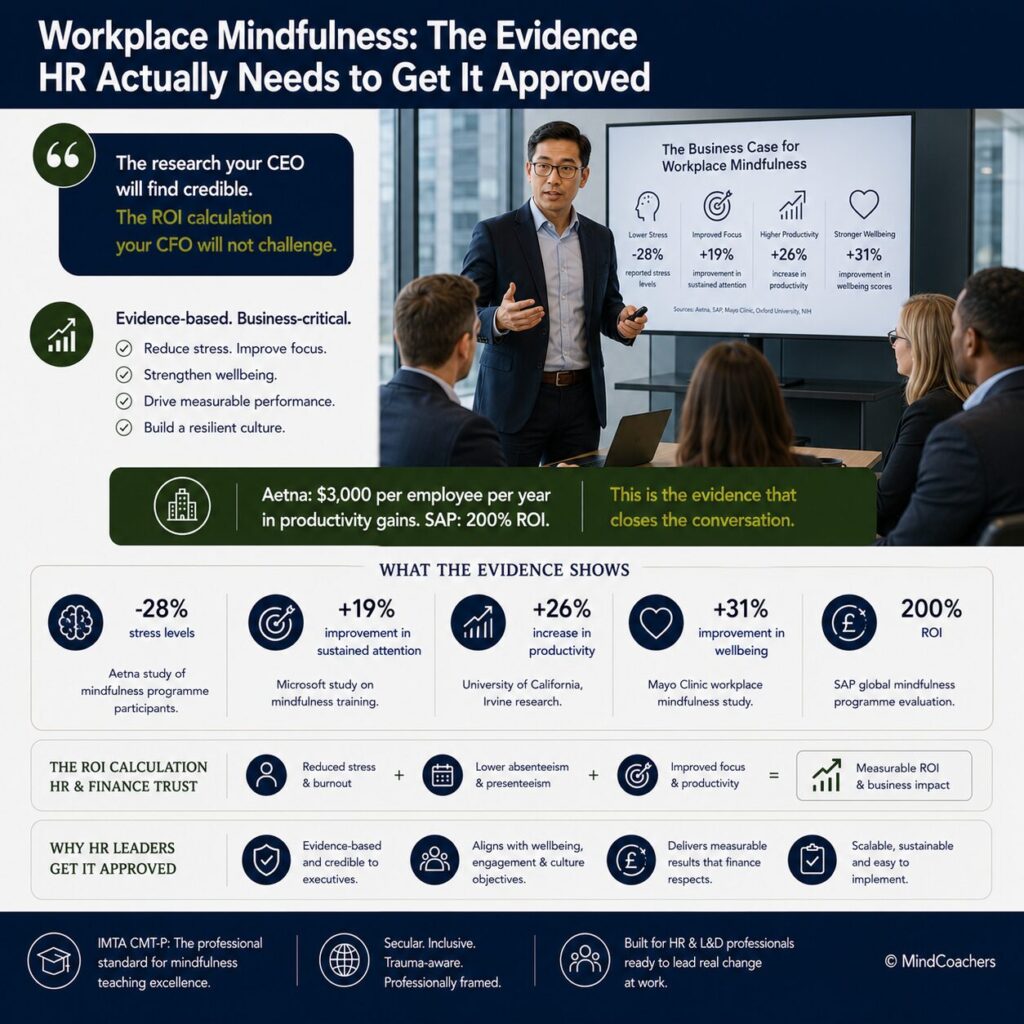
Most workplace mindfulness business cases fail not because the evidence is weak — it is not — but because the evidence is presented in the wrong language to the wrong stakeholders. Wellness framing to a CFO, personal practice language to a sceptical operations director, a single study citation to a board that expects systematic review: these are presentation failures, not evidence failures. The underlying research on workplace mindfulness is substantial and consistent. Getting it approved requires knowing which studies carry weight with which stakeholders and how to translate outcomes into the language that corporate decision-making runs on.
This article is for HR and wellbeing leads who are building or rebuilding a workplace mindfulness business case. It covers the three evidence anchors that carry weight with senior stakeholders, the ROI calculation methodology that CFOs will find credible, the programme structure that produces measurable outcomes, and the facilitator specification that protects the programme from the failure modes that have undermined previous wellbeing initiatives. For the full context on mindfulness teaching qualifications in corporate settings, see mindfulness in the workplace: what qualifications do corporate facilitators need and demand for mindfulness teachers in Europe: 2027-2030 forecast.
The best mindfulness teacher training for HR professionals: 2027 comparison covers the training options for HR professionals who want to develop internal delivery capability alongside the commissioning skills this article develops.
Key takeaways
→ The three evidence anchors that carry weight with senior stakeholders are Aetna’s 2015 ROI study (financial framing), the Khoury et al. 2015 meta-analysis of 209 studies (health outcome credibility), and NICE NG222 (institutional authority). Lead with Aetna for CFOs, Khoury for CHROs, NICE for NHS-adjacent organisations.
→ The strongest ROI argument is presenteeism, not absenteeism. Research estimates stress costs UK employers over £25 billion annually in lost productivity, and workplace mindfulness is one of the few interventions with a measurable presenteeism impact.
→ One-off mindfulness workshops produce engagement without development. Structured programmes of 6 to 8 sessions with home practice produce measurable, lasting change. The business case for structured programmes is significantly stronger than for workshops.
→ The facilitator credential is not a nicety — it is the primary quality signal. Require IMTA CMT-P or equivalent before any commissioning decision. A single poorly-delivered programme does more damage to the organisational mindfulness case than years of positive evidence.
→ HR professionals who hold their own IMTA CMT-P credential are positioned to build and quality-assure organisational mindfulness programmes with professional authority. The MCMI — MindCoachers Certified Mindfulness Instructor develops this credential in a format compatible with a demanding corporate role.
Why previous mindfulness business cases have failed — and how to fix yours
The most common failure mode in workplace mindfulness business cases is not insufficient evidence — it is mismatched framing. HR professionals who have attempted to build a mindfulness business case and failed typically report one of three presentation problems:
- Wellness framing to financial stakeholders: presenting mindfulness as a wellbeing benefit to stakeholders who make decisions in financial and performance terms. Wellbeing language triggers the “nice to have” objection. Performance and productivity language triggers the “strategic investment” response.
- Personal practice language to analytical audiences: using contemplative, spiritual, or wellness-adjacent language with senior leaders who respond to evidence, measurement, and business outcome framing. The same intervention described as “stress reduction” versus “attentional performance training” receives categorically different reception from analytical stakeholders.
- Single intervention format with weak evidence: proposing a one-off workshop or a mindfulness app subscription — the formats with the weakest evidence base — while citing research conducted on structured 8-week programmes. The credibility gap between the evidence cited and the format proposed is visible to any informed reviewer.
The fix for all three: align the evidence to the stakeholder, the format to the evidence, and the facilitator specification to the format. This article covers all three. For additional context on what HR directors find after AI rollouts, the wellbeing gap that emerges from technology-driven change is now a significant organisational driver for mindfulness investment.
The three pieces of evidence that carry weight with senior stakeholders
Not all evidence is equal in a corporate boardroom. The research base on workplace mindfulness is large — but three anchors specifically carry weight with senior business stakeholders:
1. Aetna’s 2015 ROI study — for financial framing
Aetna’s internally conducted mindfulness programme produced measurable financial outcomes: approximately $2,000 per employee annually in healthcare savings and approximately $3,000 per employee in productivity gains, on a programme cost of approximately $300 per participant. This was reported in Harvard Business Review and is the most frequently cited corporate mindfulness ROI case. It is specifically useful with CFOs and finance directors because it uses their language: cost per participant, healthcare savings, productivity recovery, and net positive return. It is also a large-employer case study, which makes it relevant to organisations commissioning at scale.
2. Khoury et al. 2015 meta-analysis — for health outcome credibility
The Khoury et al. (2015) meta-analysis of 209 studies involving 12,145 participants found mindfulness-based interventions produced significant improvements in anxiety, depression, and stress across populations. For HR stakeholders whose primary concern is employee mental health and absence management, this provides the systematic review credibility that single studies cannot. It also contextualises mindfulness as an evidence-based intervention rather than a wellness trend — a distinction that matters to CHROs who are accountable for clinical prudence in wellbeing commissioning.
3. NICE NG222 — for institutional authority
NHS NICE guideline NG222 recommends MBCT (Mindfulness-Based Cognitive Therapy) for adults with recurrent depression. For HR stakeholders in NHS, healthcare-adjacent, or public sector organisations, this represents institutional clinical endorsement. Even for corporate HR stakeholders, the NICE guideline signals that mindfulness has passed the evidence review threshold of the most rigorous public health institution in the UK — which is a meaningful credibility marker for any wellbeing intervention competing for L&D budget alongside EAP services and occupational health. Reference it as institutional validation, not as a clinical mandate.
How to calculate ROI without overpromising
The ROI calculation that survives CFO scrutiny is conservative, specific, and based on inputs the stakeholder can verify independently. Do not use unverifiable claims of productivity uplift. Use proxy metrics with research backing:
- Absenteeism reduction: the research supports an average 1 to 1.5 days per year reduction in stress-related absence for participants in structured mindfulness programmes. Apply this to your average daily employee cost and programme participant count for a conservative annual saving estimate.
- Presenteeism improvement: the stronger ROI argument. Research estimates stress-related presenteeism — being at work but not fully functional — costs UK employers substantially more than absenteeism annually. A measurable improvement in perceived stress scores (PSS) and self-reported concentration correlates with presenteeism reduction. Use the Standish Group or CIPD benchmarks for presenteeism cost per employee in your sector.
- EAP utilisation reduction: organisations with structured mindfulness programmes consistently report reduced EAP referral rates for stress-related counselling within 12 to 18 months of programme launch. If your organisation tracks EAP utilisation cost, this is a directly measurable ROI input.
The calculation to present: programme cost (facilitator fee + participant time cost) versus estimated annual saving from absenteeism and presenteeism improvement. Use a conservative 1.3x return in year one. Do not promise 10x returns — an informed CFO will reject the business case on credibility grounds before examining the evidence. How to measure whether your mindfulness programme works covers the measurement framework in detail.
What your CFO actually wants to know
CFOs evaluating a mindfulness programme investment are asking four questions, whether they articulate them or not:
- What does it cost per head, and how does that compare to other wellbeing investments? Frame the cost against the alternative: an EAP session costs £80 to £120 per employee hour. A structured mindfulness programme that reduces EAP utilisation by 0.5 sessions per participant per year pays for itself at typical programme costs.
- How do we know it worked? Commit to pre- and post-programme measurement using validated instruments: the Perceived Stress Scale (PSS-10), PHQ-9 for wellbeing, and self-reported concentration and sleep quality. These are brief, free, and produce the quantitative outcome data that makes renewal conversations straightforward.
- What happens if we don’t do it? The counterfactual is the strongest argument. What is the cost of not addressing moderate-to-high employee stress at your current prevalence rate? Use your own EAP data, absence data, and any staff survey wellbeing scores to build this case. The counterfactual is more compelling than the intervention ROI for most CFOs.
- Can we stop if it doesn’t work? Build in a review gate: commit to measuring outcomes at 8 weeks post-programme and presenting results before committing to a second cohort. This reduces the perceived risk for a first commissioning decision.
The programme structure that produces measurable outcomes
The evidence base for workplace mindfulness is not evenly distributed across programme formats. The research that supports ROI claims — Khoury, Aetna, NICE — was conducted on structured 6 to 8-session programmes with home practice between sessions, delivered by credentialled facilitators. One-off workshops and app-based programmes are supported by much weaker evidence, and where evidence exists, effects are smaller and less durable.
The programme structure that produces measurable outcomes:
- 6 to 8 sessions: sufficient session count to develop a personal practice, build home practice habituation, and cover the full practice range. 4-session formats produce engagement without the practice depth that drives lasting outcomes.
- 90 minutes per session: sufficient time for formal practice (20 to 30 minutes), guided inquiry, and teaching content. 60-minute sessions typically sacrifice inquiry — the pedagogical element most strongly associated with sustained change.
- Home practice as central pedagogy: 10 to 20 minutes daily between sessions. The research consistently shows that home practice frequency predicts outcomes more strongly than session attendance alone.
- IMTA CMT-P qualified facilitator: the facilitator credential is the primary quality determinant. A poorly delivered programme damages the organisational mindfulness case more than no programme at all. Why mindfulness programmes fail in organisations and how to prevent it covers the specific failure modes and how to specify against them.
One-off workshop vs structured programme: the evidence-based argument
The one-off workshop format is the default corporate mindfulness format — and the format with the weakest evidence base. The reasons organisations commission workshops over programmes are all procurement-side: easier to budget, easier to schedule, easier to cancel, lower risk. The reasons the evidence does not support them are all outcome-side: insufficient session count to develop practice, no home practice architecture, no group continuity that supports sustained engagement.
The evidence-based argument for structured programmes over workshops: the Khoury et al. meta-analysis found effect sizes for structured mindfulness-based interventions consistently in the moderate to large range; effect sizes for brief interventions and single-session formats are consistently smaller. Aetna’s ROI figures were from a structured programme, not a workshop. NICE NG222 recommends MBCT — an 8-week structured programme — not a mindfulness workshop.
The procurement reframe: position the workshop as a pilot, not a programme. If stakeholders want lower initial risk, offer a single 90-minute introductory session with explicit framing as a pilot to assess participant interest — followed by a full programme proposal once interest is demonstrated. This reduces the initial commitment barrier while preserving the outcome credibility of the full programme case.
How to choose and specify a qualified mindfulness facilitator
The facilitator specification is the most frequently overlooked element of corporate mindfulness commissioning — and the one with the greatest impact on programme quality. What to require:
- IMTA CMT-P credential: the international professional standard for secular mindfulness teaching. Verify directly at the IMTA directory — imta.org/accredited-programs. Do not accept other credentials as equivalent without understanding what they do and do not cover.
- Corporate delivery experience: request references from at least two corporate clients. Ask specifically: what populations did they work with, how was the programme structured, what outcomes were measured, and would they recommission? Wellbeing or yoga teaching experience does not substitute for corporate mindfulness facilitation experience.
- Professional liability insurance covering mindfulness facilitation: confirm in writing before any delivery commences. Some practitioners hold yoga or coaching PI policies that do not cover mindfulness teaching in corporate contexts.
- Participant screening protocol: a qualified facilitator will have a participant pre-screening process — brief questionnaire covering mental health history, current treatment, and contraindications. If a proposed facilitator has no screening protocol, do not commission them.
For HR professionals building internal delivery capability alongside external commissioning, why schools, hospitals and corporations increasingly require IMTA accreditation explains why the credential specification matters at institutional level — not just individual programme quality.
Download the MCMI — MindCoachers Certified Mindfulness Instructor — prospectus: full curriculum, faculty profiles, pricing and cohort information.
Further reading and professional resources
Best Mindfulness Teacher Training for HR and Corporate Wellbeing Professionals: 2027 Comparison
Mindfulness in the Workplace: What Qualifications Do Corporate Facilitators Need?
Demand for Mindfulness Teachers in Europe: 2027–2030 Forecast
What HR Directors Find After AI Rollouts — a Wellbeing Gap
How to Measure Whether Your Mindfulness Programme Works
Why Mindfulness Programmes Fail in Organisations and How to Prevent It
Why Schools, Hospitals and Corporations Increasingly Require IMTA Accreditation
Next steps
If you are an HR or wellbeing professional ready to build or deliver a workplace mindfulness programme with professional authority, the MCMI — MindCoachers Certified Mindfulness Instructor develops the IMTA CMT-P credential alongside explicit corporate mindfulness application content — in a 12-week online format compatible with a demanding HR schedule.
Frequently asked questions
About mindfulness teacher training for psychologists and the MCMI — MindCoachers Certified Mindfulness Instructor