
How to Commission a Corporate Mindfulness Programme: An HR Buyer’s Checklist
What credentials to require, what questions filter out unqualified providers, and how to brief, structure, and measure a programme that will actually be renewed.
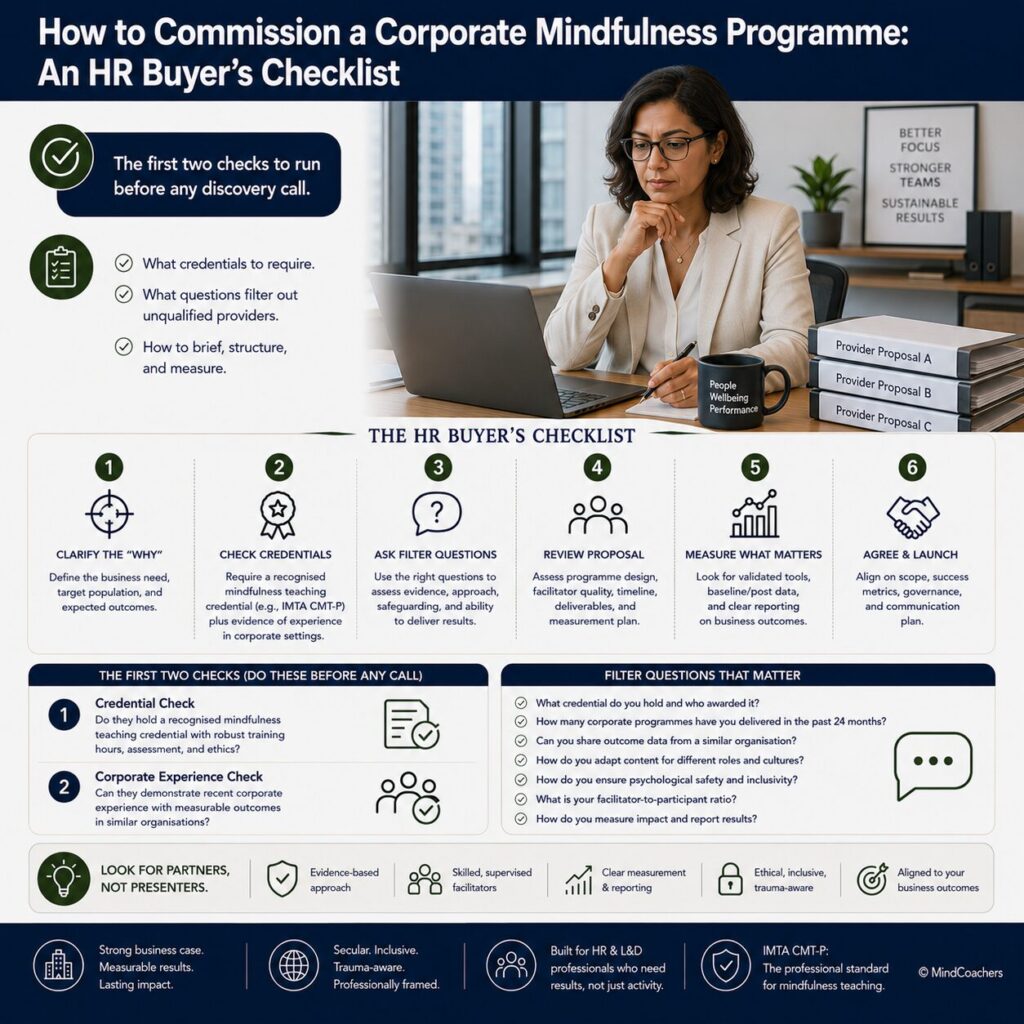
HR professionals tasked with finding a corporate mindfulness facilitator face an unusual procurement challenge: the market includes credentialled professionals with clinical depth, lifestyle coaches with a meditation practice and a website, and everything in between — with no obvious external signal to distinguish them. Unlike most professional services, mindfulness facilitation has no mandatory registration, no licensing body, and no protected job title. The credential system exists, but knowing which credentials to require and how to verify them is specialist knowledge that most HR buyers do not have when they first approach this market.
This guide closes that gap. It covers the two pre-call checks that filter the majority of unqualified providers, how to verify a credential in two minutes, what a proper brief looks like, the questions that distinguish serious providers from general wellness contractors, and how to build a measurement framework that makes the renewal conversation straightforward. For the evidence framework and ROI case that precedes this guide, see workplace mindfulness: the evidence HR actually needs to get it approved.
For HR professionals who want to develop internal delivery capability alongside commissioning skills, the best mindfulness teacher training for HR professionals: 2027 comparison covers the training options — including the MCMI — MindCoachers Certified Mindfulness Instructor, built for professionals with demanding HR schedules.
Key takeaways
→ Run two checks before any discovery call: (1) IMTA CMT-P credential verification on the IMTA registered teachers list; (2) written confirmation that professional liability insurance covers mindfulness facilitation for corporate clients. These two checks filter the majority of unqualified providers.
→ A proper brief specifies credential requirement (IMTA CMT-P), format preference, outcome framework, and participant profile. Briefs that specify these elements attract serious providers and filter out general wellness contractors.
→ The questions that distinguish serious providers: “Can you describe your trauma-aware facilitation protocol?” and “What participant screening do you use before the programme?” Providers who cannot answer these specifically are not appropriate for corporate commissioning.
→ Measure with validated instruments (PSS-10, PHQ-9) before and after the programme. Pre/post data is the renewal case. Without it, continuation decisions are based on anecdote and goodwill — both of which erode.
→ HR professionals who hold IMTA CMT-P themselves are positioned to quality-assure external providers, deliver internal sessions, and design organisational programmes with professional authority. The MCMI — MindCoachers Certified Mindfulness Instructor develops this in a 12-week online format compatible with a demanding corporate role.
The first two checks to run before any discovery call
Before you speak to any mindfulness facilitator or provider, run two checks. These filter the majority of unqualified providers before you invest time in a discovery call.
Check 1: IMTA CMT-P credential verification. Go to imta.org/accredited-programs and search for the provider or facilitator by name. IMTA maintains a publicly searchable list of accredited programmes and credentialled teachers. If the facilitator is not on this list, they do not hold IMTA CMT-P. Note: accreditation is at the programme level; if the provider trained through an IMTA-accredited programme, their credential should be verifiable. If you cannot verify it directly, ask for the IMTA accreditation number and check it.
Check 2: professional liability insurance covering mindfulness facilitation. Email or ask in writing before any commissioning decision: “Please confirm in writing that your professional liability insurance covers mindfulness facilitation for corporate client groups.” Yoga teachers, coaches, and wellness practitioners frequently hold PI policies that cover their primary professional activity but do not extend to corporate mindfulness facilitation. A qualified mindfulness facilitator will confirm this immediately. Vague responses or redirections to “general liability” coverage are not sufficient.
These two checks take five minutes. What hospitals and schools actually check before hiring a mindfulness teacher confirms that the same checks are applied by institutional HR departments across sectors — corporate HR is not alone in requiring this standard.
How to verify a mindfulness facilitator’s credential in two minutes
The IMTA verification process is simple. At imta.org, the accredited programmes list shows all IMTA-accredited training programmes. If the facilitator trained through one of these programmes and successfully completed the CMT-P application process, they are IMTA CMT-P qualified.
If you cannot verify the credential directly on the IMTA site, ask the facilitator specifically: “Can you provide your IMTA CMT-P registration number so I can verify it?” A credentialled practitioner will provide this without hesitation. If the response is:
- “I trained with [organisation] for 200 hours” — this is not IMTA CMT-P. Programme completion certificates are not equivalent to IMTA CMT-P accreditation.
- “I have extensive experience and testimonials” — testimonials are not credential evidence.
- “My credential is equivalent to IMTA” — ask them to specify what body issued the credential and how it is recognised by institutional commissioners. If they cannot, it is not equivalent.
The mindfulness teacher certification credentials that actually matter to employers covers the full credential landscape and what each credential type does and does not signal to institutional buyers. Why schools, hospitals and corporations increasingly require IMTA accreditation explains why IMTA has become the de facto institutional standard.
What a proper brief for a corporate mindfulness programme looks like
A brief that attracts quality providers and filters out general wellness contractors specifies four things clearly:
- Credential requirement: “We require the facilitator to hold IMTA CMT-P or independently assessed equivalent accreditation at 200-hour professional level. Please include your credential number and verification path in your proposal.”
- Format preference: number of sessions (6 to 8 for a structured programme), group size (8 to 16 is the evidence-supported range for cohort-based mindfulness), delivery mode (online or in-person), and scheduling requirements (daytime, lunchtime, or after-hours).
- Outcome framework: specify that you want pre- and post-programme measurement using validated instruments. Serious providers will propose PSS-10 (Perceived Stress Scale) and PHQ-9 at minimum. Providers who do not include a measurement framework in their proposal are not operating at professional standard.
- Participant profile: role level and function, sector context, any known stress or wellbeing presentations (without disclosing clinical information), and whether the group has prior mindfulness experience.
A brief that includes these four elements will produce significantly higher quality proposals than a brief that simply says “we are looking for a mindfulness facilitator.” It also signals to providers that the buyer is informed — which filters providers who rely on undifferentiated marketing rather than genuine professional competency.
Format decisions: online vs in-person, one-off vs programme
Two format decisions matter most, and both have evidence implications:
Online vs in-person: both formats produce measurable outcomes in the research literature, and the choice should be driven by participant accessibility rather than format preference. Online delivery enables wider reach, removes commute or logistics barriers, and is well-suited to distributed teams. In-person delivery produces stronger initial group cohesion and is better for executive populations who benefit from the visible commitment signal. For a first programme, online delivery typically produces higher participation rates by removing the access barrier.
One-off vs structured programme: this is the more consequential decision. A one-off workshop produces awareness and engagement — valuable as an introduction to mindfulness but insufficient to produce the behavioural change that the ROI evidence is built on. A structured programme of 6 to 8 sessions with home practice produces measurable, lasting change. If budget only allows a one-off session, commission it explicitly as an introduction rather than a programme, and include a structured programme proposal as a second phase. Corporate mindfulness language — how to open budgets covers how to frame both phases in L&D budget conversations.
Questions that distinguish serious providers from general wellness contractors
Seven questions that any qualified corporate mindfulness facilitator should be able to answer specifically — and that filter out practitioners who present well but lack professional depth:
- “Can you describe your trauma-aware facilitation protocol?” A qualified facilitator will describe specific protocols: body scan dissociation risk management, breath practice contraindications for trauma participants, participant screening approach, and crisis referral procedures. A vague answer about “being sensitive to participants” is not a trauma-aware protocol.
- “What participant screening do you use before the programme?” A qualified facilitator will have a pre-programme questionnaire covering mental health history, current treatment, and contraindications. If they have no screening process, do not commission them.
- “How do you adapt the programme for a corporate audience that has never tried mindfulness?” Look for specific answers about secular framing, performance language, shorter initial practices, and expectation management. Vague answers about “meeting people where they are” indicate a lack of corporate facilitation experience.
- “What outcome measurement do you include?” A professional facilitator will include validated pre/post instruments as standard. If outcome measurement is not included in the standard proposal, it should be negotiated before commissioning.
- “Can you provide two corporate client references?” Wellness or yoga teaching references are not equivalent to corporate mindfulness facilitation references. Ask specifically about corporate clients, group size, and outcomes observed.
- “What is your professional indemnity cover for this engagement?” As per check 2 — get written confirmation before signing any contract.
- “Which IMTA-accredited programme did you complete your training through?” This should be verifiable on the IMTA accredited programmes list. If the provider cannot name a specific IMTA-accredited programme, they do not hold IMTA CMT-P.
How to measure impact — and make the renewal case
Pre- and post-programme measurement is not optional — it is the renewal case. Without outcome data, continuation of a mindfulness programme depends on anecdote, goodwill, and organisational memory. With outcome data, it is a straightforward evidence review.
Minimum measurement framework:
- PSS-10 (Perceived Stress Scale): a 10-item validated instrument measuring perceived stress, freely available, takes 3 minutes to complete. Administer at programme start and programme end. A statistically significant reduction in PSS-10 scores is the primary outcome metric.
- PHQ-9 (Patient Health Questionnaire): a 9-item validated instrument measuring depression severity. Useful for organisations with occupational health integration or where mental health outcomes are a primary programme objective.
- Self-reported concentration and sleep quality: two brief questions on work concentration and sleep quality, asked pre and post. Not validated instruments, but produce accessible data for non-clinical stakeholder presentations.
- Attendance and completion rate: a completion rate above 75% is a positive engagement signal. Below 60% indicates a format or timing issue worth diagnosing before the next cohort.
Present results in a one-page summary at the renewal decision point: average PSS-10 improvement, completion rate, and two or three participant quotes (with consent). How to measure whether your mindfulness programme works covers the full measurement framework for HR leads who want to develop more robust outcome reporting.
Handling the ‘we tried this before and it didn’t work’ objection
The most common objection from budget holders who have commissioned mindfulness before is: “We did this two years ago and engagement was poor.” This is a legitimate concern, and meeting it with evidence requires understanding what specifically failed.
The three most common causes of previous mindfulness programme failures — and the brief specifications that address each:
- Wrong format: a single session or app-based programme was commissioned without the structure to produce lasting change. Specify a minimum 6-session structured programme with home practice.
- Wrong facilitator: the provider lacked the professional depth to hold sustained participant engagement. Specify IMTA CMT-P, require corporate references, and ask the seven vetting questions above.
- Wrong framing: the programme was positioned as a wellness benefit rather than a performance and resilience tool. Specify that the programme should be framed in performance and wellbeing outcome language from the first participant communication.
In the budget holder conversation: “The previous programme had [specific issue]. This proposal addresses that specifically by [specific change]. We are also building in pre/post measurement so we can demonstrate outcome this time, which we did not have before.”
Download the MCMI — MindCoachers Certified Mindfulness Instructor — prospectus: full curriculum, faculty profiles, pricing and cohort information.
Further reading and professional resources
Best Mindfulness Teacher Training for HR and Corporate Wellbeing Professionals: 2027 Comparison
Mindfulness in the Workplace: What Qualifications Do Corporate Facilitators Need?
Mindfulness Teacher Certification: Which Credentials Actually Matter to Employers? (2027)
Workplace Mindfulness: The Evidence HR Actually Needs to Get It Approved
Corporate Mindfulness Language — How to Open Budgets
Community Mindfulness Teaching — Why the Credential Matters
What Hospitals and Schools Actually Check Before Hiring a Mindfulness Teacher
Why Schools, Hospitals and Corporations Increasingly Require IMTA Accreditation
Next steps
If you are an HR professional ready to develop internal mindfulness teaching capability alongside your commissioning role, the MCMI — MindCoachers Certified Mindfulness Instructor produces the IMTA CMT-P credential in a 12-week online format built for professionals with demanding corporate schedules.
Frequently asked questions
About mindfulness teacher training for psychologists and the MCMI — MindCoachers Certified Mindfulness Instructor