
How Many Teaching Practice Hours Does a Mindfulness Training Actually Need?
Not all hours are equal. Here is how to read a programme’s hour breakdown — and what the numbers actually mean for your professional readiness.
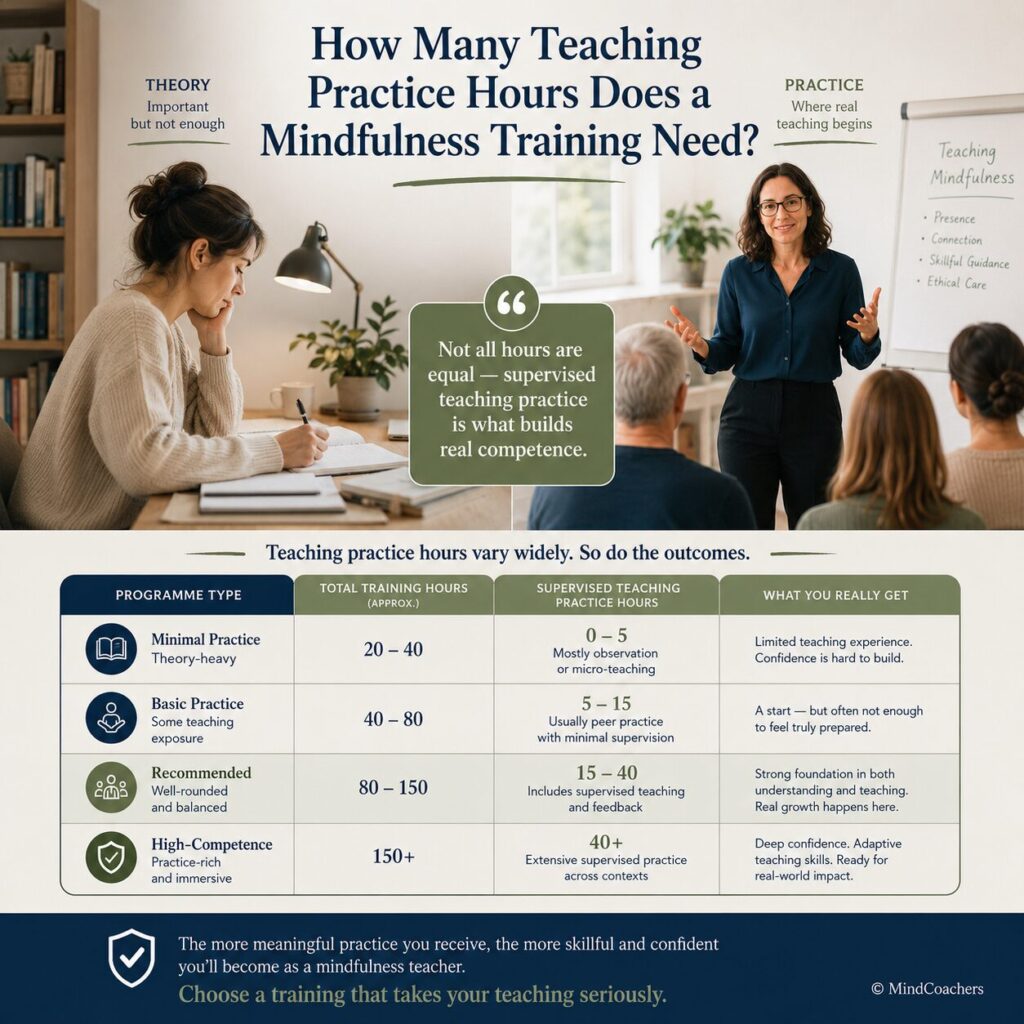
When comparing mindfulness teacher training programmes, hours are the first number everyone looks at. A programme advertises 200 hours; another offers 250. The assumption embedded in this comparison is that more hours means more training. In reality, the total hour count is one of the least informative numbers a mindfulness teacher training programme can give you.
What matters is not how many hours a programme contains but what those hours consist of. A 200-hour programme where 160 hours are asynchronous video content and 40 are live sessions is a fundamentally different experience from one where the same 200 hours are structured around live instruction, peer teaching, and a concurrent practicum. The number is identical. The outcome is not.
This article explains how to read a programme’s hour structure critically. For the full seven-criteria evaluation framework, see what makes a good mindfulness teacher training?. For the evidence on why practice timing matters, see why teaching practice from day one makes better mindfulness teachers. For accreditation context, see IMTA vs Yoga Alliance vs IMMA: mindfulness teacher accreditation compared.
Key takeaways
→ The 200-hour total required by IMTA is a floor, not a quality benchmark — what matters is the composition of those hours.
→ Teaching practice hours and curriculum hours are not equivalent: only hours spent actually guiding real people develop teaching competence.
→ A concurrent practicum — running alongside the curriculum, not after it — is the structural feature that makes practice hours count.
→ 30–40 hours of supervised teaching practice, distributed across the full programme, is the practical threshold for meaningful development.
→ A programme that cannot specify its hour breakdown by category is not being transparent about what it is actually delivering.
Why the 200-hour standard exists — and what it does not guarantee
The International Mindfulness Teachers Association (IMTA) requires a minimum of 200 hours for CMT-P (Certified Mindfulness Teacher – Professional) accreditation. For a full comparison of what different accreditation bodies require, see IMTA vs Yoga Alliance vs IMMA: mindfulness teacher accreditation compared. For the full CMT-P credential pathway, see CMT-P certification explained.
What the 200-hour standard does not guarantee is any particular distribution of those hours across categories. Two programmes can both meet the 200-hour requirement while delivering radically different amounts of actual teaching practice.
The four categories of hours that actually matter
When reviewing any programme’s hour structure, break the total down into four categories. Ask the programme explicitly for this breakdown before you enrol.
1. Live instruction hours
These are hours where a qualified instructor is present, teaching, demonstrating, and responding to participants in real time. Live instruction hours are not equivalent to asynchronous video content, even when the video content covers identical curriculum material. For a direct comparison of online vs in-person formats, see online vs in-person mindfulness teacher training: what the evidence says.
2. Supervised teaching practice hours
These are hours where you are actually guiding real people through mindfulness practices — not watching someone else teach, not role-playing as a participant, not discussing teaching in theory. These are the hours that directly develop the skills assessed by the MBI-TAC competency framework.
3. Practicum hours
The practicum is the period of external supervised teaching. IMTA requires this to run concurrently with the taught curriculum. For the full case on why concurrent timing produces better outcomes, see why teaching practice from day one makes better mindfulness teachers. For a detailed breakdown of what 200 hours should look like, see 200-hour mindfulness teacher training: what you actually get for the hours.
4. Personal practice and self-study hours
These hours include personal meditation practice, reading, reflection, and asynchronous content. They are legitimate and necessary — but they are not teaching practice hours, and a programme that conflates the two in its hour breakdown is obscuring something important.
What the numbers look like in a well-structured programme
- Live instruction: At minimum 30–40% of total hours. For a 200-hour programme, that means 60–80 hours of live, interactive sessions.
- Supervised teaching practice (in-training): At minimum 15–20% of total hours — 30–40 hours of actual teaching practice within the training structure.
- Practicum (external): 35 hours is the MCMI standard and a defensible professional benchmark, running concurrently across the full programme.
- Personal practice and self-study: The remainder — valuable, but not the primary vehicle for developing teaching competence.
Questions to ask any programme before you enrol
- What is the total hour breakdown by category — live instruction, supervised teaching practice, practicum, and self-study?
- In which week does supervised teaching practice first appear?
- When does the practicum begin, and how many weeks does it run?
- How are practicum hours logged and verified?
- Is the practicum supervised, and if so, by whom and how?
- How is teaching practice assessed within the programme? Against what criteria?
For the complementary framework on reading curriculum content, see how to read a mindfulness teacher training curriculum before you enrol. For programme comparisons, see best IMTA-accredited mindfulness teacher training programmes: 2027 guide and 12-week vs 12-month mindfulness teacher training: which is right for you?.
What the IMTA CMT-P pathway requires post-graduation
The IMTA CMT-P credential is not awarded automatically on completion of an accredited programme. Graduates must apply to IMTA directly, submitting evidence of their teaching practice hours. The hours you accumulate during training are the evidence base for your post-graduation IMTA application. For the full pathway, see CMT-P certification explained: how to become an IMTA-certified mindfulness teacher. For what credentials employers actually check, see mindfulness teacher certification: which credentials actually matter to employers?.
Download the MCMI — MindCoachers Certified Mindfulness Instructor — prospectus: full curriculum, faculty profiles, pricing and cohort information.
Further reading and professional resources
↗ What makes a good mindfulness teacher training? 7 criteria
↗ Why teaching practice from day one makes better mindfulness teachers
↗ How to read a mindfulness teacher training curriculum before you enrol
↗ IMTA vs Yoga Alliance vs IMMA: mindfulness teacher accreditation compared
↗ 200-hour mindfulness teacher training: what you actually get for the hours
↗ CMT-P certification explained: how to become an IMTA-certified mindfulness teacher
↗ IMTA CMT-P accreditation requirements and hour structure
↗ MBI-TAC: the competency framework for mindfulness teaching assessment
Next steps
The MCMI — MindCoachers Certified Mindfulness Instructor publishes its full hour breakdown transparently: live cohort sessions, supervised peer teaching from week one, a 35-hour concurrent practicum launched in the first session, and structured asynchronous content between sessions. IMTA accreditation at CMT-P level is confirmed.
Frequently asked questions
About mindfulness teacher training for psychologists and the MCMI — MindCoachers Certified Mindfulness Instructor