
Online vs In-Person Mindfulness Teacher Training: What the Evidence Says (2027)
The research is more nuanced than the debate. Here is what the evidence actually says — and what it does not.
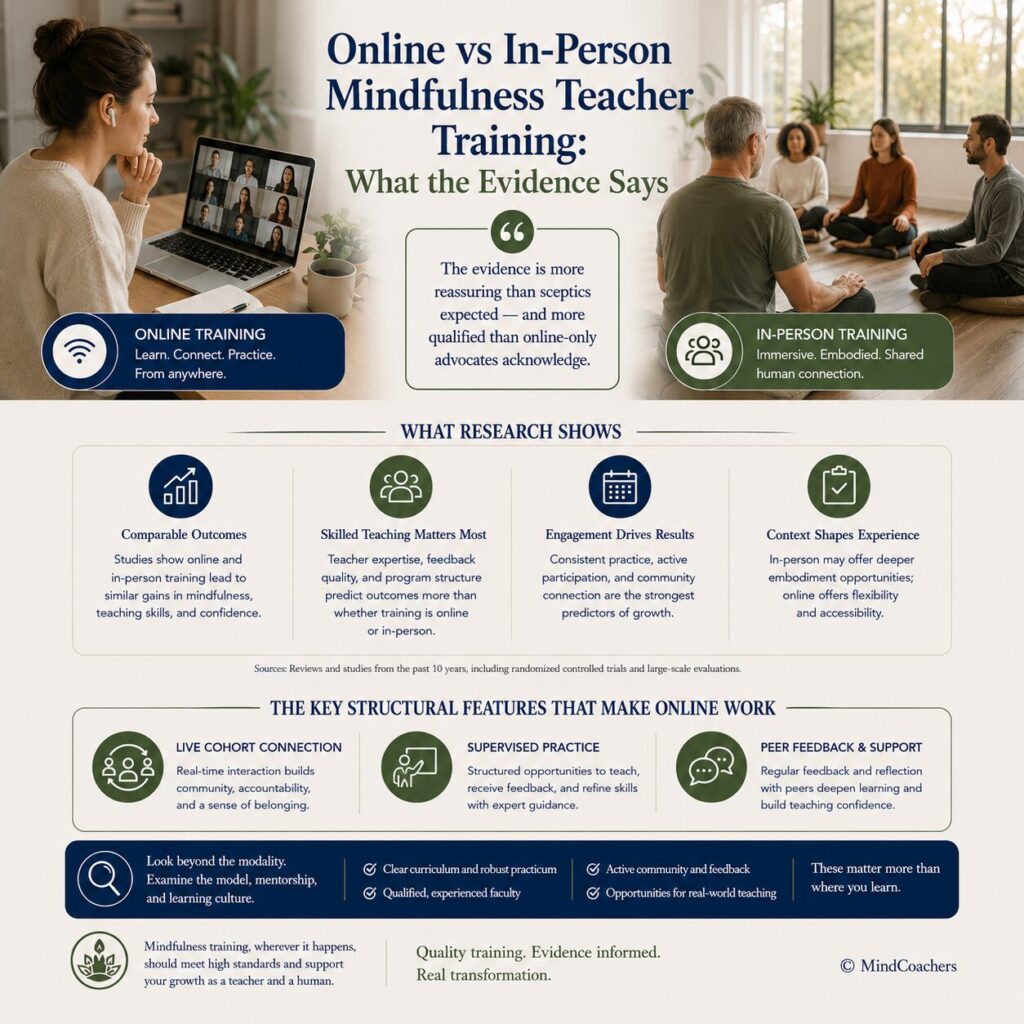
The debate between online and in-person mindfulness teacher training has generated more heat than light. Advocates of in-person training argue that physical co-presence is irreplaceable for developing the embodied teaching presence that mindfulness requires. Advocates of online training argue that format is irrelevant provided the pedagogical structure is sound. Both positions contain truth and both contain significant overreach.
The research on online professional education is now extensive enough to be precise. It does not support the wholesale dismissal of online delivery — nor does it support the claim that format is irrelevant. What it supports is a more specific conclusion: outcomes depend on pedagogical structure, not on delivery format. The right question is not “online or in-person?” but “what structural features make any format effective for developing mindfulness teaching competence?”
This article examines what the evidence actually shows, where the genuine limitations of online delivery lie, and what structural features determine whether an online programme produces professional outcomes. For how to apply this to specific programme decisions, see best online mindfulness teacher training programmes: ranked and compared. For the full evaluation framework, see what makes a good mindfulness teacher training? 7 criteria.
Key takeaways
→ The research on online professional education consistently shows that outcomes depend on pedagogical structure, not delivery format — live synchronous online sessions produce comparable outcomes to equivalent in-person sessions.
→ The genuine limitation of online delivery is not format but the absence of physical co-presence — which matters specifically for embodiment-based competencies that require physical proximity to develop fully.
→ Asynchronous online delivery is the format that research consistently shows produces worse outcomes — not online delivery per se.
→ The MBI-TAC competency domains can be developed and assessed in online settings provided the programme creates sufficient live interaction, peer teaching, and structured feedback.
→ For most European practitioners, online IMTA-accredited training is the practical route to qualification — in-person IMTA-accredited programmes are geographically limited.
What the research on online professional education shows
The most comprehensive meta-analysis of online vs in-person professional education — covering medicine, nursing, psychology, social work, and allied health professions — found no significant difference in knowledge acquisition or skill development between online and in-person delivery when the instructional design was equivalent. The decisive variable was not format but interaction quality: programmes with high levels of synchronous interaction, peer feedback, and supervised practice produced better outcomes regardless of whether they were delivered online or in person.
What this means for mindfulness teacher training is direct: a live online cohort session with structured peer teaching and real-time feedback from a qualified instructor is not materially different from an equivalent in-person session in its effect on teaching competence development. The medium of Zoom does not significantly change the quality of instruction or feedback compared to the medium of a training room — provided the session structure is equivalent.
Where online delivery does produce worse outcomes is in asynchronous formats: pre-recorded video content, self-paced modules, and discussion forums replace the live interaction that drives skill development. This is the format distinction that matters — not online vs in-person, but live and interactive vs asynchronous and self-paced. For the full breakdown of why asynchronous content is insufficient for teaching competence development, see how many teaching practice hours does a mindfulness training actually need?.
The genuine limitations of online delivery
The research does not support wholesale dismissal of online delivery — but it does identify genuine limitations that are relevant for mindfulness teacher training specifically.
Embodiment and physical co-presence
Mindfulness teaching is fundamentally an embodied practice. The teaching presence that experienced mindfulness teachers develop — a quality of groundedness, attunement, and physical stillness that communicates something beyond words — is most directly transmitted in physical co-presence. Research on somatic learning and contemplative pedagogy suggests that certain aspects of teaching presence are most efficiently developed when teacher and student share physical space.
This is the most substantive limitation of online delivery for mindfulness teaching specifically — and it is a limitation that the evidence acknowledges. Online training can develop the technical skills of mindfulness teaching: practice guidance, inquiry facilitation, group management, curriculum delivery. It is less certain that it can fully develop the embodiment dimension of teaching presence without physical co-presence at some point in the training. The blog post the embodiment gap — what AI cannot replicate in teaching examines this limitation in the context of AI and digital delivery more broadly.
Physical group dynamics
Managing the physical dynamics of a mindfulness group — the energy of a room, the somatic signals of participant distress, the physical orientation of bodies in space — is a competency that can only be practised in physical settings. Online training can simulate group dynamics through breakout rooms and cohort sessions, but it cannot replicate the full complexity of physical group management.
For most clinical and workplace contexts, however, this limitation is manageable: practitioners learn to work with online group dynamics, which are themselves increasingly common in professional practice. A mindfulness teacher trained entirely online is not underprepared for online facilitation — which represents an increasing proportion of professional mindfulness teaching.
Residential retreat experience
Several IMTA-accredited programmes include a residential retreat component — typically 3–5 days of intensive in-person practice. The research on residential retreat as a component of teacher training suggests it provides a qualitatively different experience of sustained practice and group immersion that online sessions cannot replicate. For programmes that include a residential component, this is a meaningful differentiator — it addresses the embodiment limitation of online training directly.
What compensates for the absence of physical co-presence
Well-designed online mindfulness teacher training programmes compensate for the absence of physical co-presence through structural features:
- Small cohort size: Cohorts of 12–20 participants allow the relational depth that compensates for the absence of physical proximity. Larger online cohorts lose the intimacy that makes peer teaching developmentally meaningful.
- Video-on practice sessions: Camera-on requirements for teaching practice sessions allow instructors to observe body language, facial expression, and physical presence cues — a partial but meaningful substitute for physical co-presence.
- Video review of teaching: Recording and reviewing teaching sessions allows more granular analysis of physical presence markers than is often possible in real-time in-person sessions.
- Personal retreat practice: Requiring participants to maintain a residential retreat practice — attending in-person retreats independently of the training — addresses the embodiment dimension that online delivery cannot fully provide.
For the video that addresses what online delivery can and cannot replicate, see why teaching mindfulness online doesn’t lower the professional bar. For the evidence on cohort learning specifically, see why cohort learning produces better teachers than solo study.
The practical landscape for European practitioners
For most European practitioners, the online vs in-person debate is partially academic — because the landscape of IMTA-accredited programmes in Europe is predominantly online. The in-person IMTA-accredited programmes that exist are geographically concentrated, typically require travel and accommodation costs that significantly increase the total programme investment, and often offer cohort schedules that are incompatible with active professional practice.
Online IMTA-accredited training is, for the majority of European practitioners, the practical route to qualification. The evidence supports this choice — provided the programme has the structural features (live synchronous sessions, cohort model, concurrent practicum, structured feedback) that make online delivery effective. For the best current online options, see best online mindfulness teacher training programmes: ranked and compared. For format comparisons more broadly, see 12-week vs 12-month mindfulness teacher training: which is right for you?.
The MBI-TAC question: can competencies be assessed online?
The MBI-TAC (Mindfulness-Based Interventions Teaching Assessment Criteria) — the peer-reviewed instrument for assessing mindfulness teaching quality — was developed in an in-person training context. The question of whether its six competency domains can be adequately assessed in an online setting is directly relevant to the credibility of online IMTA-accredited training.
The evidence suggests yes — with one qualification. Five of the six MBI-TAC domains (relational skills, guiding mindfulness practices, inquiry skills, didactic teaching, and group learning environment) can be observed and assessed in online live sessions without significant loss of assessment quality. The sixth domain — embodiment of mindfulness — is the domain where online assessment is most limited, precisely because embodiment is the competency most dependent on physical co-presence for both development and observation.
This is consistent with the broader evidence: online training is effective for developing technical teaching competencies. It is less certain for embodiment-based competencies that require physical proximity. For clinical professionals for whom embodiment depth is particularly important, in-person components — through retreats or intensive residentials — are worth seeking. See mindfulness teacher training for psychologists for the clinical practitioner’s perspective.
Download the MCMI — MindCoachers Certified Mindfulness Instructor — prospectus: full curriculum, faculty profiles, pricing and cohort information.
Further reading and professional resources
↗ Best online mindfulness teacher training programmes: ranked and compared
↗ What makes a good mindfulness teacher training? 7 criteria
↗ How many teaching practice hours does a mindfulness training actually need?
↗ 12-week vs 12-month mindfulness teacher training: which is right for you?
↗ 200-hour mindfulness teacher training: what you actually get for the hours
↗ Why cohort learning produces better teachers than solo study
↗ MBI-TAC: Mindfulness-Based Interventions Teaching Assessment Criteria
Next steps
The MCMI — MindCoachers Certified Mindfulness Instructor is delivered fully online as a live synchronous cohort programme. All sessions are camera-on, interactive, and structured around peer teaching and real-time feedback. The 35-hour concurrent practicum runs from week one. The programme is designed to address the genuine limitations of online delivery — small cohort size, structured video review of teaching, and camera-on practice sessions — while providing the schedule flexibility that professional practitioners require. IMTA accreditation is confirmed at CMT-P level.
Frequently asked questions
About mindfulness teacher training for psychologists and the MCMI — MindCoachers Certified Mindfulness Instructor