
Can Therapists Teach Mindfulness Without Extra Training? A Clinical Perspective
Using mindfulness in therapy and formally teaching mindfulness are professionally distinct activities. Here is what that distinction means in practice.
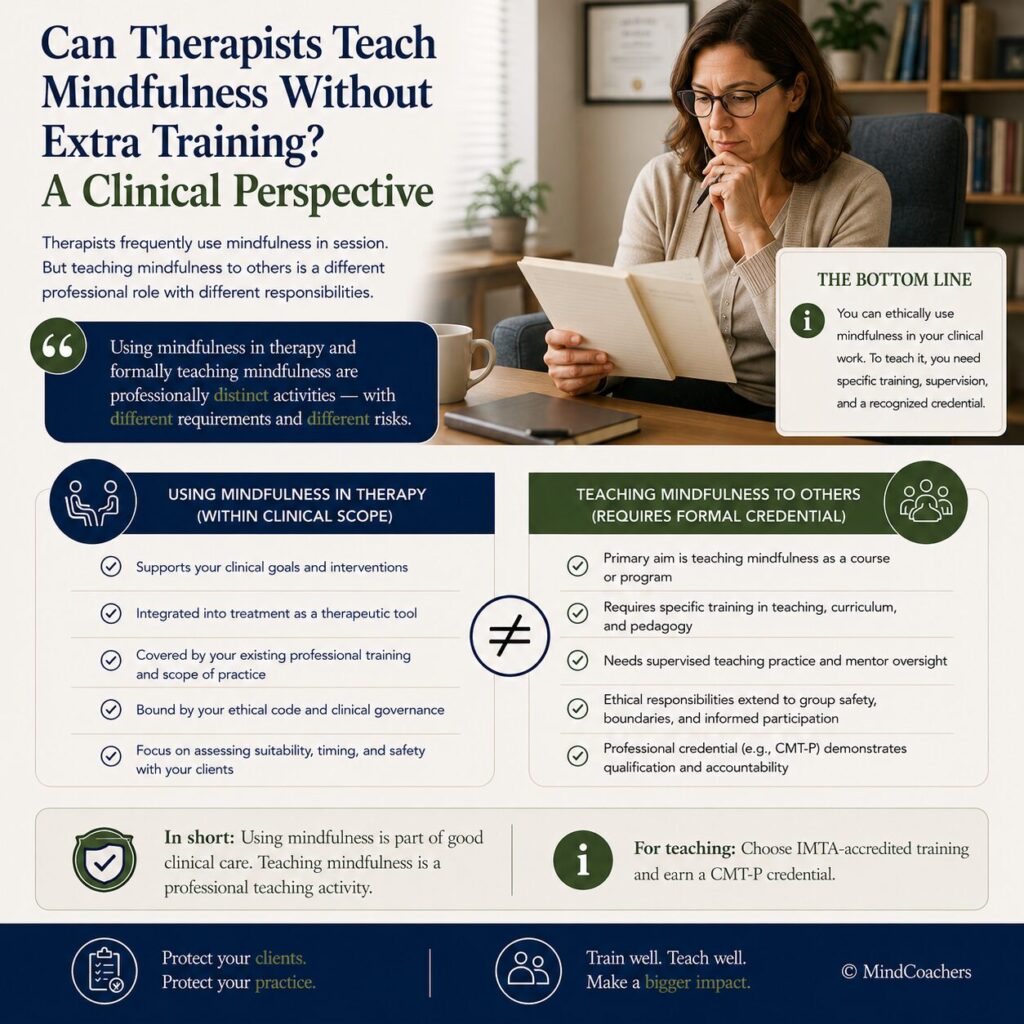
The question of whether therapists can teach mindfulness without formal teacher training is one of the most consequential questions in the mindfulness teaching field — and one that is too rarely asked with the clarity it deserves. Therapists who use mindfulness in their clinical work are not automatically qualified to teach mindfulness formally. The two activities — mindfulness integration in therapy and formal mindfulness teaching — are professionally distinct, with different competency requirements, different liability implications, and different credential expectations.
This matters because the therapist who assumes their clinical training qualifies them to run a public mindfulness programme, or to deliver corporate wellbeing mindfulness, or to facilitate a clinical mindfulness group in a context where they are acting as a mindfulness teacher rather than as a clinician, is making a professional assumption that has real consequences when it is tested.
This article addresses the distinction precisely: what using mindfulness in therapy involves, what formally teaching mindfulness involves, where the competency gaps lie, and what formal mindfulness teacher training adds to a therapist’s professional practice. For the psychologist’s perspective, see mindfulness teacher training for psychologists. For the regulatory context, see is mindfulness teacher training regulated? What professionals need to know.
Key takeaways
→ Using mindfulness techniques in therapy and formally teaching mindfulness are professionally distinct activities requiring different competencies.
→ Clinical training in CBT, ACT, DBT, or MBCT provides theoretical grounding in mindfulness mechanisms — it does not provide formal mindfulness teaching competency.
→ The primary competency gaps for therapists are: pedagogical structure, invitational language, group facilitation as a mindfulness teacher (not a clinician), and scope-of-practice management in non-clinical teaching contexts.
→ Formal mindfulness teacher training does not duplicate clinical training — it adds what clinical training does not cover.
→ IMTA CMT-P accreditation is the credential that most consistently satisfies the requirements of institutional contexts where therapists want to teach mindfulness professionally.
What using mindfulness in therapy involves
Most therapists who work with mindfulness do so in one or more of the following ways: assigning mindfulness practices as homework within a CBT or ACT protocol; guiding brief mindfulness practices within individual therapy sessions; using mindfulness-based inquiry as a therapeutic technique; or delivering structured mindfulness exercises as part of a treatment package (MBCT, DBT skills training, ACT). All of these are legitimate clinical applications of mindfulness within a therapeutic relationship.
What distinguishes these activities is their context: they occur within a regulated clinical relationship, under the therapist’s primary professional registration, with participants who are clients in a therapeutic sense. The mindfulness practice serves the therapeutic relationship — it does not constitute a standalone mindfulness teaching interaction.
This context is the key variable. When a therapist assigns a body scan as homework to a client, they are a therapist using a mindfulness technique. When the same therapist leads a body scan for a group of ten people who have enrolled in a mindfulness programme, they are acting as a mindfulness teacher. The activity looks similar; the professional context, liability framework, and competency requirements are different.
What formally teaching mindfulness involves
Formally teaching mindfulness — running a structured mindfulness programme, delivering corporate wellbeing workshops, facilitating a mindfulness group for non-clinical populations — involves a distinct set of competencies that clinical training does not fully address:
Pedagogical structure
A formal mindfulness teacher designs and delivers a curriculum — a structured sequence of practices, didactic content, and group processes. This is pedagogical work: sequencing practices appropriately, calibrating complexity across sessions, managing the arc of a programme from orientation to integration. Therapists are skilled at structuring therapeutic interactions; they are not automatically skilled at structuring pedagogical programmes. The MBI-TAC competency framework — the peer-reviewed instrument for assessing mindfulness teaching quality — assesses six domains, most of which are pedagogical rather than clinical.
Invitational language
Mindfulness teaching uses a specific register of language — invitational rather than directive, offering choices rather than instructions, framing practices as experiments rather than prescriptions. This language register is distinct from both therapeutic directive techniques (homework assignments, behavioural experiments) and conversational CBT language. It requires specific training and practice to develop. Many therapists who first attempt to guide a mindfulness practice in a teaching context find that their instinct to be directive — a clinical skill — creates the wrong relationship with participants.
Group facilitation as a mindfulness teacher
Group therapy and group mindfulness teaching are different group formats with different facilitation norms. In group therapy, the therapist holds clinical responsibility for the wellbeing of each group member and manages group dynamics within a therapeutic frame. In mindfulness teaching, the teacher holds a different kind of responsibility — creating the conditions for participants to explore their own experience, without the therapeutic relationship that defines group therapy. The facilitation skills overlap; they are not identical. For the scope-of-practice dimension of this, see why every mindfulness teacher needs a defined scope of practice.
Scope-of-practice management in non-clinical contexts
When a therapist teaches mindfulness in a non-clinical context — a corporate wellbeing programme, a community class, a yoga studio workshop — they are acting outside their clinical registration. The scope-of-practice clarity that their clinical training provides does not automatically transfer to the mindfulness teaching context. What does a therapist who is teaching a corporate mindfulness class do when a participant discloses a clinical history? What is the boundary between their role as a mindfulness teacher and their role as a clinician in that moment?
Formal mindfulness teacher training addresses this directly. IMTA-accredited programmes include substantive scope-of-practice content that is specifically calibrated for the mindfulness teaching context — not a translation of clinical scope-of-practice frameworks, but a purpose-built set of protocols for the situations that arise specifically in mindfulness teaching. The video what most mindfulness training misses about trauma-aware practice explains what this looks like in practice.
What formal mindfulness teacher training adds to a therapist’s practice
Formal mindfulness teacher training is not remediation for clinical training. It does not cover ground that clinical training has failed to cover. It covers different ground — the specific competencies that mindfulness teaching requires that clinical training does not provide.
For therapists considering formal mindfulness teacher training, the most valuable additions are:
- Supervised teaching practice with structured feedback: Clinical training provides supervised clinical practice. Mindfulness teacher training provides supervised teaching practice — a different activity with different feedback criteria. For why early supervised teaching practice matters, see why teaching practice from day one makes better mindfulness teachers.
- Invitational language development: Specific training in the language register of mindfulness teaching — developed through practice and feedback, not through reading about it.
- Pedagogical curriculum design: How to design, sequence, and deliver a structured mindfulness programme — the curricular architecture that formal mindfulness teaching requires.
- Mindfulness teaching scope of practice: Purpose-built protocols for the scope-of-practice situations that arise specifically in mindfulness teaching contexts — not clinical scope-of-practice translated into a teaching context.
- IMTA CMT-P credential: The independent verification that institutional commissioners in corporate and clinical contexts are beginning to specify. For the credential context, see which credentials actually matter to employers?.
The MBCT question: does MBCT training qualify you to teach mindfulness?
MBCT (Mindfulness-Based Cognitive Therapy) training is frequently cited by therapists as evidence of mindfulness teaching qualification. The picture is more nuanced:
MBCT teacher training — particularly at the Bangor/Oxford/Exeter pathway level — does provide genuine mindfulness teaching competency for the specific context of MBCT delivery. If a therapist has completed formal MBCT teacher training and is delivering MBCT as specified in that pathway, their MBCT training is relevant evidence of mindfulness teaching competency for that specific application.
What MBCT training does not provide is general mindfulness teacher competency for non-MBCT contexts. A therapist with MBCT training who wants to deliver corporate mindfulness workshops, run a public-facing mindfulness programme, or teach mindfulness outside the specific MBCT protocol is working outside the scope of their MBCT training. The MBCT qualification covers MBCT delivery; it does not cover the full range of mindfulness teaching contexts that a formal IMTA-accredited programme addresses.
The blog post how to assess trauma-aware competency in any training gives a practical framework for evaluating whether any training — including MBCT — provides the trauma-aware competency that formal mindfulness teaching requires.
What the clinical literature says
The NICE guideline NG222 recommending MBCT for recurrent depression implies a standard of training that IMTA CMT-P most closely reflects for general mindfulness teaching. The BPS guidance on mindfulness for clinical practitioners emphasises the distinction between therapeutic applications of mindfulness and formal mindfulness teaching, and recommends formal training for the latter.
The professional bodies most relevant to UK therapists — BACP, UKCP, BPS — do not mandate a specific mindfulness teaching credential for members, but their CPD frameworks treat formal mindfulness teacher training as substantial professional development. IMTA CMT-P is the credential most consistent with the evidence-based practice frameworks these bodies apply to CPD activities generally.
Download the MCMI — MindCoachers Certified Mindfulness Instructor — prospectus: full curriculum, faculty profiles, pricing and cohort information.
Further reading and professional resources
↗ Mindfulness teacher training for psychologists
↗ What makes a good mindfulness teacher training? 7 criteria
↗ How to read a mindfulness teacher training curriculum before you enrol
↗ Is mindfulness teacher training regulated? What professionals need to know
↗ Which credentials actually matter to employers?
↗ Best IMTA-accredited mindfulness teacher training programmes: 2027 guide
↗ NICE guideline NG222 — evidence base for MBCT
↗ MBI-TAC: Mindfulness-Based Interventions Teaching Assessment Criteria
Next steps
The MCMI — MindCoachers Certified Mindfulness Instructor is designed for established clinical professionals — therapists, psychologists, counsellors — who are formalising mindfulness teaching rather than beginning from scratch. The curriculum integrates ACT across all twelve modules, addresses scope of practice from week one, and includes trauma-aware teaching protocols at clinical depth. Faculty are doctorate-level specialists in clinical psychology and third-wave CBT. IMTA accreditation is confirmed at CMT-P level. The twelve-week intensive format is designed for practitioners in active clinical practice.
Frequently asked questions
About mindfulness teacher training for psychologists and the MCMI — MindCoachers Certified Mindfulness Instructor