
Why HR Professionals Are Getting Mindfulness Teaching Credentials — and What It Changes
How IMTA CMT-P is changing the internal credibility, quality assurance capability, and career trajectory of HR and wellbeing leads who complete it.
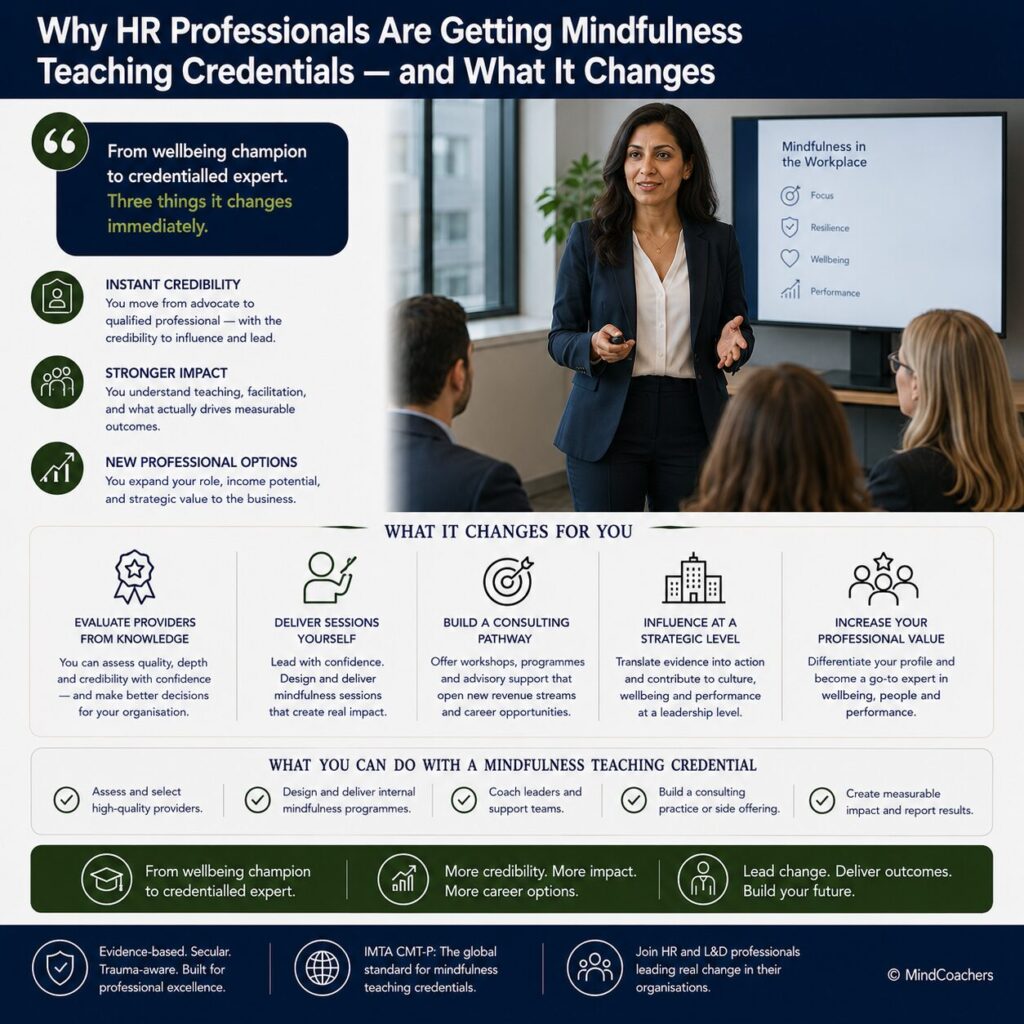
There is a pattern emerging in HR and wellbeing functions that is worth naming clearly. A growing number of HR managers, wellbeing leads, and people experience professionals are completing IMTA-accredited mindfulness teacher training — not primarily to change career, but to change what they can do in the role they already hold. The credential is being sought for a specific set of professional reasons: the ability to quality-assure external mindfulness providers with genuine professional knowledge, the authority to deliver introductory sessions without commissioning external contractors for every touchpoint, and the internal credibility shift that comes from moving from wellbeing champion to credentialled expert.
This article is for HR professionals who are considering this move and want an honest account of what it changes — professionally, practically, and in terms of career trajectory. For the training options available, see the best mindfulness teacher training for HR professionals: 2027 comparison. For the commissioning and quality assurance context, see how to commission a corporate mindfulness programme.
The MCMI — MindCoachers Certified Mindfulness Instructor is the programme in this segment built for professionals with demanding corporate schedules — fully online, 12 weeks, one live session per week, with a concurrent practicum that HR professionals can deliver using internal volunteer groups.
Key takeaways
→ The internal credibility shift from wellbeing champion to credentialled expert is the most consistently reported professional change among HR professionals who complete IMTA CMT-P. It is visible in board conversations, provider evaluation, and programme design authority.
→ Three specific capabilities change: internal delivery without external commissioning; quality assurance of external providers from a position of professional knowledge; and programme design authority — specifying what a mindfulness programme should deliver, not accepting whatever a provider proposes.
→ IMTA CMT-P is a meaningful asset for wellbeing consulting career pathways, but not the whole picture. HR experience in a specific sector + IMTA CMT-P + a defined niche is the combination that creates a consulting practice.
→ Employer CPD funding is achievable with the right framing: procurement protection, internal delivery cost reduction, and professional credential equivalence are the three arguments that carry weight with HR directors and L&D budget holders.
→ The MCMI — MindCoachers Certified Mindfulness Instructor is designed for HR professionals with full schedules — 12 weeks online, concurrent practicum integrated into internal organisational settings. Two credentials result: the MCMI certificate (automatic, included in tuition) and the IMTA CMT-P (post-graduation IMTA application, ~€150–250). Distinct steps.
The internal credibility shift: from wellbeing champion to credentialled expert
Most HR professionals who champion mindfulness internally occupy an ambiguous position: they advocate for something they believe in, they commission external providers, they measure outcomes with varying rigour, and they defend the investment when stakeholders question it — without the professional grounding to do so from a position of expert knowledge. They are advocates, not experts.
The shift that IMTA CMT-P produces is specific and visible. An HR professional who holds IMTA CMT-P:
- Can evaluate an external mindfulness provider’s curriculum and facilitation quality with professional knowledge, not just participant feedback and testimonials
- Can speak to the board about the organisation’s mindfulness programme from a position of direct professional competency, not relay of provider claims
- Can specify what a mindfulness programme should deliver — practice sequence, session structure, outcome measurement, trauma-aware protocols — rather than accepting whatever a provider proposes
- Can deliver introductory mindfulness sessions internally without commissioning external providers for every touchpoint
The why HR professionals need a mindfulness teaching credential covers the specific internal credibility dynamics in detail. The shift from advocate to expert is not about status — it is about the professional authority that changes what conversations are available to you and how they go.
What an HR professional with IMTA CMT-P can do that one without it cannot
Three practical capabilities change. Each is specific and immediately applicable in the HR role:
undefined An IMTA CMT-P credential enables HR professionals to deliver mindfulness sessions for their own employees — introductory sessions, team offsites, leadership development programmes, staff wellbeing days — without commissioning external providers for every delivery. This is not a trivial change. A single introductory session delivered internally saves the procurement overhead, scheduling overhead, and external provider cost associated with commissioning the same session externally. Over a programme of three to four cohorts per year, the financial case is straightforward.
undefined The credential enables genuine professional evaluation of external providers — not just reference checking and testimonial review, but curriculum scrutiny, facilitation quality assessment, and credential verification with professional knowledge. An HR professional with IMTA CMT-P can ask the seven vetting questions in the commissioning guide and evaluate the answers correctly. Without the credential, they are relying on provider self-report and participant satisfaction data that may not reflect programme quality.
undefined IMTA CMT-P equips HR professionals to design the organisational mindfulness programme themselves — specifying practice sequence, session structure, participant screening, outcome measurement, and facilitator requirements — rather than accepting whatever an external provider proposes. This is the capability that most directly changes the quality of the organisation’s mindfulness culture over time.
The financial case for a mindfulness teaching credential provides the specific financial modelling for each of these three capabilities in typical HR and wellbeing professional contexts.
Quality assurance: evaluating external providers from a position of knowledge
The quality assurance capability is the one that HR professionals most consistently underestimate before completing IMTA CMT-P — and most consistently value after. The reason is structural: the corporate mindfulness market has no licensing body, no protected job title, and no mandatory registration. The credential system exists, but the ability to use it as a quality filter requires understanding what each credential does and does not confer.
An HR professional without mindfulness teaching credentials who receives a proposal from a mindfulness provider is evaluating: the provider’s website, testimonials, price, and availability. They may ask for a sample session and assess participant response. None of this reliably distinguishes a credentialled professional from a practitioner whose primary identity is yoga teacher, life coach, or wellness influencer.
An HR professional with IMTA CMT-P evaluating the same proposal can ask specifically: Which IMTA-accredited programme did you train through? What is your CMT-P registration number? Can you describe your trauma-aware facilitation protocol for a group where participants have unknown mental health histories? What participant screening do you use before the programme? What validated outcome instruments do you include as standard? These questions, and the ability to evaluate the answers correctly, are the quality assurance capability that the credential produces. How a verified mindfulness teaching credential changes conversations covers how this plays out in specific provider evaluation scenarios.
The consulting and advisory career pathway it opens
For HR professionals who are building toward a consulting or advisory career in organisational wellbeing, IMTA CMT-P is a meaningful credential asset — but it is not the whole picture. The combination that creates a consulting practice is:
- HR or people experience background in a specific sector — the sector knowledge that gives consultancy relevance and specificity
- IMTA CMT-P — the professional mindfulness teaching credential that enables delivery alongside advisory
- A defined niche — the specific organisational context or population where the combination of sector knowledge and mindfulness expertise is differentiated: NHS wellbeing, professional services burnout, education sector staff mental health, etc.
IMTA CMT-P alone does not create a consulting practice. IMTA CMT-P plus sector expertise plus a defined niche produces a genuinely differentiated professional position. The career pathway from HR professional to wellbeing consultant typically takes three to five years from the point of IMTA CMT-P qualification — the time required to build the track record and client relationships that consulting depends on. Why the IMTA mindfulness teaching credential compounds in value over time explains why the credential value increases as the professional track record builds.
Making the case for employer-funded CPD
Employer funding for IMTA CMT-P level mindfulness teacher training is achievable. The three arguments that carry weight with HR directors and L&D budget holders:
- Procurement protection: completing IMTA-accredited mindfulness teacher training enables you to evaluate external mindfulness providers against a professional standard — protecting the organisation from poorly designed or inadequately credentialled programmes. A single poorly-delivered mindfulness programme does more damage to the organisational wellbeing case than years of positive evidence. This is a direct risk management argument.
- Internal delivery cost reduction: IMTA CMT-P qualification enables internal delivery of introductory workplace mindfulness sessions, reducing external provider costs for foundational delivery. The training investment is typically recoverable within 12 to 18 months through reduced commissioning spend at organisations running two or more mindfulness cohorts per year.
- Professional credential equivalence: IMTA CMT-P is a recognised international professional credential — equivalent in professional standing to specialist CPD in other HR disciplines (coaching qualifications, occupational health certificates, employment law qualifications). This argument is most effective with HR directors who understand the professional development investment framework for senior HR practitioners.
If employer funding is refused, the training investment is typically recovered within 12 to 18 months through freelance mindfulness facilitation alongside the day job — starting with the organisation’s own staff wellbeing events, progressing to external corporate clients as the track record builds.
Fitting the training around a demanding HR role
The format question is the most practically important for HR professionals with demanding schedules. The MCMI — MindCoachers Certified Mindfulness Instructor is designed specifically for practitioners in active professional roles:
- One live session per week (2.5 to 3 hours) — scheduled as a fixed commitment, typically a weekday evening or morning. Most HR professionals protect this as they would a senior meeting commitment.
- Self-study between sessions — approximately 2 to 3 hours per week, typically completed across commute time, lunch breaks, and early mornings. The content is engaging enough that most practitioners report this as restorative rather than burdensome.
- Concurrent 35-hour practicum — the most logistically challenging element, but HR professionals have a structural advantage: access to internal volunteer groups. Staff wellbeing champions, team offsites, internal events, and lunch-and-learn sessions are viable practicum contexts that cost no additional recruitment time.
Most HR professionals complete the training without taking annual leave or reducing their core HR responsibilities. Planning the practicum four to six weeks in advance is the single most important logistical step — identifying the internal groups who will participate in supervised mindfulness teaching sessions before training starts, not after.
Download the MCMI — MindCoachers Certified Mindfulness Instructor — prospectus: full curriculum, faculty profiles, pricing and cohort information.
Further reading and professional resources
Best Mindfulness Teacher Training for HR and Corporate Wellbeing Professionals: 2027 Comparison
Mindfulness in the Workplace: What Qualifications Do Corporate Facilitators Need?
CMT-P Certification Explained: How to Become an IMTA-Certified Mindfulness Teacher
Why HR Professionals Need a Mindfulness Teaching Credential
The Financial Case for a Mindfulness Teaching Credential
How a Verified Mindfulness Teaching Credential Changes Conversations
Why the IMTA Mindfulness Teaching Credential Compounds in Value Over Time
Next steps
If you are an HR or wellbeing professional ready to make the shift from wellbeing champion to credentialled expert, the MCMI — MindCoachers Certified Mindfulness Instructor is designed for practitioners with demanding corporate schedules — fully online, one live session per week, concurrent practicum integrated into internal organisational settings.
Frequently asked questions
About mindfulness teacher training for psychologists and the MCMI — MindCoachers Certified Mindfulness Instructor