
Mindfulness Teacher Training for Social Workers and Community Practitioners (2027)
How social workers, OTs, and community health practitioners are using IMTA CMT-P to reach the populations they already serve — with a practice that the evidence consistently supports.
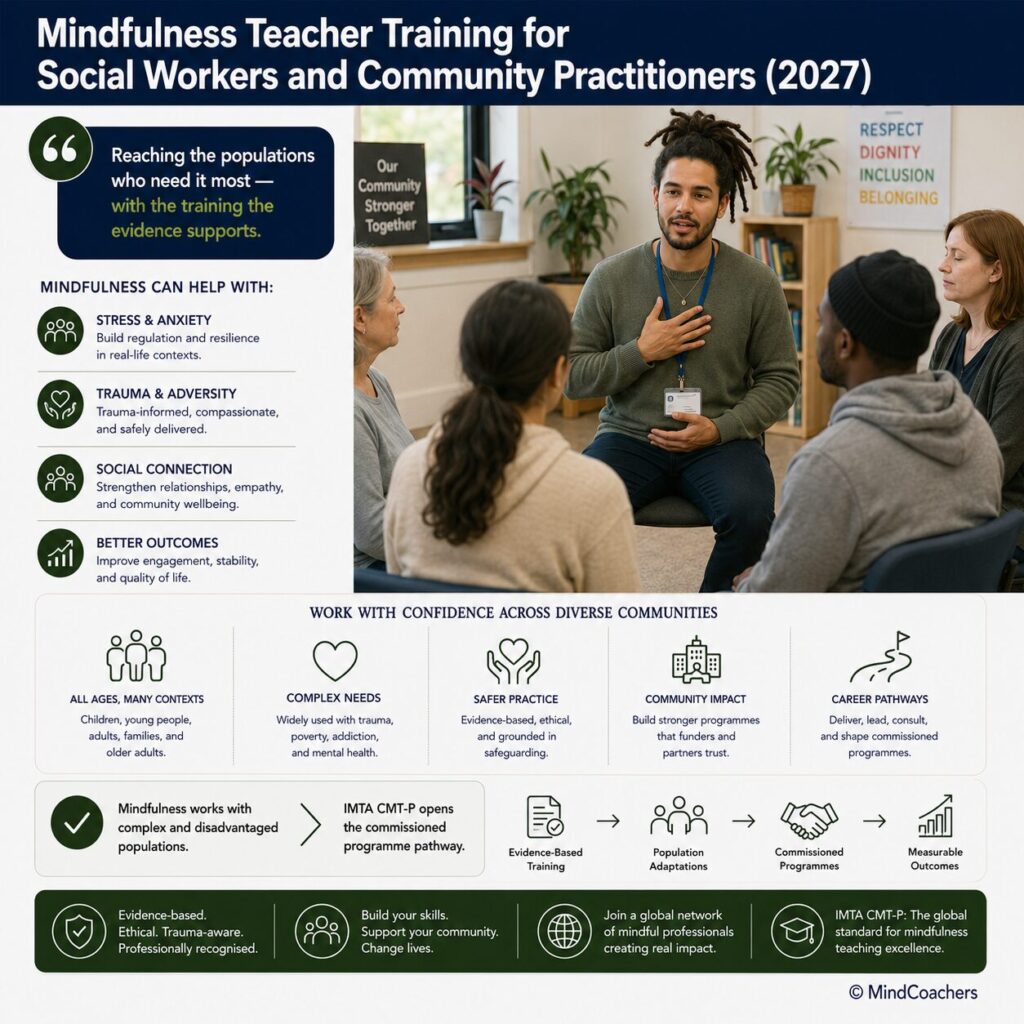
Social workers, occupational therapists, and community health practitioners occupy a distinctive professional position relative to mindfulness teaching: they already work with the populations that mindfulness research most consistently supports, they already hold the relational and clinical skills that formal mindfulness facilitation requires, and they already understand the systemic barriers that prevent disadvantaged communities from accessing conventional wellbeing provision.
What many of these practitioners do not yet hold is the formal mindfulness teaching credential that allows them to deliver structured mindfulness programmes in commissioned professional contexts — and the specific adaptations training that makes mindfulness work for populations with complex trauma histories, chaotic lives, and high levels of scepticism toward anything that sounds like therapy.
This article is for social workers and community practitioners at the point of asking: could mindfulness be a more deliberate professional tool? It covers the evidence for mindfulness with complex populations, what formal training adds to an existing social work background, how IMTA CMT-P opens voluntary and health sector programme contracts, and the honest practical guidance on fitting training into a high-intensity caseload. For the broader comparison of training options, see the best mindfulness teacher training for educators and social workers: 2027 comparison. For the credential framework, see CMT-P certification explained.
Key takeaways
→ The evidence base for mindfulness with complex and disadvantaged populations is substantial and growing: addiction recovery (Bowen et al., 2014), offender rehabilitation (Samuelson et al., 2007), homelessness services, and trauma recovery all show positive outcomes with appropriately adapted delivery.
→ Social workers and community practitioners bring competencies that most mindfulness teacher training participants lack: established therapeutic relationships, systemic understanding of service users’ lives, and clinical risk management experience. These are significant advantages in formal mindfulness teaching contexts.
→ IMTA CMT-P opens voluntary sector, NHS community mental health, and Local Authority commissioned mindfulness programme contracts that practitioners without this credential cannot access. This is one of the most direct impact pathways for social workers who want to reach more people.
→ The timing question deserves an honest answer: formal training is most successfully completed by practitioners at a genuine professional decision point — planning to shift toward community practice, develop a freelance strand, or reduce direct caseload. Acute caseload pressure is a real constraint.
→ The MCMI — MindCoachers Certified Mindfulness Instructor is built for public sector practitioners — trauma-aware protocols for complex populations, cultural competency content, and a 12-week online format. Two credentials result: the MCMI certificate (automatic, included in tuition) and the IMTA CMT-P (post-graduation IMTA application, ~€150–250). Distinct steps.
Why mindfulness works with complex and disadvantaged populations — and what the adaptations require
The evidence base for mindfulness with complex and disadvantaged populations is often not the starting point in mindfulness teacher training discussions, which tend to focus on well populations in corporate or clinical settings. For social workers and community practitioners, this evidence is the relevant evidence — and it is substantially more encouraging than is commonly known.
On addiction recovery: Bowen et al. (2014) demonstrated that Mindfulness-Based Relapse Prevention (MBRP) produced significantly lower substance use rates and higher levels of self-efficacy at 12-month follow-up compared to standard relapse prevention. The mechanism is specific: mindfulness training interrupts the automatic reactivity that drives addictive behaviour, creating a pause between craving and response that standard cognitive approaches do not reliably produce.
On offender rehabilitation: Samuelson et al. (2007) found that a prison-based mindfulness programme produced significant reductions in hostility, self-reported stress, and psychological distress among participants. The adaptation for this population — shorter sessions, grounding-forward practices, explicit choice-based facilitation — is directly transferable to other high-adversity community contexts.
On trauma and complex needs: the growing literature on trauma-sensitive mindfulness (Treleaven, 2018) provides the specific adaptation framework for populations with high trauma prevalence. The adaptations are learnable and specific — shorter practice durations, grounding-oriented anchors with eyes open, explicit trauma-sensitive protocols, and a facilitation style that offers genuine choice rather than direction. Community mindfulness teaching — why the credential matters covers why the credential specifically matters for these population contexts.
The critical caveat: these adaptations require formal training. Informal mindfulness use with complex needs populations — without the trauma-aware protocols, without the facilitation competency for difficult group dynamics, without the crisis referral procedures — carries higher clinical risk than use with general populations. The evidence supports adapted, formally delivered mindfulness for these populations. It does not support improvised mindfulness integration without formal training.
What formal mindfulness training adds to a social work or community practice background
Social workers and community practitioners who complete IMTA CMT-P training consistently report that the training builds on competencies they already have in ways that produce rapid facilitation confidence. The competencies that transfer immediately:
- Therapeutic relationship management: holding a group through difficult emotional material, managing individual distress within a group context, knowing when to end a practice and attend to an individual — these are clinical skills social workers already have and that mindfulness teacher training builds on directly
- Systemic awareness: understanding that a participant’s difficulty with a practice may reflect housing instability, childcare stress, or a mental health appointment that morning — not a practice failure. Social workers bring this contextual understanding to facilitation in ways that practitioners without community backgrounds cannot
- Risk management: crisis referral, safeguarding responses, the clinical judgement to adapt or end a session when something goes wrong — these competencies are already developed in social work training and transfer directly to mindfulness facilitation
What formal mindfulness teacher training adds specifically:
- The secular evidence-based framing: the language that makes mindfulness credible to participants who are sceptical of anything that sounds like therapy or spirituality — and to the commissioners who fund community programmes
- Programme design competency: the ability to design a structured, sequenced mindfulness programme appropriate for a specific community population — not just introduce individual practices
- IMTA CMT-P accreditation: the professional credential that voluntary sector, NHS, and Local Authority commissioners require for funded programme delivery
The MCMI — MindCoachers Certified Mindfulness Instructor is the programme in this segment with the community population adaptations built into the curriculum. Cultural competency in mindfulness teaching covers the specific cross-cultural facilitation content that makes the difference in diverse community contexts.
The commissioned programme pathway: how IMTA CMT-P opens voluntary and health sector contracts
One of the most direct impact pathways for social workers who want to reach more people with evidence-based intervention is the commissioned mindfulness programme pathway — and it is largely inaccessible without IMTA CMT-P.
The commissioning landscape for community mindfulness programmes has changed significantly over the past five years. Voluntary sector organisations, NHS community mental health teams, Local Authority public health functions, and social prescribing link workers are increasingly commissioning structured mindfulness programmes as part of community wellbeing provision. These commissioners are not looking for general wellbeing facilitators — they are looking for credentialled practitioners who can demonstrate professional competency and provide programme outcome data.
For social workers with IMTA CMT-P, the specific commissioned programme opportunities include:
- NHS social prescribing commissioned programmes: GPs and social prescribing link workers regularly refer patients to community wellbeing programmes. Credentialled mindfulness teachers can be included on social prescribing provider lists in most CCG areas with IMTA CMT-P
- Voluntary sector community wellbeing contracts: charities and community interest companies delivering funded community wellbeing services increasingly include mindfulness programmes in their delivery portfolios, and commission IMTA CMT-P practitioners to deliver them
- Local Authority public health commissioned programmes: local authority public health functions commissioning community stress management and mental health resilience programmes increasingly specify IMTA CMT-P as the facilitator credential standard
The social work clinical background is a significant commercial advantage in these commissioning contexts: commissioners seeking practitioners who can work safely with complex needs populations — participants with mental health presentations, trauma histories, and unstable life circumstances — prefer practitioners with clinical backgrounds. IMTA CMT-P plus social work experience is a stronger commissioning proposition than IMTA CMT-P alone. Why good intentions are not enough to respond to the wellbeing crisis covers why professional credentialling has become the commissioning standard.
How to introduce mindfulness to service users who have never heard of it
Introducing mindfulness to populations with high scepticism, chaotic lives, and previous negative experiences of therapeutic intervention requires a specific approach that differs substantially from standard mindfulness programme introductions.
undefined. Do not explain what mindfulness is before offering an experience of it. Open with: “We are going to try something that helps many people manage difficult feelings more easily. It takes about five minutes and you can stop at any time.” The experience precedes the explanation — not the other way around.
undefined. For populations with high trauma prevalence, breath-focused and body-scan practices carry higher risk of activation. Grounding practices — five senses in the room, feet on floor, hands visible — are safer starting points that produce a similar attentional anchoring effect without internal focus. Build toward internal attention practices only after the group has established trust in the practice format.
undefined. Three to five minutes for the first practice. This is not about attention spans — it is about permission. A five-minute practice that goes well creates more engagement than a 20-minute practice that participants endure. Length can increase as the group develops practice confidence.
undefined. Invitational language is not just pedagogical style — for populations with histories of coercion or control, genuine choice in how to participate is the therapeutic foundation of the session. “You might try” not “please close your eyes.” “If that feels comfortable” not “when you are ready.”
undefined. For groups with limited exposure to psychological or reflective language, simple physiological anchors are most accessible: the temperature of the air, the sound of the room, the weight of the body in the chair. These produce the same attentional present-moment effect as more conceptual practices, without requiring psychological vocabulary.
Fitting training into a high-intensity caseload: honest guidance
The timing question for social workers considering formal mindfulness teacher training deserves an honest answer rather than a sales pitch.
A 12-week intensive programme — one live session per week, plus 5 to 8 hours of self-study and practicum between sessions — is a significant commitment. For social workers with unpredictable and high-intensity caseloads, crisis duty responsibilities, and service user relationships that cannot be easily managed around a fixed training schedule, this commitment is real and should not be minimised.
The practitioners who complete IMTA CMT-P training most successfully from social work backgrounds are those at a genuine professional decision point: planning to shift toward community practice or a community interest company delivery model, developing a freelance strand alongside or instead of statutory work, or moving into a wellbeing lead or programme coordinator role that allows more schedule control.
If you are in acute caseload pressure with no near-term intent to change your professional context, the honest recommendation is to wait until that changes before beginning intensive formal training. The training will be more rewarding and more completable when your professional circumstances create genuine space for it.
Practical scheduling guidance for those who are ready:
- Protect the weekly live session as a fixed commitment — treat it with the same scheduling protection as a statutory appointment
- Use commute time, lunch breaks, and early mornings for self-study — the content is engaging enough that most practitioners report this as restorative rather than burdensome
- Plan the practicum before starting training, not during it — identify the groups you will work with for your 35 teaching hours before you begin, so this is not a logistical problem to solve mid-training
Community health practitioners, mental health support workers, and social prescribing link workers typically find the scheduling constraints of IMTA CMT-P more manageable than frontline social workers with statutory caseloads. If you hold a community-facing role with more schedule flexibility, the training typically fits more cleanly.
CPD, HCPC registration, and the qualification case
HCPC-registered social workers are required to maintain CPD as a condition of registration. HCPC does not specify particular CPD activities — it requires evidence of ongoing learning directly relevant to professional practice. IMTA CMT-P training clearly meets this standard.
When recording IMTA CMT-P training for HCPC CPD: “Completed IMTA-accredited professional mindfulness teacher training (200 hours, CMT-P level) to develop evidence-based mindfulness facilitation competency for use with community and clinical populations. Training covered trauma-aware facilitation protocols, programme design for complex-needs populations, and secular mindfulness curriculum design and delivery.”
This framing is directly relevant to social work professional practice — trauma-aware facilitation and community programme design are core social work competencies — and is substantial in volume (200 hours). It satisfies the HCPC CPD standard without qualification.
For practitioners who are not HCPC-registered, IMTA CMT-P functions as professional credential evidence independently — it is the internationally recognised standard for professional mindfulness teaching and is recognised as such by commissioning bodies, employers, and professional development frameworks across the European public and voluntary sector.
The full credential and qualification context is covered in is mindfulness teacher training regulated? What professionals need to know — including what IMTA CMT-P does and does not confer, and how it fits within the wider landscape of health and social care professional development.
Download the MCMI — MindCoachers Certified Mindfulness Instructor — prospectus: full curriculum, faculty profiles, pricing and cohort information.
Further reading and professional resources
Best Mindfulness Teacher Training for Educators and Social Workers: 2027 Comparison
CMT-P Certification Explained: How to Become an IMTA-Certified Mindfulness Teacher
Is Mindfulness Teacher Training Regulated? What Professionals Need to Know
Community Mindfulness Teaching — Why the Credential Matters
Cultural Competency in Mindfulness Teaching
Why Good Intentions Are Not Enough to Respond to the Wellbeing Crisis
Why Schools, Hospitals and Corporations Increasingly Require IMTA Accreditation
Next steps
If you are a social worker or community practitioner ready to formalise your mindfulness teaching competency, the MCMI — MindCoachers Certified Mindfulness Instructor is built for public sector practitioners — trauma-aware protocols for complex populations, cultural competency content for diverse community contexts, and a 12-week online format designed for those who cannot take residential time away from practice.
Frequently asked questions
About mindfulness teacher training for psychologists and the MCMI — MindCoachers Certified Mindfulness Instructor