
What Mindfulness Teacher Training Adds to an Educator’s Practice — Beyond the Obvious
How formal mindfulness teaching credentials are changing what teachers, school staff, and educational leaders can deliver — and why informal classroom mindfulness does not cover the same ground.
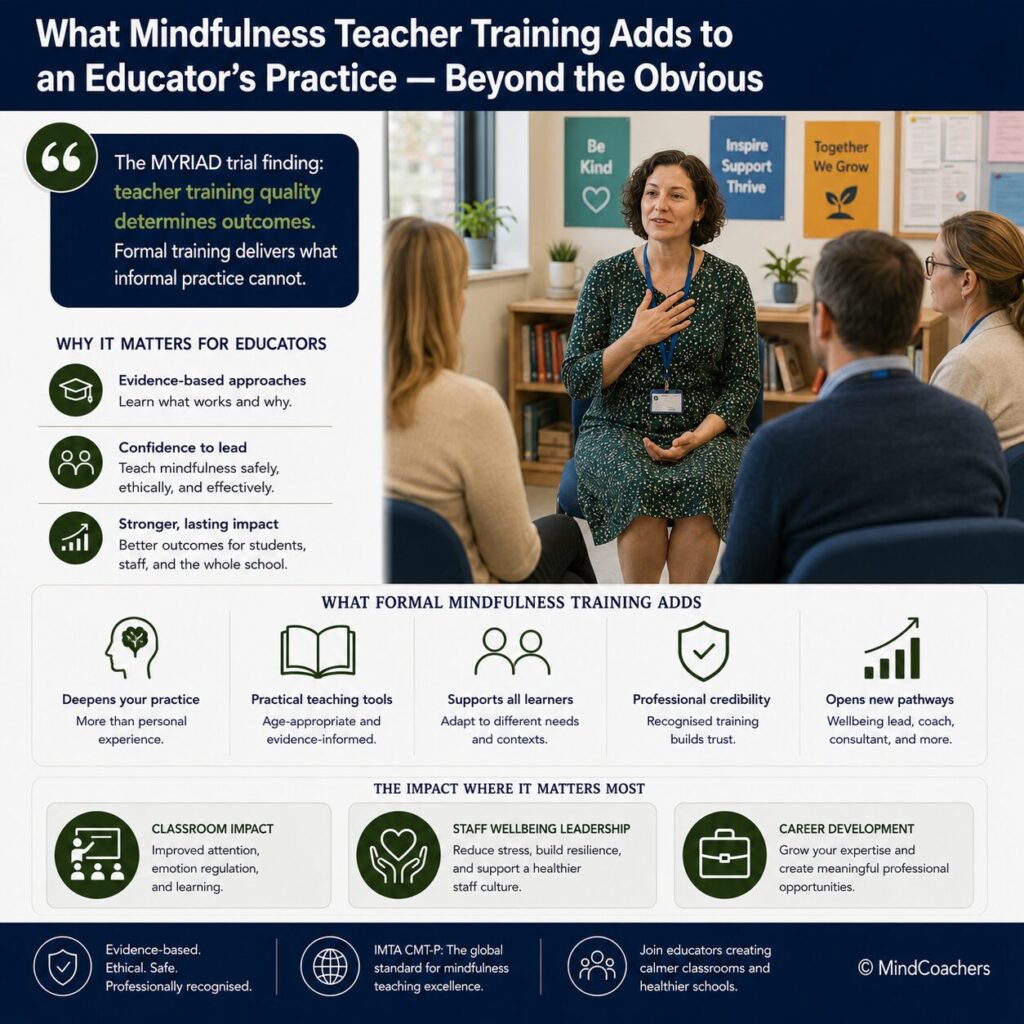
Most teachers who use mindfulness in their classrooms already know that it helps. They see the difference when a class settles into a brief breathing exercise before a test, when a student who normally cannot regulate themselves manages to pause before reacting, when the tone of the room shifts after a two-minute awareness practice. The intuition is strong, the experience is consistent, and the evidence base — though nuanced — supports it.
What most teachers do not know is what formal mindfulness teacher training adds to what they are already doing. This is the question this article answers — specifically, honestly, and with reference to the research that matters. For the comparison of training programmes available to educators, see the best mindfulness teacher training for educators and social workers: 2027 comparison. For the credential context, see mindfulness teacher certification: which credentials actually matter to employers.
The MCMI — MindCoachers Certified Mindfulness Instructor is the programme in this segment built for public sector practitioners — trauma-aware protocols for complex student and community populations, secular framing for diverse school contexts, and a 12-week online format designed for educators with demanding term-time schedules.
Key takeaways
→ Informal classroom mindfulness develops students’ practice through your practice. Formal mindfulness teacher training develops your ability to adapt when it goes wrong — the psychological theory, the trauma-aware protocols, and the pedagogical competency that intuition alone does not produce.
→ The MYRIAD trial (Kuyken et al., 2022) found that teacher training quality is the primary determinant of school mindfulness outcomes. Formally trained instructors consistently produce better results than briefly trained classroom teachers. This is the central evidence argument for professional training investment.
→ A credentialled educator can lead staff wellbeing mindfulness programmes, evaluate external providers, and commission and quality-assure formal mindfulness programmes for the school — three capabilities that informal classroom practice does not confer.
→ Formal mindfulness teacher training consistently reduces teacher burnout. Research (Jennings et al., 2011; Roeser et al., 2013) shows that mindfulness training for teachers reduces emotional exhaustion, improves emotional regulation, and strengthens teacher-student relationship quality.
→ The MCMI — MindCoachers Certified Mindfulness Instructor develops IMTA CMT-P level competency in a 12-week online format designed for educators. Two credentials result: the MCMI certificate (automatic, included in tuition) and the IMTA CMT-P (post-graduation IMTA application, ~€150–250). Distinct steps.
What informal classroom mindfulness does — and what it cannot do
Teachers who use mindfulness informally in their classrooms are doing something genuinely valuable. A brief grounding practice before an exam, a body-awareness exercise after a challenging lesson, a moment of breath awareness at the transition between activities — these interventions help, and teachers who use them consistently report positive effects on classroom atmosphere, student regulation, and their own presence in session.
The limits of informal classroom mindfulness are not about quality of delivery — an experienced teacher can guide a two-minute breath practice with genuine skill and care. They are about competency range: what you can do when the standard approach meets an unexpected situation. When a student dissociates during a body scan, when a practice triggers visible distress in a student with an unknown trauma history, when a class is so dysregulated that a grounding practice escalates rather than settles — these are the moments where formal training makes the clinical difference.
Formal mindfulness teacher training develops three specific competencies that informal practice does not:
- Psychological theory: understanding why the practices work — attentional regulation, decentering, the relationship between stress physiology and mindfulness practice — which allows intelligent adaptation rather than rigid script-following when students struggle
- Trauma-aware protocols specific to mindfulness practice: body scan dissociation risk, breath practice contraindications for students with trauma histories, in-session response protocols for acute distress — the clinical safety competency that classroom experience alone does not develop
- Programme design competency: the ability to design a structured, sequenced mindfulness programme — not just introduce individual practices — with appropriate participant screening, session structure, and outcome measurement
The MCMI — MindCoachers Certified Mindfulness Instructor develops all three in a 12-week intensive built specifically for practitioners with existing facilitation experience. What qualifies you to teach mindfulness in schools covers the credential threshold at which informal practice becomes formal programme delivery.
What the MYRIAD trial actually shows about training quality and outcomes
The MYRIAD trial (Kuyken et al., 2022) is the landmark research on school mindfulness, and it is frequently misread. The headline finding — that school mindfulness programmes produced no significant beneficial effects — has led some educators to conclude that school mindfulness does not work. This is a misreading of the trial’s actual finding, which is more specific and more instructive for training decisions.
The MYRIAD trial enrolled over 8,000 secondary school students across England. The mindfulness programmes were delivered by classroom teachers who received brief training. The finding was specific: programmes delivered by briefly trained classroom teachers produced no significant beneficial effects — and some non-beneficial effects in vulnerable subgroups. The key variable was teacher training quality.
The trial’s secondary analysis — comparing outcomes by teacher training depth — found consistent evidence that formally trained, credentialled instructors produce significantly better outcomes than those delivered by minimally trained teachers. This finding directly supports investment in formal mindfulness teacher training for educators who want to deliver effective school mindfulness programmes. It is not an argument against school mindfulness. It is an argument for training quality — specifically, for IMTA CMT-P level training over brief introductory courses.
For educators making a CPD funding case to senior leaders, the MYRIAD finding is the central evidence argument: the DfE Wellbeing for Education programme explicitly supports school wellbeing programme quality, and IMTA CMT-P level training is the evidence-based standard for that quality. AI in schools — qualified mindfulness teachers needed now provides the wider policy context.
The classroom impact: what changes when a teacher is formally trained
Educators who complete IMTA CMT-P training and return to classroom mindfulness practice consistently report specific changes in how they work — not always in what they do, but in how they do it and what they can handle when things go differently than expected.
undefined. Formal training develops the specific linguistic register for guiding mindfulness practices that maximises participant agency and minimises directiveness. The shift from “close your eyes and breathe deeply” (instructional) to “if it feels comfortable, you might allow your eyes to soften or close, and notice whatever is happening with your breath right now” (invitational) is a significant pedagogical change that produces measurably different student engagement. It takes formal training to develop — it is not intuitive for most teachers trained in instructional delivery.
undefined. Teachers who have completed formal mindfulness teacher training approach practice selection differently: they choose body-scan and breath-focused practices with specific knowledge of which student presentations make these practices contraindicated. They default to eyes-open and sound-based practices for new groups. They have explicit in-session response protocols for distress — which replaces improvised management of difficult moments with a practised, calm, effective response.
undefined. The post-practice debrief — “what did you notice?” — is the pedagogical element most strongly associated with sustained change in participants. It is also the element that informal classroom mindfulness use almost universally lacks. Formal training develops the capacity to hold group inquiry — non-directive, open, able to hold a range of responses — which transforms the classroom mindfulness experience from a brief intervention into a genuine learning conversation.
Staff wellbeing: the role a credentialled educator can play
One of the most practically important and least frequently discussed benefits of IMTA CMT-P for educators is the staff wellbeing dimension. Teacher burnout is a structural problem in UK and European education systems — and formally trained educators are uniquely positioned to address it from within their institutions.
An educator with IMTA CMT-P can:
- Design and deliver structured staff mindfulness programmes — 4 to 6 sessions for staff wellbeing, separate from classroom delivery, with appropriate participant screening and outcome measurement
- Lead staff wellbeing sessions at INSET days and professional development events — brief practices and awareness introductions that reach the whole school community
- Evaluate and quality-assure external wellbeing providers who offer mindfulness services to the school — applying the same credential and programme quality checks covered in the commissioning guide
- Serve as an internal expert reference for the school’s wellbeing lead and senior leadership team on mindfulness programme commissioning and quality
Research on teacher mindfulness and burnout (Jennings et al., 2011; Roeser et al., 2013) shows that mindfulness training for teachers significantly reduces emotional exhaustion, improves emotional regulation, and strengthens teacher-student relationship quality. The process of completing formal training has a specific additional benefit: the reflective and regulatory capacities developed through formal teacher training are precisely those that protect against burnout in the sustained way that brief wellness interventions do not.
The career development argument: what IMTA CMT-P opens for educators
Beyond the classroom and staff wellbeing dimensions, IMTA CMT-P opens a specific set of professional development opportunities that informal classroom mindfulness practice does not:
- External commissioned mindfulness facilitation: corporate wellbeing contracts, community mindfulness programmes, NHS-adjacent commissioned services, and professional CPD delivery — all accessible with IMTA CMT-P, none accessible with school-based informal practice
- Educational leadership development roles: wellbeing lead, PSHE lead, or school counselling support roles that include responsibility for mindfulness programme quality and delivery — positions where the credential distinguishes applicants
- External income alongside teaching: freelance mindfulness facilitation on weekends, evenings, and holidays — supplementary income that is typically structured differently from teaching rates and accessible immediately after qualification
For educators evaluating whether IMTA CMT-P is a viable career investment, is mindfulness teaching a viable career in 2027 provides the specific income and demand projections for the European market. Why schools, hospitals and corporations increasingly require IMTA accreditation explains why the institutional demand for credentialled practitioners is growing.
How to make the CPD funding case to your headteacher
Employer funding for IMTA CMT-P training is achievable in the education sector with the right framing. The arguments that carry weight with headteachers and school business managers:
- MYRIAD trial evidence: the trial demonstrates directly that school mindfulness outcomes depend on teacher training quality. Investing in IMTA CMT-P level training is the evidence-based response to the MYRIAD findings — not an optional extra, but a quality standard.
- DfE Wellbeing for Education alignment: the DfE Wellbeing for Education Return programme has established a policy expectation of school wellbeing programme quality. IMTA CMT-P is the professional credential standard that satisfies this expectation for mindfulness-based wellbeing programmes.
- Professional credential equivalence: IMTA CMT-P is a recognised international professional credential — equivalent in professional standing to specialist CPD in other educational disciplines. It is not a wellness course; it is professional qualification.
- Staff wellbeing ROI: the research shows that mindfulness training for teachers reduces emotional exhaustion and absence rates. A teacher who completes IMTA CMT-P can then deliver staff wellbeing mindfulness sessions internally, reducing external provider costs for the school.
If school funding is refused: the training investment is typically recovered within 12 to 18 months through freelance mindfulness facilitation income in evenings and holidays. What hospitals and schools actually check before hiring a mindfulness teacher covers the credential context for external commissioned work.
Download the MCMI — MindCoachers Certified Mindfulness Instructor — prospectus: full curriculum, faculty profiles, pricing and cohort information.
Further reading and professional resources
Best Mindfulness Teacher Training for Educators and Social Workers: 2027 Comparison
Is Mindfulness Teaching a Viable Career in 2027? Jobs, Income and European Outlook
Mindfulness Teacher Certification: Which Credentials Actually Matter to Employers? (2027)
What Qualifies You to Teach Mindfulness in Schools?
AI in Schools — Qualified Mindfulness Teachers Needed Now
What Hospitals and Schools Actually Check Before Hiring a Mindfulness Teacher
Why Schools, Hospitals and Corporations Increasingly Require IMTA Accreditation
Next steps
If the evidence in this article reflects what you already sense in your teaching practice, the MCMI — MindCoachers Certified Mindfulness Instructor is designed for educators at exactly this professional stage — informal mindfulness already in practice, ready to formalise to IMTA CMT-P level in a 12-week online intensive compatible with a term-time teaching schedule.
Frequently asked questions
About mindfulness teacher training for psychologists and the MCMI — MindCoachers Certified Mindfulness Instructor