
200-Hour Mindfulness Teacher Training: What You Actually Get for the Hours (2027)
Two hundred hours is the floor, not the standard. Here is what those hours should consist of — and how to tell the difference between programmes that use them well and those that do not.
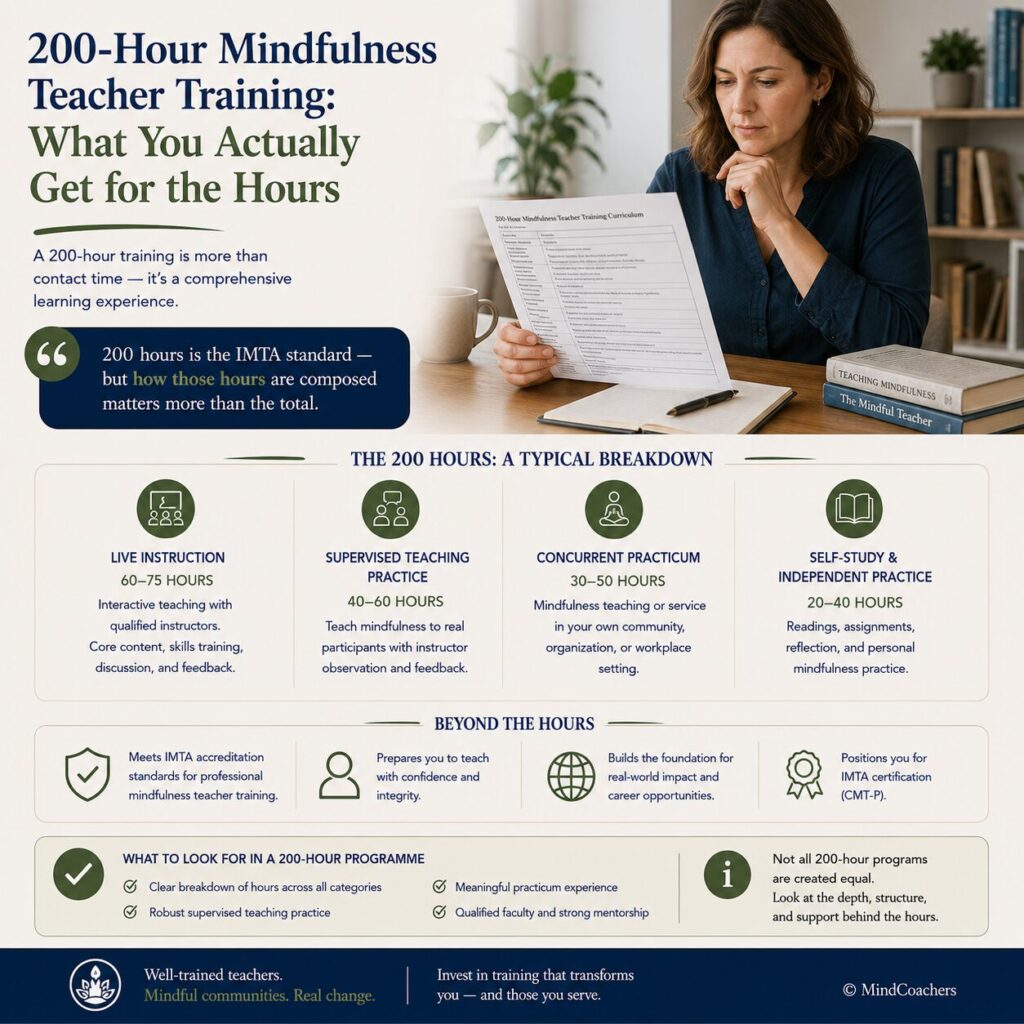
Two hundred hours is the minimum requirement for IMTA CMT-P (Certified Mindfulness Teacher – Professional) accreditation. It is also one of the most misused numbers in mindfulness teacher training marketing. Programmes routinely advertise “200-hour” training as if the number itself confers professional readiness — as if two hundred hours of watching pre-recorded video content produced the same outcome as two hundred hours of live cohort sessions, supervised teaching practice, and concurrent practicum.
It does not. The 200-hour figure is a floor, not a standard. Two programmes can both reach 200 hours while delivering radically different amounts of the specific activity that actually develops teaching competence. Understanding what those hours should consist of is the most practical thing you can do before choosing a mindfulness teacher training programme.
This article gives you a precise account of what a well-structured 200-hour mindfulness teacher training should deliver, how to assess any programme’s hour composition, and what the gap between “200 hours” as a marketing claim and “200 hours” as a rigorous professional programme actually looks like. For the foundational framework, see how many teaching practice hours does a mindfulness training actually need?. For how to read a curriculum to verify this, see how to read a mindfulness teacher training curriculum before you enrol.
Key takeaways
→ 200 hours is the IMTA minimum — two programmes can both reach this total while delivering very different amounts of live instruction, teaching practice, and concurrent practicum.
→ The single most important question is not the total hours but what percentage are live and synchronous vs pre-recorded and asynchronous.
→ A well-structured 200-hour programme delivers: 60–80 hours of live instruction, 30–40 hours of in-programme supervised teaching practice, a 35-hour concurrent practicum, and the remainder in personal practice and structured self-study.
→ Hours spent watching video content count toward the 200-hour total but do not develop teaching competence — only hours spent actually teaching do.
→ The cheapest 200-hour programmes typically reach the total by maximising asynchronous content — which is the lowest-cost delivery mechanism and the least effective for skill development.
Why 200 hours became the benchmark
The 200-hour minimum reflects the professional consensus — embodied in the IMTA CMT-P standard — about what is required to develop a credible foundation in mindfulness teaching. It is not an arbitrary number. It reflects the approximate time required to cover the theoretical foundations, practise teaching under supervision, complete an external practicum, develop personal practice, and integrate ethics and scope-of-practice content.
What 200 hours does not reflect is any particular distribution of those hours across activity types. The IMTA standard requires a concurrent practicum and supervised teaching practice, but it does not specify a minimum number of hours for live instruction or set a ceiling on asynchronous content. This is where significant variation between programmes exists — and where the 200-hour marketing claim can be most misleading.
For the full accreditation context, see what is IMTA accreditation for mindfulness teachers — and does it matter?. For the comparison between programmes, see best IMTA-accredited mindfulness teacher training programmes: 2027 guide.
The four-category breakdown: what 200 hours should consist of
Category 1: Live instruction hours (target: 60–80 hours)
Live instruction hours are hours where a qualified instructor is present and teaching in real time — responding to what is actually happening in the session, adapting to participant questions and confusion, demonstrating practices, and modelling the teaching presence that participants are trying to develop.
A programme with 60–80 live instruction hours across 200 total hours is spending 30–40% of its delivery on live interaction. This is a reasonable minimum for a programme that takes the development of teaching competence seriously. A programme where live instruction represents less than 20% of total hours is primarily an asynchronous content programme with a live component attached.
Ask any programme: how many hours of live, synchronous instruction are there? Which sessions are live and which are pre-recorded? The answer tells you more about programme quality than the total hour count. For the video that explains this distinction clearly, see the ceiling every mindfulness practitioner eventually hits — which addresses the gap between content knowledge and actual teaching capability.
Category 2: Supervised teaching practice hours (target: 30–40 hours)
Supervised teaching practice hours are hours where you are guiding real people through mindfulness practices — not watching, not participating as a student, not discussing teaching in theory. This is the in-programme counterpart to the external practicum, and it is the primary vehicle through which the MBI-TAC competency framework skills are actually developed.
Thirty to forty hours of in-programme supervised teaching practice — spread across the full programme, with structured feedback after each session — is the practical threshold for meaningful competence development. A programme that offers fewer than 15 hours of actual in-programme teaching practice is not primarily a teaching development programme; it is a curriculum programme with a teaching component.
For what supervised teaching practice should actually include, see the blog post what supervised teaching practice should actually include.
Category 3: Concurrent practicum hours (target: 30–40 hours)
The concurrent practicum is the external teaching component — guiding real participants outside the training context while the curriculum is running. IMTA requires this to run concurrently with the taught curriculum, not after it. A 35-hour concurrent practicum is a defensible professional benchmark.
The practicum hours are distinct from in-programme supervised teaching practice hours. They represent your first independent teaching experience — holding a teaching context without your instructor present, managing real group dynamics, and navigating the ethical responsibilities of teaching in the field. For the full case on why concurrent timing matters, see why teaching practice from day one makes better mindfulness teachers.
Category 4: Personal practice and self-study (remaining hours)
The remaining hours in a 200-hour programme are typically allocated to personal mindfulness practice and structured self-study — reading, reflection, practice logs, and asynchronous content engagement. These hours are legitimate and necessary: a mindfulness teacher without a sustained personal practice has a credibility problem that no amount of curriculum content can solve.
What they are not is teaching practice. A programme that conflates personal practice hours with supervised teaching practice hours in its hour breakdown is obscuring something important. Ask specifically: of the 200 hours, how many are personal practice and self-study, and how many are live instruction and supervised teaching?
What the cheapest 200-hour programmes actually deliver
The most budget-accessible 200-hour mindfulness teacher training programmes typically reach the 200-hour total by maximising asynchronous content. Pre-recorded video lectures are the lowest-cost delivery mechanism — they are produced once and delivered indefinitely without additional instructor time. A programme that delivers 150 of its 200 hours through pre-recorded content has a very different cost structure from one that delivers 70 of its hours through live instruction.
The consequence of this cost optimisation is predictable: practitioners who complete content-heavy, practice-light programmes are theoretically informed but practically underprepared. They have watched a great deal of mindfulness teaching; they have not done very much of it. The gap between knowing how mindfulness should be taught and being able to do it under real conditions is exactly the gap that supervised teaching practice is designed to close — and it cannot be closed by watching video content.
For the full picture of what cheap programmes actually cost professionally, see the real cost of the cheapest mindfulness certification and the video the three invisible costs of teaching mindfulness without proper training.
How to verify a programme’s hour composition
Any serious programme should be able to give you a clear, specific breakdown of its hours by category before you enrol. The questions to ask:
- How many total hours are live and synchronous (not pre-recorded)?
- How many hours are specifically supervised teaching practice — you guiding real people, not observing or participating as a student?
- When does the concurrent practicum begin, and how many hours does it require?
- What is the remainder — personal practice, self-study, asynchronous content?
- Is the full hour breakdown available in a published document before enrolment?
A programme that cannot answer these questions specifically, or that responds with vague descriptions rather than numbers, is either not tracking its hours by category or protecting a breakdown that does not reflect well on it. For the full curriculum evaluation framework, see how to read a mindfulness teacher training curriculum before you enrol. For what a rigorous curriculum should contain alongside the hours, see what a professional mindfulness curriculum should contain.
The MCMI hour structure
The MCMI — MindCoachers Certified Mindfulness Instructor publishes its full hour breakdown transparently. The programme structure:
- Live cohort sessions: Weekly 3-hour sessions across 12 weeks = 36 hours of live synchronous instruction with the full cohort and faculty.
- Supervised peer teaching practice: Structured within every live session from week one — each session includes teaching practice blocks with immediate feedback.
- Concurrent practicum: 35 hours of external supervised teaching, launched in session one and running across all 12 weeks.
- Personal practice: Documented daily personal practice across the 12-week programme — a requirement for the IMTA CMT-P application.
- Structured self-study: Asynchronous content between sessions — video resources, readings, and reflection tasks that supplement live instruction.
The full curriculum and hour structure are available at mindcoachers.com/en/mtt-mindfulness-teacher-training/ before enrolment. No sales conversation required.
Download the MCMI — MindCoachers Certified Mindfulness Instructor — prospectus: full curriculum, faculty profiles, pricing and cohort information.
Further reading and professional resources
↗ How many teaching practice hours does a mindfulness training actually need?
↗ Why teaching practice from day one makes better mindfulness teachers
↗ What makes a good mindfulness teacher training? 7 criteria
↗ How to read a mindfulness teacher training curriculum before you enrol
↗ 12-week vs 12-month mindfulness teacher training: which is right for you?
↗ Best IMTA-accredited mindfulness teacher training programmes: 2027 guide
↗ What supervised teaching practice should actually include
↗ MBI-TAC: Mindfulness-Based Interventions Teaching Assessment Criteria
Next steps
The MCMI — MindCoachers Certified Mindfulness Instructor publishes its full hour breakdown transparently — live instruction, supervised teaching practice, concurrent practicum, and self-study clearly separated and available before enrolment. IMTA accreditation is confirmed at CMT-P level. The distribution of hours is designed so that the activities that actually develop teaching competence — live instruction and supervised practice — account for the majority of structured programme time.
Frequently asked questions
About mindfulness teacher training for psychologists and the MCMI — MindCoachers Certified Mindfulness Instructor