
What Mindfulness Actually Adds to Executive Coaching — And What the Evidence Shows
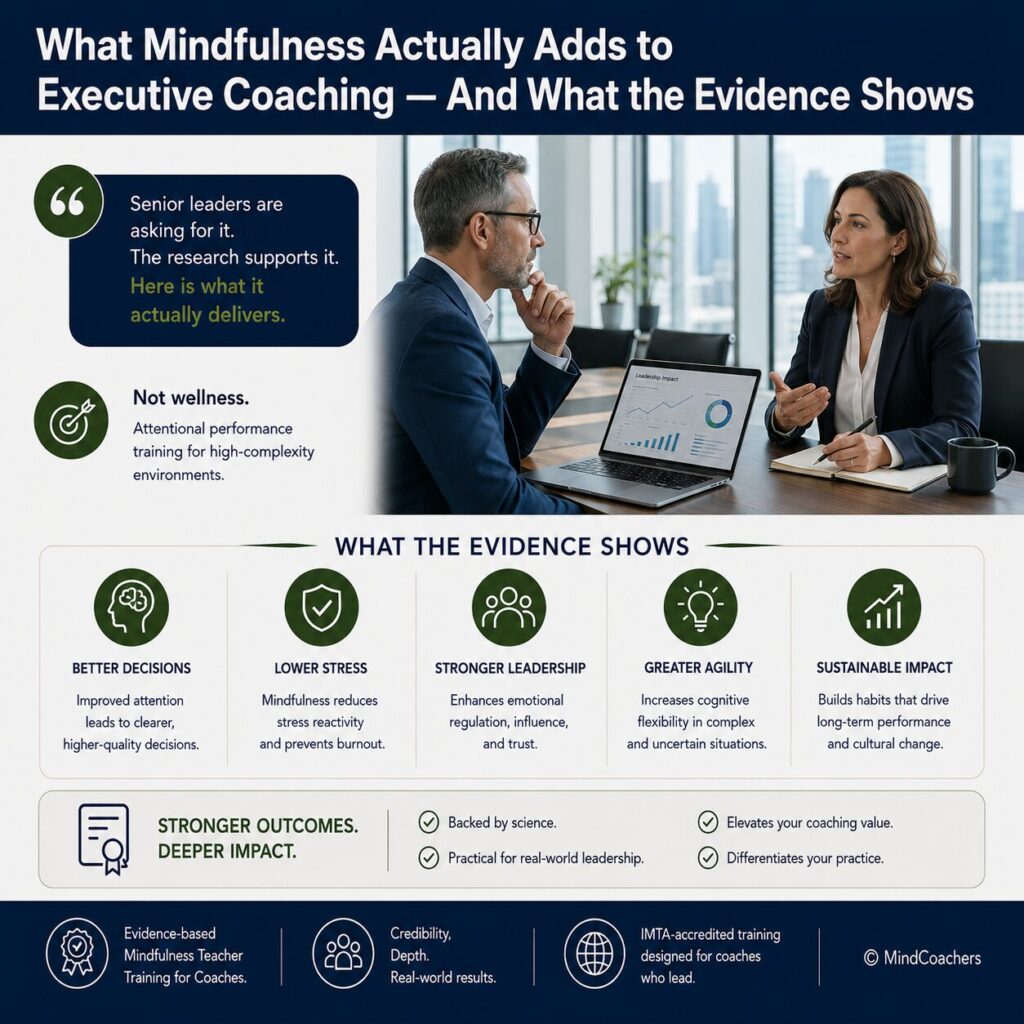
Senior leaders are asking for it. The research supports it. Here is what mindfulness-integrated coaching delivers that standard coaching cannot.
Executive coaches are increasingly encountering the same signal from different directions: clients mentioning meditation apps, organisations requesting mindfulness components in leadership programmes, procurement functions asking whether coaches can facilitate mindfulness alongside their coaching work. For many coaches, the question is no longer whether mindfulness belongs in executive coaching — it is whether they have the competency to deliver it, and what formal training would actually add to their existing practice.
This article answers both questions with specificity. It draws on the performance research on mindfulness and executive function, examines what mindfulness-integrated coaching actually delivers that standard coaching cannot, and explains the credential question honestly — why referencing mindfulness in sessions is a different professional capability from being able to teach it. For coaches who have already decided that formal training is the next step, the best mindfulness teacher training for executive coaches: 2027 comparison provides the full programme evaluation.
The starting context is mindfulness teacher training for executive and leadership coaches — the segment overview that covers the professional landscape. This article goes deeper into the demand-side case: what clients are actually asking for, what the research shows it delivers, and which coaches and clients benefit most.
Key takeaways
→ The executive mindfulness market is demand-led: senior leaders are requesting mindfulness-integrated coaching, not being sold it. Understanding what they are asking for — attentional performance, decision quality, leadership presence — determines how to frame and deliver it.
→ Multiple peer-reviewed studies show that mindfulness training improves executive function components directly relevant to leadership: working memory, selective attention, cognitive flexibility, and the capacity to regulate reactive decision-making under pressure.
→ Referencing mindfulness in coaching is mindfulness-informed practice. Formally integrating mindfulness — guiding structured practices, designing mindfulness development programmes alongside coaching — requires formal teacher training and a separate credential.
→ The MCMI — MindCoachers Certified Mindfulness Instructor is the programme in this segment built specifically for coaches in active practice — ACT integration throughout, corporate mindfulness content, and a 12-week cohort format that does not require pausing coaching work.
→ Two credentials result from the MCMI: the MCMI certificate (automatic on completion, included in tuition) and the IMTA CMT-P (post-graduation IMTA application, independent fee ~€150–250). They are distinct steps — never presented as one.
Why senior clients are asking for mindfulness — and what they actually want
The executive mindfulness market is demand-led. Senior leaders are not being sold mindfulness by coaches — they are arriving at coaching conversations having already encountered it: through corporate wellbeing programmes, through reading on cognitive performance, through peer networks where daily practice is increasingly normalised at senior level. The coach who cannot respond to this demand from a position of competency is already behind the curve.
What senior leaders are actually asking for is worth unpacking, because it is often not what coaches assume. The language is rarely spiritual or wellness-oriented. The questions are typically performance-framed: how do I maintain decision quality when I am cognitively overloaded? How do I stay present in high-stakes conversations when I have three other pressures active in my working memory? How do I interrupt reactive patterns that are undermining my leadership effectiveness? These are attentional and regulatory questions — and mindfulness training answers them with more precision than any other intervention available to coaches.
For the language that opens this conversation with sceptical executives, corporate mindfulness language — how to open budgets provides the specific framing. What AI research shows employers value adds the organisational context: the capabilities that mindfulness training develops are precisely those that employers are identifying as high-value in the current professional landscape.
What the performance research shows about mindfulness and leadership
The research base on mindfulness and executive function is now substantial, and the findings are consistent across methodologies and populations. For coaches evaluating whether mindfulness has a credible evidence base for the executive context, the following is the relevant evidence.
On attention and cognitive load: Jha et al. (2010) showed that mindfulness training produces significant improvements in working memory capacity and attentional stability under high cognitive load — the exact conditions of senior leadership. The mechanism is well-understood: mindfulness training strengthens the prefrontal regulatory systems that govern attentional deployment, reducing the cognitive load cost of task-switching and interruption.
On decision quality: research by Hafenbrack et al. (2014) demonstrated that brief mindfulness induction before decision tasks significantly reduced sunk-cost bias — one of the most pervasive and costly decision errors in executive populations. The effect was mediated by reduced rumination, which freed attentional resources for more accurate probability assessment.
On reactive leadership: Good et al. (2016) in a systematic review found consistent evidence that mindfulness training reduces reactivity — the tendency to respond to situational triggers with habitual rather than considered responses. For senior leaders managing complex stakeholder environments, reduced reactivity is among the highest-value changes a developmental intervention can produce.
On leadership effectiveness ratings: Reb et al. (2015) found that leader mindfulness was significantly positively correlated with subordinate performance and wellbeing — mediated by the leader’s reduced emotional reactivity and improved attentional capacity. This is the metric that matters most for organisational clients commissioning leadership development.
The competency difference: referencing mindfulness vs teaching it
Most executive coaches who have personal mindfulness practice already reference mindfulness in their coaching work — noting when a client is ruminating, discussing the relationship between attentional stability and decision quality, framing a difficult client pattern in terms of reactivity and defusion. This is mindfulness-informed coaching. It is useful, and it is different from mindfulness-integrated coaching.
The difference is competency and credential:
- Referencing mindfulness — drawing on mindfulness concepts in coaching conversation. No specific credential required beyond coaching registration.
- Guiding a formal practice — leading a client through a structured mindfulness practice within a session. Requires specific teaching competency: invitational language, practice structure, in-session risk management, debrief protocol.
- Designing a parallel mindfulness programme — developing a structured mindfulness development programme that runs alongside coaching. Requires programme design competency, participant screening, and formal teaching credential.
- Facilitating corporate mindfulness groups — leading mindfulness sessions for leadership teams or corporate groups. Requires IMTA CMT-P or equivalent, separate professional liability coverage, and formal teaching competency.
The difference between knowing ACT and teaching mindfulness with it illustrates the competency gap precisely — a coach can have a deep understanding of ACT theory and still lack the specific facilitation skills that formal mindfulness teacher training develops.
What mindfulness-integrated executive coaching can deliver that coaching alone cannot
Standard executive coaching develops insight, clarity on values, and skill in navigating complex professional situations. These are significant outcomes. Mindfulness-integrated coaching adds a set of capabilities that standard coaching does not develop — and that clients at senior level increasingly need:
- A daily attention training practice — a structured personal practice that clients can maintain independently, producing cumulative attentional and regulatory development beyond the coaching engagement itself. Standard coaching does not produce a self-maintaining developmental practice.
- In-session regulatory experience — the capacity to guide a client from a high-activation state into a regulated state within the session, using specific mindfulness techniques. This is a distinct clinical-adjacent competency that requires formal training.
- Interrupt-and-redirect skill — teaching clients to recognise and interrupt reactive patterns in real time, using specific mindfulness techniques. ACT’s defusion exercises and values-based pause practices are the most directly applicable tools. See why premium mindfulness teaching rates depend on communicable structure for how to position this capability.
- Parallel group mindfulness facilitation — the ability to offer standalone mindfulness sessions or programmes to the client’s organisation, creating additional value and revenue alongside the coaching engagement.
The credential question: why referencing mindfulness in sessions is not enough
The moment a coach guides a structured mindfulness practice in a coaching session — even informally — they have entered mindfulness teaching territory. This matters for two practical reasons.
First, professional liability. Standard coaching professional indemnity policies do not typically cover mindfulness facilitation. If a client has an adverse reaction to a guided practice — dissociation, acute anxiety, emotional overwhelm — in a session where the coach is not covered for mindfulness facilitation, the professional exposure is significant. IMTA CMT-P training addresses this directly by developing the risk management competency that formal teaching requires, and most professional liability insurers recognise the IMTA credential as the appropriate standard for coverage.
Second, the corporate facilitation market. When coaching clients ask coaches to facilitate mindfulness sessions for their leadership teams — which is happening with increasing frequency — the context shifts from coaching to mindfulness teaching. Why executive coaches need a mindfulness teaching credential covers this boundary question directly. The short answer: a coaching credential is not sufficient. IMTA CMT-P is.
Which executive coaching clients specifically benefit most from mindfulness integration
Mindfulness-integrated coaching is not the right approach for every executive client. It is specifically well-matched to clients presenting with:
- Cognitive overload and decision fatigue — senior leaders managing high cognitive demand, frequent task-switching, and complex stakeholder environments. Attention training produces the most measurable results in this population.
- Reactive leadership patterns — leaders whose habitual response patterns are creating friction in teams, damaging senior relationships, or undermining their own strategic effectiveness. Mindfulness-based defusion and values-reconnection are among the most effective interventions for this presentation.
- Leadership presence development — leaders who have been told they need to develop “executive presence” but have not received specific developmental guidance. Mindfulness training develops the attentional and regulatory capacities that presence is built on — with measurable outcomes.
- Transition and identity work — leaders navigating major role transitions, where the combination of mindfulness-based equanimity training and ACT values-clarification work produces a distinctive developmental experience.
Clients presenting with active mental health issues, trauma history, or significant psychological vulnerability require a clinical assessment before mindfulness practices are introduced — and should be working with a clinical practitioner rather than a coach for that dimension of their development. The scope of practice boundary is clear, and the MCMI — MindCoachers Certified Mindfulness Instructor covers exactly where that boundary sits and how to manage referrals across it.
Download the MCMI — MindCoachers Certified Mindfulness Instructor — prospectus: full curriculum, faculty profiles, pricing and cohort information.
Further reading and professional resources
Best Mindfulness Teacher Training for Executive and Leadership Coaches: 2027 Comparison
Mindfulness Teacher Training for Executive and Leadership Coaches (2027)
Adding Mindfulness Certification to Your Coaching Practice: A Practical Guide
Why Executive Coaches Need a Mindfulness Teaching Credential
Corporate Mindfulness Language — How to Open Budgets
What AI Research Shows Employers Value — Teachers Deliver It
The Difference Between Knowing ACT and Teaching Mindfulness With It
Why Premium Mindfulness Teaching Rates Depend on Communicable Structure
Next steps
If the evidence here reflects what you are already seeing in your coaching practice, the MCMI — MindCoachers Certified Mindfulness Instructor is built for coaches at exactly this professional stage — active practice maintained throughout training, ACT integration as a curriculum thread, and corporate mindfulness content included as a dedicated module.
Frequently asked questions
About mindfulness teacher training for psychologists and the MCMI — MindCoachers Certified Mindfulness Instructor