
The Mindfulness-Integrated Coach: How to Position and Price a Dual Credential
You have both the coaching credential and the mindfulness teaching credential — now here is how to communicate the combination in a way that attracts premium clients.
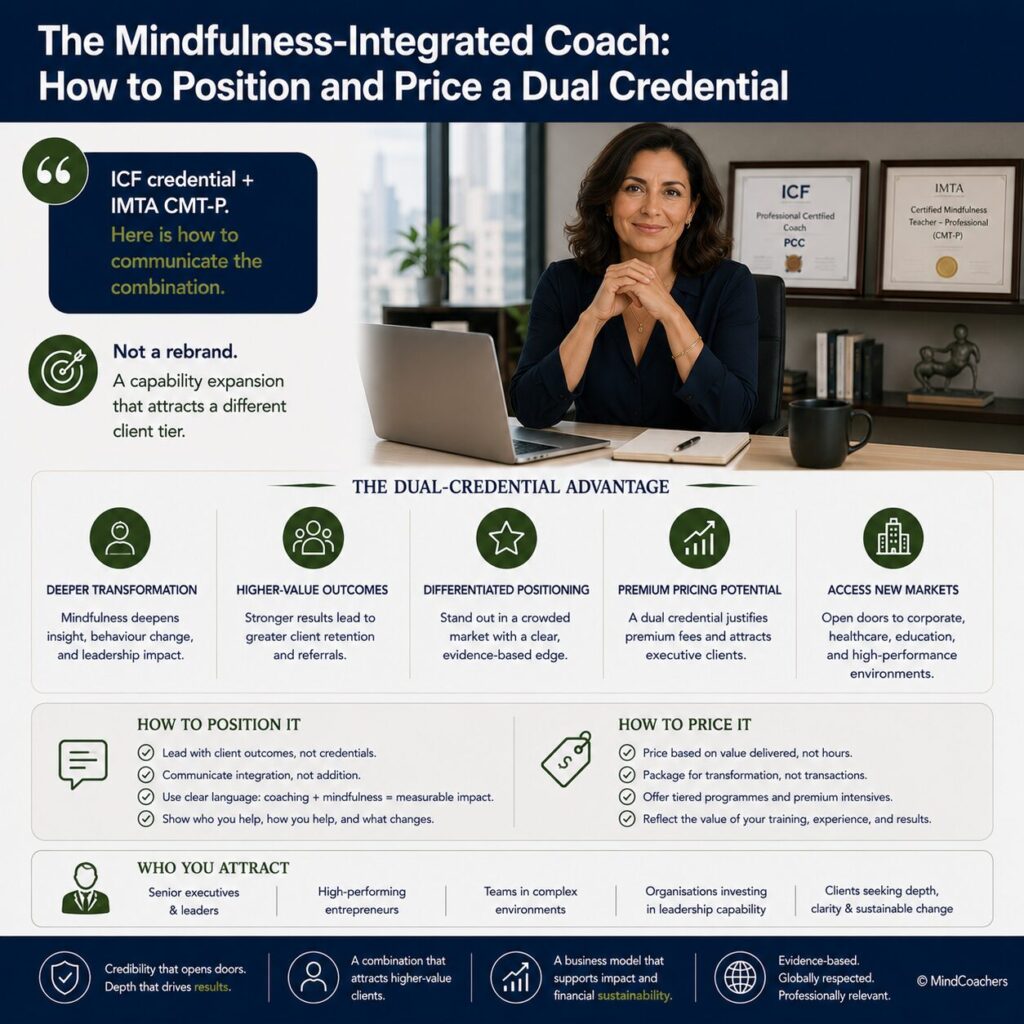
Completing mindfulness teacher training alongside an established coaching practice raises a specific set of professional questions that most training programmes do not address: how to update your professional positioning without it looking like a career pivot, how to talk about mindfulness in coaching proposals without triggering scepticism from corporate clients, how to price the expanded offer, and which client types are actively looking for what you now bring.
This article is for coaches who hold — or are about to hold — both an ICF credential and an IMTA CMT-P, and who want to turn that combination into a clearly differentiated professional market position. The context is set out in mindfulness teacher training for executive and leadership coaches and what mindfulness actually adds to executive coaching. This guide goes further: the practical positioning, communication, and pricing decisions that come after training is complete.
The MCMI — MindCoachers Certified Mindfulness Instructor is the programme that produces the IMTA CMT-P alongside the MCMI certificate — the combination this article addresses. For coaches currently evaluating training options, the best mindfulness teacher training for executive coaches: 2027 comparison covers the full programme evaluation.
Key takeaways
→ The dual credential is a positioning asset when communicated as a distinct professional capability — not as a wellness add-on or a coaching enhancement. The distinction is in how you frame it, not in what you have done.
→ LinkedIn positioning should lead with coaching experience and credential, introduce mindfulness as a capability expansion within the coaching context — not as a rebrand or a separate professional identity.
→ The premium from holding both credentials is not automatic — it comes from designing genuinely distinct programmes that clients cannot get from a coach-only or teacher-only practitioner. The combination itself is the product.
→ Three client types consistently self-select for mindfulness-integrated coaching: high-performers with performance plateaus, leaders in transition, and technically excellent professionals developing leadership competencies.
→ The MCMI produces two credentials: the MCMI certificate (automatic on completion, included in tuition) and the IMTA CMT-P (post-graduation IMTA application, independent fee ~€150–250). They are distinct steps — and both are relevant to how you position the dual credential professionally.
Why the dual credential is a positioning asset, not just a qualification
Most coaches who complete mindfulness teacher training think of it primarily as a qualification — something to add to a CV or LinkedIn profile. The coaches who achieve a genuine market premium think of it differently: as a product design decision. The combination of coaching competency and mindfulness teaching competency allows the design of programmes that neither a coach-only nor a teacher-only practitioner can offer — and that specific programme design is the positioning asset.
A senior leader engaging a mindfulness-integrated coach gets something structurally different from what they get from a coach who references mindfulness concepts or from a mindfulness teacher who facilitates group programmes. They get a coaching relationship that develops strategic and leadership competency alongside a mindfulness development track that develops the attentional and regulatory foundations for that competency. These are synergistic, not parallel — and the synergy is only available from a practitioner who holds genuine competency in both.
The mindfulness teacher certification credentials that actually matter to employers covers how institutional buyers evaluate the credential combination. The short version: IMTA CMT-P alongside a recognised coaching credential (ICF PCC or above, EMCC Senior Practitioner or above) is the combination that opens senior corporate L&D commissioning conversations.
The LinkedIn update that does not look like a career change
The most common mistake coaches make when adding mindfulness teacher training to their profile is creating a new professional identity alongside the coaching one — separate summary, separate experience entry, separate positioning. This signals career transition rather than capability expansion, and it triggers the question coaches least want clients to ask: “Are they still a coach?”
The positioning that works leads with coaching and integrates mindfulness as a capability within it:
- In the About section: “I am an [ICF credential] executive coach with [X] years working with [sector/level]. I have completed IMTA-accredited mindfulness teacher training (CMT-P), which I integrate into coaching programmes for clients who want to develop attentional performance and regulatory capacity alongside their strategic objectives.”
- In the Experience section: add IMTA CMT-P as a qualification within your current coaching role description — not as a separate role. The framing: “Programmes include mindfulness development tracks for clients seeking integrated attentional and leadership development.”
- In the Featured section: a case study or article on mindfulness-integrated coaching outcomes is more effective than a credential announcement. Standing out in an overcrowded mindfulness teaching market covers the content positioning strategy.
The underlying principle: the mindfulness teaching credential expands what you can deliver as a coach — it does not replace or compete with the coaching identity. The LinkedIn positioning should communicate exactly that.
How to talk about mindfulness in coaching proposals without losing credibility
Corporate buyers of coaching services are generally comfortable with evidence-based coaching methodologies. They are less comfortable with anything that sounds like wellness, spirituality, or lifestyle practice. The challenge for mindfulness-integrated coaches is framing the mindfulness component in language that passes the procurement filter.
The framing that works in proposals:
- Use outcome language first: “This engagement develops the attentional and regulatory foundations that strategic decision-making at senior level requires.”
- Name the mechanism second: “This is achieved through a structured mindfulness development track — evidence-based attention training that produces measurable improvements in working memory, cognitive flexibility, and reactive pattern interruption.”
- Reference the credential last: “The mindfulness development component is facilitated under my IMTA CMT-P credential — the internationally recognised professional standard for mindfulness teaching.”
This sequence — outcome, mechanism, credential — positions the mindfulness component as a professional service with a specific functional purpose, not as a lifestyle practice appended to a coaching engagement. For the specific language that opens corporate mindfulness budgets, see corporate mindfulness language — how to open budgets.
The client types who specifically seek mindfulness-integrated coaching
Three client types consistently self-select for mindfulness-integrated coaching — and understanding them allows more targeted positioning and outreach:
- High-performers experiencing performance plateaus: senior leaders who are technically strong but hitting limits in their leadership effectiveness — typically presenting as cognitive overload, reactive pattern persistence, or difficulty being present in high-stakes conversations. These clients are often already aware of mindfulness; what they want is a coach who can integrate it meaningfully rather than recommend an app.
- Leaders in transition: role change, burnout recovery, post-restructure reorientation, retirement transition. These clients are navigating identity and regulatory challenges simultaneously — and the combination of coaching and mindfulness development addresses both dimensions that neither element alone can hold.
- Technically excellent professionals moving into leadership: practitioners, engineers, finance professionals, and specialists who have been promoted into leadership roles and are developing relational and regulatory competencies they did not need in their prior roles. Mindfulness-integrated coaching develops the attentional and self-awareness foundations for these competencies with unusual efficiency.
These client types are reached through senior HR and L&D contacts managing leadership development programmes, professional associations for senior practitioners, and referral networks that mindfulness-integrated coaches need to build alongside their credential.
When to charge more — and how to justify it
The premium available from the dual credential is not automatic — and it is not generated by the credential itself. It is generated by the programme design the credential enables.
Coaches who add mindfulness as a session-opening practice to existing coaching engagements, without redesigning the engagement structure, rarely achieve a meaningful premium. The practice is visible but not distinctly positioned — it becomes a feature, not a product.
Coaches who design a genuinely distinct engagement — a six-month coaching contract that includes a parallel six-session mindfulness development programme, priced and scoped separately — typically achieve 25–40% above their standard engagement rate. The premium is justified by the deliverable: a self-maintaining daily practice with measurable attentional benefits, a debrief framework connecting mindfulness observations to leadership behaviour, and a programme architecture that produces developmental outcomes the coaching engagement alone does not.
For corporate mindfulness facilitation — standalone mindfulness sessions or workshops for leadership teams, commissioned separately from coaching — the rate structure is different again: corporate facilitation day rates, not coaching session rates, applied to a separately contracted service. From mindfulness teacher to wellbeing strategic advisor covers the longer professional development arc.
Building the referral network for mindfulness-integrated coaching
The referral network for mindfulness-integrated coaching is different from the referral network for standard executive coaching — because the client need being served is different. The most productive referral relationships for mindfulness-integrated coaches:
- Senior HR and L&D professionals managing leadership development programmes where mindfulness-integrated coaching addresses specific performance gaps they have already identified — cognitive overload, reactive leadership, presence in senior stakeholder relationships.
- Occupational health and EAP providers who refer senior leaders for burnout recovery and performance restoration — contexts where the combination of coaching and mindfulness development is directly responsive to the presenting need.
- Other coaches without mindfulness teacher training who encounter clients asking for mindfulness integration and prefer to refer to a credentialled practitioner. Why your referral network matters as much as your credential covers how to build these relationships systematically.
- Mindfulness teachers without coaching credentials whose clients are asking for more structural developmental support than a teaching relationship provides — the reverse referral from teacher to coach that the dual credential makes possible.
Download the MCMI — MindCoachers Certified Mindfulness Instructor — prospectus: full curriculum, faculty profiles, pricing and cohort information.
Further reading and professional resources
Best Mindfulness Teacher Training for Executive and Leadership Coaches: 2027 Comparison
Mindfulness Teacher Training for Executive and Leadership Coaches (2027)
Mindfulness Teacher Certification: Which Credentials Actually Matter to Employers? (2027)
Why Your Referral Network Matters as Much as Your Credential
From Mindfulness Teacher to Wellbeing Strategic Advisor
How a Verified Mindfulness Teaching Credential Changes Conversations
Standing Out in an Overcrowded Mindfulness Teaching Market
Next steps
If you are an executive coach ready to develop the dual credential that this guide addresses, the MCMI — MindCoachers Certified Mindfulness Instructor produces exactly the IMTA CMT-P alongside the MCMI certificate — in a 12-week online format designed for coaches in active practice.
Frequently asked questions
About mindfulness teacher training for psychologists and the MCMI — MindCoachers Certified Mindfulness Instructor