
What Formal Mindfulness Teaching Actually Adds to a Yoga Practice — Professionally
You already guide mindfulness in your classes. Here is what formal teacher training changes — in participant experience, professional access, and income ceiling.
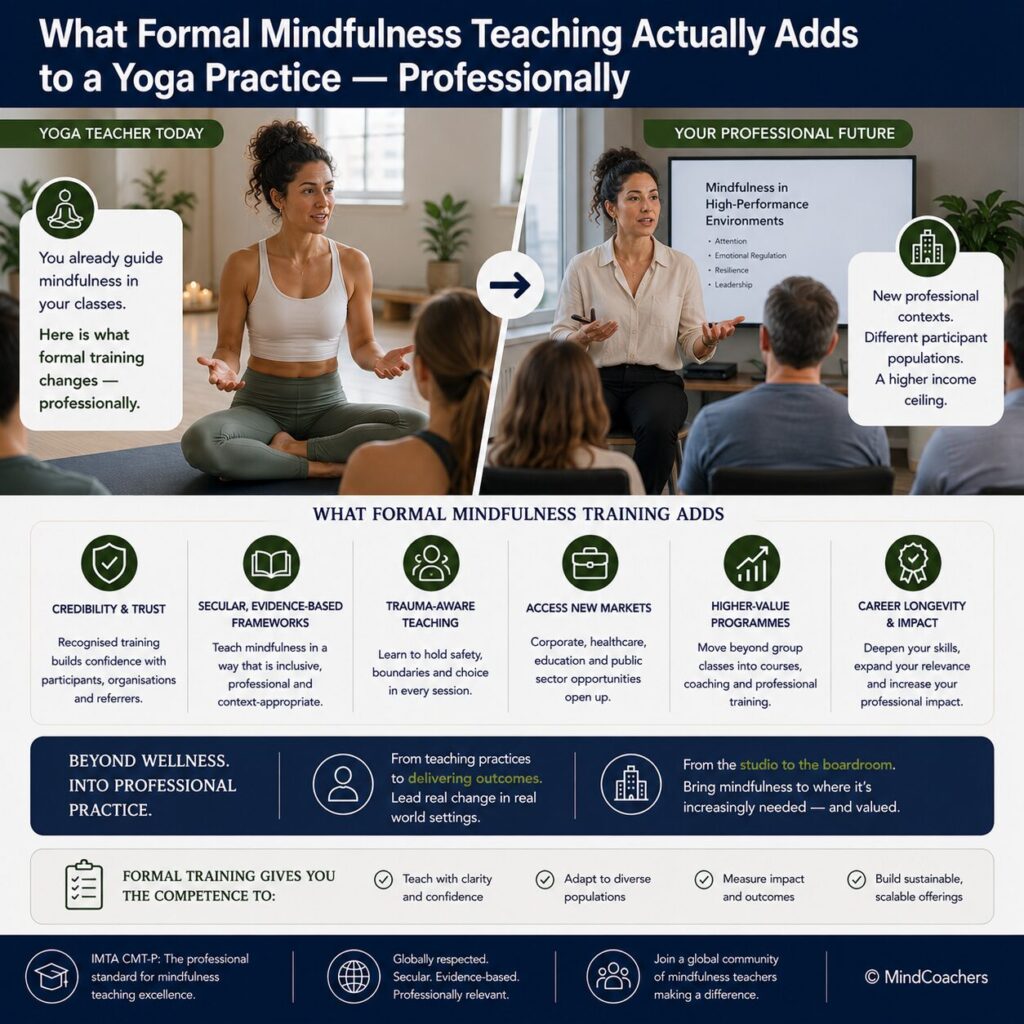
Most yoga teachers who incorporate mindfulness into their classes are doing something genuinely valuable. The closing meditation, the breath awareness cues during asana, the invitation to notice sensation without judgment — these elements deepen the yoga experience in ways students consistently notice and appreciate. The question is not whether this is good teaching. It is whether it is the same thing as formal mindfulness teaching — and whether the distinction matters professionally.
It is not the same thing. And the distinction matters considerably — for what participants experience, for which professional contexts become accessible, and for the income ceiling attached to yoga-with-mindfulness versus formal mindfulness teaching. This article addresses all three, for yoga teachers who are curious about formal training but not yet convinced that it changes anything meaningful. For the comparison of specific training programmes, see the best mindfulness teacher training for yoga teachers: 2027 comparison.
The context is set out in mindfulness teacher training for yoga teachers: bridging practice and formal instruction and teaching mindfulness professionally as a yoga teacher: 5 things your training needs to cover. This article goes deeper into the value question that precedes those practical decisions.
Key takeaways
→ Guiding meditation at the end of a yoga class and holding a standalone mindfulness teaching context are different professional competencies. The participant experience is demonstrably different; the professional credential requirements are different; the income potential is different.
→ Yoga Alliance credentials do not satisfy IMTA CMT-P requirements — regardless of total training hours or mindfulness content included. Corporate, NHS-adjacent, and educational institutional contexts require mindfulness-specific credentials.
→ Formal mindfulness teacher training adds three things yoga training does not: secular evidence-based framing for institutional audiences, trauma-aware protocols specific to seated practice, and the IMTA CMT-P credential that opens institutional markets.
→ The income ceiling of yoga-with-mindfulness is the yoga market ceiling. The income ceiling of formal mindfulness teaching is significantly higher, because it opens institutional commissioning contexts that pay at different rate structures.
→ The MCMI — MindCoachers Certified Mindfulness Instructor is built for yoga teachers at exactly this professional stage — existing teaching experience, informal mindfulness integration already in place, and ready to formalise to IMTA CMT-P level. Two credentials result: the MCMI certificate (automatic, included in tuition) and the IMTA CMT-P (post-graduation IMTA application, ~€150–250). Distinct steps.
The difference your students cannot articulate but consistently feel
Ask yoga students who have attended both a yoga class with mindfulness elements and a dedicated mindfulness programme to describe the difference. They typically cannot articulate it precisely — but they are consistent: the experiences feel categorically different, serve different needs, and produce different outcomes.
In a yoga class with mindfulness elements, participants are primarily engaged with physical practice. The mindfulness is a quality of attention applied to movement — the breath cue during a pose, the body scan at the end, the invitation to notice sensation without judgment. The experience is somatic and physical first, with mindfulness as a depth quality. Participants leave feeling physically worked and present.
In a dedicated mindfulness programme, the entire structure is built around developing present-moment awareness directly — through seated practice, guided inquiry, and home practice that accumulates between sessions. There is no physical practice to anchor the experience. The cognitive engagement is more didactic, more psychologically oriented, more verbal. Participants are asked to notice their minds, not their bodies, and to bring that noticing into conversation with the group. They leave the session having encountered the contents of their own minds in a structured and supported way.
The practitioner who can hold both of these experiences — the somatic and the cognitive, the physical and the psychological — is teaching two distinct things. Yoga training develops competency in the first. Formal mindfulness teacher training develops competency in the second. The identity shift from practising mindfulness to teaching it professionally covers exactly this transition.
Why informal mindfulness at the end of a yoga class is not the same as teaching it
The distinction is not about quality — an experienced yoga teacher may guide a closing meditation with extraordinary skill and presence. It is about competency structure: what the teacher can do when the context changes, when the participant population is different, when there is no yoga practice to hold the container.
Informal mindfulness in a yoga context typically operates within the safety of an established relationship: participants know the teacher, they have already moved their bodies and regulated their nervous systems through physical practice, and the mindfulness element arrives when they are already settled. The teacher can guide beautifully in this context using intuition, personal practice depth, and group facilitation experience developed in yoga.
Remove the yoga context — take the same teacher into a corporate group that has never done yoga, a workplace wellbeing session with people in office clothes on hard chairs, a clinical-adjacent group where some participants have trauma histories and the facilitator has no established relationship with them — and the competency requirements change substantially. What most mindfulness training misses about trauma-aware practice covers exactly the gap that becomes visible in these contexts.
Formal mindfulness teacher training at IMTA CMT-P level develops competency for the second context: secular framing for participants who do not share a yoga orientation, trauma-aware protocols for groups where clinical risk management is necessary, inquiry-based facilitation that holds psychological depth without the physical practice container, and the professional credential that institutional commissioners require. The ceiling every mindfulness practitioner eventually hits describes this transition point precisely.
What Yoga Alliance credentials cover — and what they do not
This is the most practically important distinction for yoga teachers evaluating formal training — and the most frequently misunderstood.
Yoga Alliance credentials certify yoga instruction competency. The RYT 200 and RYT 500 standards require specific hours in yoga technique, teaching methodology, anatomy, philosophy, and practicum — but they do not require mindfulness-specific curriculum content, supervised mindfulness teaching practice, trauma-aware mindfulness protocols, or any of the elements that IMTA requires for CMT-P accreditation.
A 500-hour YA training with extensive mindfulness content produces a yoga instruction credential, not a mindfulness teaching credential. A yoga teacher completing a 200-hour YA training focused on Yin yoga and mindfulness produces a yoga instruction credential, not a mindfulness teaching credential. The credential produced is determined by the credentialling body, not by the content of the training.
For a full breakdown of the credential landscape, IMTA vs Yoga Alliance vs IMMA: mindfulness teacher accreditation compared provides the complete picture. The short version: wellness course vs professional mindfulness certification is a useful starting point for yoga teachers who have completed extensive wellness training and are evaluating whether it meets institutional standards.
What formal mindfulness teacher training adds that yoga training does not
Formal mindfulness teacher training at IMTA CMT-P level adds four specific competencies that yoga training does not develop:
- Secular evidence-based framing: the ability to present mindfulness in the language of cognitive science, psychological evidence, and secular professional practice — without reference to yogic philosophy, Sanskrit terminology, or contemplative tradition. This is the framing required for corporate, educational, and clinical-adjacent institutional contexts.
- Psychological theory integration: understanding of the psychological mechanisms of mindfulness (attentional regulation, decentering, defusion) and their relationship to evidence-based interventions like ACT and MBCT. This theoretical grounding is what allows formal mindfulness teachers to work in clinical-adjacent contexts with appropriate competency.
- Trauma-aware teaching protocols for seated practice: body scan dissociation risk, breath practice contraindications for PTSD, crisis referral procedures for participants experiencing acute distress during mindfulness practice. These are categorically different from trauma-sensitive yoga protocols and are developed through formal mindfulness teacher training, not yoga training.
- The IMTA CMT-P credential: the internationally recognised professional standard for mindfulness teachers, recognised by corporate L&D departments, NHS-adjacent commissioners, EAP providers, and educational establishments. Yoga credentials are not accepted as equivalents by these institutional commissioners.
The MCMI — MindCoachers Certified Mindfulness Instructor develops all four competencies in a 12-week online intensive designed for practitioners with existing teaching experience. The programme is built for yoga teachers who already have facilitation depth and personal practice depth — and who need the secular professional framing, psychological theory, trauma-aware protocols, and IMTA CMT-P accreditation that institutional markets require.
The professional contexts that open — and why yoga credentials do not open them
The professional market access question is straightforward: which contexts become available with IMTA CMT-P that are not available with yoga credentials alone?
- Corporate wellbeing programmes: large employers commissioning workplace mindfulness increasingly require IMTA CMT-P or equivalent. A yoga teacher without this credential will not pass procurement screening for corporate mindfulness facilitation contracts.
- NHS and NHS-adjacent services: NHS trusts, PCNs, and IAPT-adjacent services commissioning mindfulness facilitation require verified professional credentials. Yoga credentials are not recognised as equivalent by NHS commissioners.
- EAP provider panels: employee assistance programme providers that refer clients for mindfulness-based support require practitioners to hold professional credentials. IMTA CMT-P is the standard for EAP panel membership; yoga credentials are not.
- Educational and school-based settings: schools and universities commissioning mindfulness programmes for staff wellbeing or student mental health increasingly require IMTA CMT-P accreditation or equivalent. Yoga credentials are not equivalent.
These contexts pay at different rate structures from yoga teaching — typically corporate facilitation day rates or per-programme fees, rather than per-class rates. The professional market access change is also an income structure change.
The income ceiling of yoga-with-mindfulness vs formal mindfulness teaching
The income ceiling of yoga-with-mindfulness is the yoga market ceiling: per-class rates for studio teaching, retreat fees, online course income, and private sessions. These are meaningful income streams — but they are bounded by market rate for yoga instruction, which in most European markets is relatively compressed.
Formal mindfulness teaching at IMTA CMT-P level opens income at a different rate structure:
- Corporate mindfulness facilitation: full-day or half-day rates at corporate training fees — typically significantly above yoga teaching rates per hour
- NHS-adjacent and EAP commissioned programmes: per-programme fees for structured 8-week or equivalent programmes, with multiple participants per session
- Standalone mindfulness programmes for professional audiences: premium pricing relative to yoga classes, reflecting professional credential and psychological depth
The transition is not instantaneous — building an institutional client base takes time. But the rate structure available to IMTA CMT-P qualified practitioners is categorically different from the rate structure available to yoga teachers without this credential. From yoga teacher to certified mindfulness instructor covers the realistic transition timeline and income expectations.
What yoga teachers bring that accelerates formal mindfulness training
The case for formal training is not that yoga teachers are lacking — it is that they are well-placed to complete it efficiently. Yoga teachers bring competencies that most mindfulness teacher training participants do not have:
- Established group facilitation experience: the capacity to hold a group, manage group dynamics, and adapt facilitation in real time. This is a significant advantage in the teaching practicum component.
- Somatic awareness and embodied practice depth: yoga teachers typically have deep personal practice in body awareness and breath — which transfers directly to mindfulness practice development and teaching authenticity.
- Experience of the learning curve students go through: yoga teachers who have helped students develop practice over time understand the psychology of developing a new mind-body practice. This accelerates the pedagogical development component of formal training.
What formal training adds to these existing strengths is specific and targeted: secular framing, psychological theory, trauma-aware seated practice protocols, and the credential. The MCMI — MindCoachers Certified Mindfulness Instructor is designed for practitioners with existing teaching experience — including yoga teachers — who want to develop formal mindfulness teaching competency efficiently and at IMTA CMT-P professional level.
Download the MCMI — MindCoachers Certified Mindfulness Instructor — prospectus: full curriculum, faculty profiles, pricing and cohort information.
Further reading and professional resources
Best Mindfulness Teacher Training for Yoga Teachers: 2027 Comparison
Mindfulness Teacher Training for Yoga Teachers: Bridging Practice and Formal Instruction (2027)
Teaching Mindfulness Professionally as a Yoga Teacher: 5 Things Your Training Needs to Cover
From Yoga Teacher to Certified Mindfulness Instructor
Wellness Course vs Professional Mindfulness Certification
The Identity Shift From Practising Mindfulness to Teaching It Professionally
The Ceiling Every Mindfulness Practitioner Eventually Hits
What Most Mindfulness Training Misses About Trauma-Aware Practice
Next steps
If the distinctions in this article reflect what you are already sensing in your yoga teaching practice, the MCMI — MindCoachers Certified Mindfulness Instructor is built for yoga teachers at exactly this professional stage — existing facilitation depth, informal mindfulness integration already in place, and ready to formalise to IMTA CMT-P level in a 12-week online intensive.
Frequently asked questions
About mindfulness teacher training for psychologists and the MCMI — MindCoachers Certified Mindfulness Instructor