
CMT-P Certification Explained: How to Become an IMTA-Certified Mindfulness Teacher
What the IMTA CMT-P credential is, what it requires, how to apply for it, and what it signals when you present it professionally.
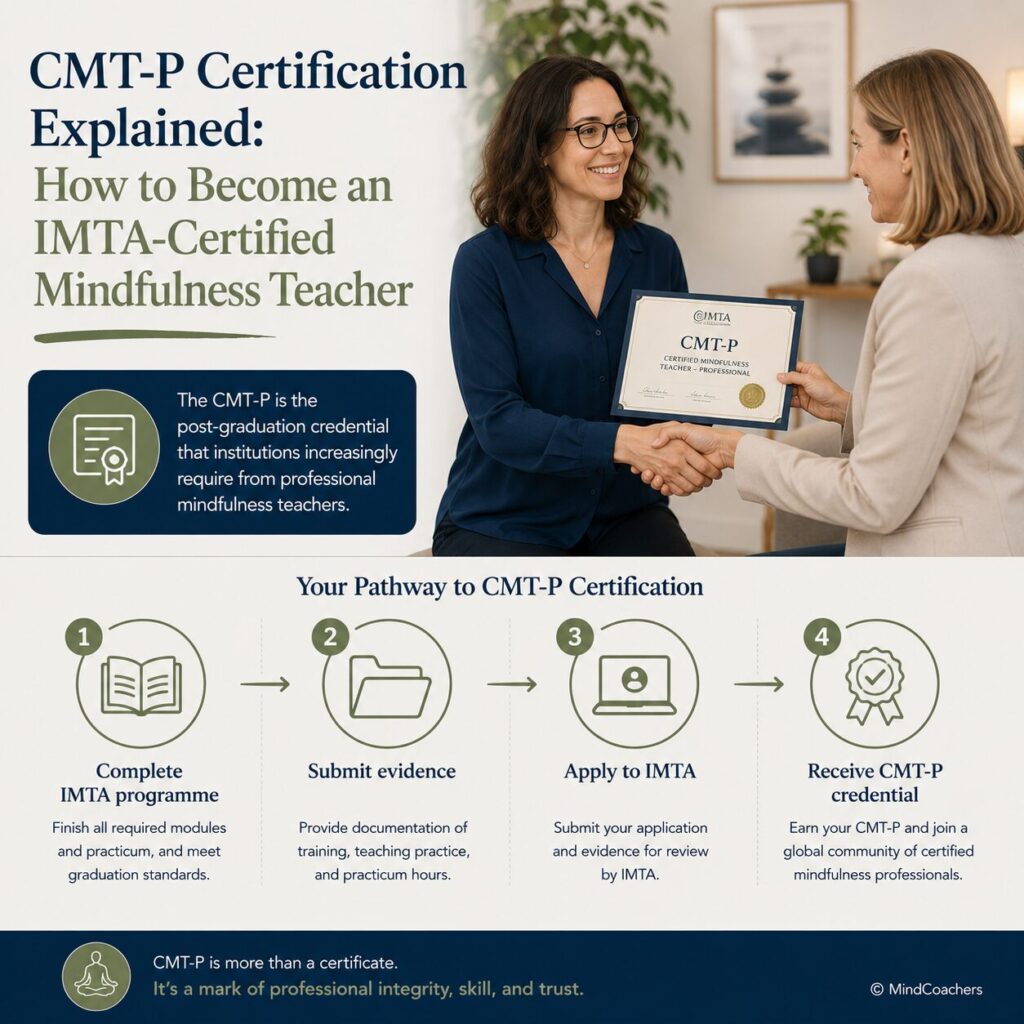
The CMT-P — Certified Mindfulness Teacher – Professional — is the credential awarded by the International Mindfulness Teachers Association to practitioners who have completed an IMTA-accredited programme and met the post-graduation application requirements. It is the most rigorous independently assessed mindfulness teaching credential currently available in the European professional market.
Understanding the CMT-P is not straightforward because it involves two distinct stages that are frequently conflated: completing an IMTA-accredited programme (which makes you eligible to apply for the CMT-P) and submitting a successful application to IMTA (which awards the CMT-P). These are different steps, with different requirements, different costs, and different timelines. Conflating them — or allowing marketing to conflate them — is one of the most common sources of confusion in the mindfulness teacher training market.
This article gives a complete, step-by-step account of the CMT-P pathway: what IMTA-accredited training requires, what the post-graduation application involves, and what the credential demonstrates once held. For the full accreditation context, see what is IMTA accreditation for mindfulness teachers — and does it matter?. For the comparison with other accreditation bodies, see IMTA vs Yoga Alliance vs IMMA: mindfulness teacher accreditation compared.
Key takeaways
→ The CMT-P credential requires two distinct steps: completing an IMTA-accredited programme (eligibility) and submitting a successful post-graduation application to IMTA (the credential itself).
→ The post-graduation IMTA application requires documented teaching practice hours, a personal practice log, programme completion evidence, and two professional references.
→ The CMT-P application fee (approximately €150–250) is paid directly to IMTA and is separate from programme tuition — it is never included in programme costs.
→ The CMT-P credential is held by the individual practitioner, not linked to any programme or employer, and does not expire provided continuing professional development requirements are met.
→ The programme completion certificate and the IMTA CMT-P are distinct credentials — always present them separately and never imply one is the same as the other.
Stage 1: Completing an IMTA-accredited programme
The first stage of the CMT-P pathway is completing a programme that appears on the IMTA accredited programmes list. This is a prerequisite — the CMT-P application cannot be submitted without evidence of completing an accredited programme. Completion of a non-accredited programme, regardless of its quality, does not qualify a practitioner to apply for the CMT-P.
What IMTA-accredited training requires
An IMTA-accredited programme must deliver a minimum of 200 hours across:
- Live instruction: Synchronous sessions with qualified instructors.
- Supervised teaching practice: Hours guiding real people under qualified supervision with structured feedback.
- Concurrent practicum: External supervised teaching running alongside the curriculum — not after it. For why concurrent timing matters, see why teaching practice from day one makes better mindfulness teachers.
- Personal practice: Documented personal mindfulness practice across the programme period.
- Self-study: Structured reading, reflection, and asynchronous content.
For a full breakdown of what these hour categories mean in practice, see how many teaching practice hours does a mindfulness training actually need?. For how to choose between IMTA-accredited programmes, see best IMTA-accredited mindfulness teacher training programmes: 2027 guide.
What completion produces
Completing an IMTA-accredited programme produces a programme completion certificate — issued by the training provider, not by IMTA. This certificate is evidence of training completion. It is not the CMT-P credential. It is the first step in a two-step process.
The distinction matters professionally. When presenting your qualifications to employers, commissioners, or clients, the programme completion certificate and the CMT-P credential signal different things. The certificate signals that you completed training with a specific provider. The CMT-P signals that you met an independently assessed professional standard. For what employers actually check, see mindfulness teacher certification: which credentials actually matter to employers?. The video certificate vs professional register: what actually verifies a mindfulness teacher explains this distinction clearly.
Stage 2: The IMTA CMT-P application
After completing an IMTA-accredited programme, graduates submit a formal application to IMTA for the CMT-P credential. This is an independent assessment process — IMTA reviews the application evidence against its published standards and makes an independent decision. It is not automatic.
Application requirements
The CMT-P application requires the following documentation:
- Programme completion evidence: Official confirmation from your IMTA-accredited programme provider that you have completed the programme.
- Teaching practice log: A documented record of your practicum hours — date, duration, participant group, practice type, and any supervisory notes. IMTA specifies the minimum practicum hours required; your programme will clarify the specific documentation format.
- Personal practice log: A documented record of your personal mindfulness practice across the programme period. IMTA requires evidence of sustained personal practice — not just during the programme, but as an ongoing commitment.
- Two professional references: References from qualified supervisors, programme faculty, or other mindfulness professionals who can attest to your teaching competence and professional conduct. References must be from qualified practitioners — peer references from cohort members are typically not sufficient.
- Application fee: Approximately €150–250, paid directly to IMTA. This fee is separate from programme tuition and is never included in programme costs. Budget for it separately.
Application timeline
IMTA processes CMT-P applications within approximately 4–8 weeks of receiving a complete application. Incomplete applications — missing documentation or references — extend this timeline. IMTA may request additional information before making a decision. Once approved, the CMT-P credential is issued in digital format and can be presented immediately.
If an application is not approved
IMTA will communicate the reasons for any unsuccessful application and, in most cases, provide guidance on what additional evidence or development is required before reapplying. Common reasons for unsuccessful applications include insufficient practicum hours, inadequate personal practice documentation, or references that do not meet IMTA’s qualification requirements for referees.
What the CMT-P credential signals
Once awarded, the CMT-P credential signals to employers, commissioners, and clients that the holder has:
- Completed an independently assessed, IMTA-accredited 200-hour professional mindfulness teacher training
- Completed a concurrent practicum — supervised teaching with real external participants during training
- Maintained a documented personal mindfulness practice
- Been assessed by a qualified practitioner as demonstrating appropriate teaching competence and professional conduct
- Met the independent post-graduation requirements of the International Mindfulness Teachers Association
This is different from what a provider-issued programme completion certificate signals. The CMT-P is independently assessed and independently verified — neither the programme provider nor the practitioner has sole control over the outcome. This independent verification is the primary professional value of the CMT-P relative to provider-issued certificates.
For the income implications of holding the CMT-P, see mindfulness teacher salary guide: realistic income ranges for Europe. For the career context, see is mindfulness teaching a viable career in 2027?. The video why the IMTA mindfulness teaching credential compounds in value over time gives the long-term professional perspective.
CMT-P maintenance and renewal
The CMT-P credential is not a one-time certification. IMTA requires credential holders to maintain their status through continuing professional development (CPD). Specific CPD requirements vary and are published by IMTA on its website. Failure to meet CPD requirements results in credential lapse — after which the credential can no longer be presented as current.
For practitioners building long-term professional practice, the ongoing CPD requirement is a feature, not a limitation: it ensures that CMT-P holders maintain currency in a field that is developing rapidly. For professional indemnity insurance purposes, currency of training is often a policy condition. See professional indemnity for mindfulness teachers for the insurance context.
The dual credential: MCMI certificate + IMTA CMT-P
Completing the MCMI — MindCoachers Certified Mindfulness Instructor produces two credentials:
- MCMI certificate: Issued automatically by MindCoachers on programme completion. Included in tuition. Evidence of completing the MCMI programme.
- IMTA CMT-P: Issued independently by IMTA after a successful post-graduation application. Application fee approximately €150–250, paid directly to IMTA. Not included in MCMI tuition. Evidence of meeting the independently assessed IMTA professional standard.
Both credentials are presented separately and accurately in all MCMI materials. The CMT-P is never described as automatic or included in programme tuition. For practitioners using the MCMI as their pathway to CMT-P, the programme completion certificate is presented as the first credential — evidence of training — and the CMT-P, once awarded, is presented as the second — independently verified professional status. For the regulatory context around credentials, see is mindfulness teacher training regulated? What professionals need to know. For the financial case for pursuing the CMT-P, see the financial case for a mindfulness teaching credential.
Download the MCMI — MindCoachers Certified Mindfulness Instructor — prospectus: full curriculum, faculty profiles, pricing and cohort information.
Further reading and professional resources
↗ What is IMTA accreditation for mindfulness teachers — and does it matter?
↗ IMTA vs Yoga Alliance vs IMMA: mindfulness teacher accreditation compared
↗ Mindfulness teacher certification: which credentials actually matter to employers?
↗ Is mindfulness teacher training regulated? What professionals need to know
↗ Best IMTA-accredited mindfulness teacher training programmes: 2027 guide
↗ Is mindfulness teaching a viable career in 2027?
Next steps
The MCMI — MindCoachers Certified Mindfulness Instructor is the pathway to both credentials: the MCMI programme completion certificate (automatic on completion, included in tuition) and IMTA CMT-P eligibility (post-graduation application to IMTA, approximately €150–250 fee paid directly to IMTA). IMTA accreditation is confirmed at CMT-P level and verifiable on the IMTA accredited programmes list. The programme is designed to support graduates through the CMT-P application process — practicum logs, personal practice documentation, and faculty references are built into the programme structure.
Frequently asked questions
About mindfulness teacher training for psychologists and the MCMI — MindCoachers Certified Mindfulness Instructor