
Is Mindfulness Teacher Training Regulated? What Professionals Need to Know
Mindfulness teaching is unregulated in most European jurisdictions — which makes the voluntary professional standards more consequential, not less.
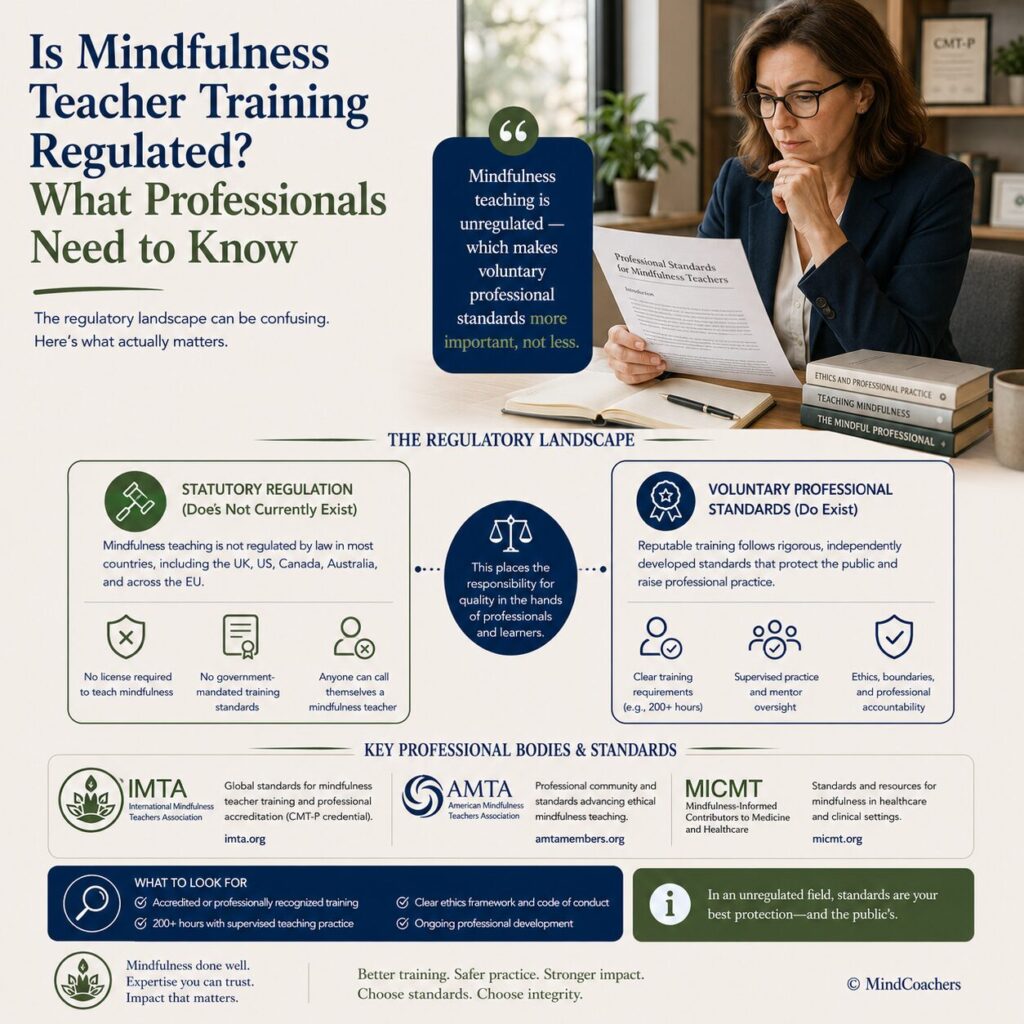
Mindfulness teaching is not a regulated profession. In the UK, across the EU, and in most other European jurisdictions, there is no statutory licensing body, no protected title, no minimum qualification requirement, and no legal framework that governs who can call themselves a mindfulness teacher or charge for mindfulness instruction. Anyone can teach mindfulness and charge for it, regardless of their training or credentials.
This is the factual starting point — and it has significant consequences that practitioners, commissioners, and potential students frequently misunderstand. Unregulated does not mean unrestricted. Unregulated does not mean without professional standards. And unregulated does not mean that credentials do not matter. In some respects, the absence of statutory regulation makes voluntary professional standards more important, not less — because in the absence of a legal floor, the market must create its own.
This article explains what the current regulatory landscape actually means for practitioners who teach mindfulness, for institutions that commission it, and for students who are considering training. For the credential context, see which credentials actually matter to employers?. For the liability context, see do you need a mindfulness teaching certification — or can you teach without one?.
Key takeaways
→ Mindfulness teaching is not a regulated profession in the UK or EU — there is no protected title, no licensing body, and no legal minimum qualification requirement.
→ Unregulated does not mean without professional standards — consumer protection law, duty of care, and professional liability apply to mindfulness teachers regardless of credential status.
→ The voluntary professional standard that matters most is IMTA CMT-P — not because it is legally required, but because it is the standard that institutional commissioners are beginning to specify through procurement.
→ For practitioners from regulated professions (psychologists, therapists, nurses) teaching mindfulness, their primary professional registration is the regulatory framework — the mindfulness teaching credential is additional.
→ The most significant regulatory risk for mindfulness teachers is professional liability — particularly in clinical or high-risk contexts where adverse events can occur.
The current regulatory status — what it means precisely
No protected title
In the UK and EU, the titles “mindfulness teacher,” “mindfulness instructor,” and “mindfulness facilitator” are not protected. Anyone can use them. This distinguishes mindfulness teaching from regulated titles such as “psychologist,” “counsellor” (in some jurisdictions), “physiotherapist,” and “nurse” — where use of the title without appropriate registration is a criminal offence.
The absence of a protected title means that a practitioner with no training and one with an IMTA CMT-P credential can both legitimately call themselves a mindfulness teacher. The credential differentiates them in the professional market; it does not protect the title against misuse.
No licensing body
There is no statutory licensing body for mindfulness teaching in the UK or EU comparable to the HCPC (Health and Care Professions Council), GMC (General Medical Council), or equivalent bodies in other professions. The International Mindfulness Teachers Association (IMTA) and British Psychological Society provide professional frameworks that mindfulness teachers can opt into — but neither has statutory authority to regulate the profession or sanction practitioners who do not hold their credentials.
No minimum qualification requirement
There is no legal minimum qualification required to teach mindfulness and charge for it in most European jurisdictions. This means that the training market is also unregulated — any organisation can offer a “mindfulness teacher training programme” and issue a “certificate” at the end of it, regardless of programme quality, faculty credentials, or curriculum depth. The IMTA accreditation standard exists to address this gap through voluntary credentialling, not legal mandate.
What applies instead of statutory regulation
The absence of statutory regulation does not create a vacuum. Three legal and professional frameworks apply to mindfulness teaching regardless of credential status:
Consumer protection law
Mindfulness teachers selling services to the public are subject to consumer protection legislation — in the UK, principally the Consumer Rights Act 2015 and the Consumer Protection from Unfair Trading Regulations 2008. These require that services are fit for purpose, that marketing claims are accurate, and that consumers are not misled. A mindfulness teacher who claims credentials they do not hold, or who markets services in ways that imply clinical therapeutic benefits beyond what mindfulness teaching delivers, is at risk of consumer protection liability.
Duty of care
Mindfulness teachers have a duty of care to participants in their programmes — a legal obligation to take reasonable steps to avoid causing harm. This duty applies regardless of whether the teacher holds formal credentials. Its content varies by context: the duty of care to participants in a corporate wellbeing workshop is different from the duty to participants in a mindfulness programme for people with chronic pain. The more clinically complex the participant population, the higher the duty of care threshold — and the greater the consequence of breaching it.
For practitioners working with clinical populations, the duty of care question intersects directly with scope-of-practice boundaries. For clinical practitioners, see can therapists teach mindfulness without extra training? A clinical perspective and mindfulness teacher training for psychologists.
Professional liability
Professional liability — the legal responsibility for harm caused by professional services — applies to mindfulness teachers who operate as professionals and charge for their services. In the absence of a statutory minimum training requirement, professional liability insurers typically set their own training standards as policy conditions. Most professional liability insurers in the UK and Europe require evidence of relevant formal training before issuing coverage for mindfulness teaching — and the standard they most commonly reference is IMTA accreditation or equivalent.
A practitioner without professional liability insurance who causes harm in a mindfulness teaching context is personally liable for damages. A practitioner with insurance but without the training standard the policy requires may find their coverage voided in a claim. See professional indemnity for mindfulness teachers for the insurance landscape. The video why every mindfulness teacher needs a defined scope of practice addresses the liability dimension of scope of practice directly.
What regulated professionals need to know
For practitioners from regulated professions — psychologists, counsellors, therapists, nurses, physiotherapists, doctors — who want to add formal mindfulness teaching to their practice, the regulatory landscape is more nuanced than for unregulated practitioners.
Primary registration is the regulatory framework
A psychologist registered with the BPS or HCPC, a counsellor registered with BACP, or a nurse registered with the NMC operates within a statutory regulatory framework that governs their professional conduct regardless of what additional services they offer. When teaching mindfulness, their primary professional registration provides the regulatory baseline — the standards of conduct, competence, and ethics that apply to them as professionals.
This does not mean regulated professionals can teach mindfulness without mindfulness-specific training. It means their professional accountability framework is more developed than an unregulated practitioner’s — and that the mindfulness teaching credential sits on top of that framework rather than replacing it. For psychologists specifically, see mindfulness teacher training for psychologists.
Scope of practice considerations for clinical professionals
The most significant regulatory question for clinical professionals teaching mindfulness is scope of practice: what a mindfulness teacher is and is not qualified to do within their professional framework. A psychologist teaching a mindfulness group is acting as a mindfulness teacher in that context — not as a clinician. If that boundary is blurry, the regulatory and liability implications are significant: using clinical registration to imply therapeutic services in a mindfulness teaching context, or using mindfulness teaching to deliver implicit therapeutic interventions, creates professional conduct risk.
IMTA-accredited mindfulness teacher training addresses this directly: scope of practice is a substantive curriculum element in accredited programmes, not a token module. The video the ethical responsibility behind teaching mindfulness and the blog post professional ethics in mindfulness teaching give the practical context.
The role of voluntary professional standards in an unregulated field
In the absence of statutory regulation, voluntary professional standards perform the function that licensing bodies perform in regulated professions: they set a benchmark, they signal competence to commissioners and clients, and they create accountability structures that the market can use to differentiate between practitioners.
IMTA CMT-P is the most significant voluntary professional standard in the mindfulness teaching field. Its importance derives not from legal authority — it has none — but from market adoption: the growing number of institutional commissioners who specify it, the liability insurers who reference it, and the professional bodies who recognise it. As the mindfulness teaching market professionalises, IMTA CMT-P is becoming the de facto standard that statutory regulation might have created — not because it is legally mandated, but because the market has converged on it.
For the full accreditation landscape, see what is IMTA accreditation for mindfulness teachers — and does it matter? and IMTA vs Yoga Alliance vs IMMA: mindfulness teacher accreditation compared. The blog post what the IMTA code of ethics requires in practice gives the practical ethical framework that IMTA applies to credential holders.
What this means for commissioners and institutional clients
For organisations commissioning mindfulness teaching — NHS trusts, corporate L&D departments, EAP providers, educational institutions — the absence of statutory regulation means they bear more responsibility for credential verification than they would in a regulated profession. In a regulated profession, a licensing body provides a searchable register that commissioners can verify directly. In mindfulness teaching, commissioners must evaluate credentials independently.
The practical implication: institutional commissioners are increasingly specifying IMTA CMT-P as a procurement requirement precisely because it provides the independent verification that statutory regulation would otherwise guarantee. For corporate commissioners specifically, see mindfulness in the workplace: what qualifications do corporate facilitators need?. For the broader career context, see is mindfulness teaching a viable career in 2027?.
Download the MCMI — MindCoachers Certified Mindfulness Instructor — prospectus: full curriculum, faculty profiles, pricing and cohort information.
Further reading and professional resources
↗ Do you need a mindfulness teaching certification — or can you teach without one?
↗ Mindfulness teacher certification: which credentials actually matter to employers?
↗ CMT-P certification explained: how to become an IMTA-certified mindfulness teacher
↗ IMTA vs Yoga Alliance vs IMMA: mindfulness teacher accreditation compared
↗ What is IMTA accreditation for mindfulness teachers — and does it matter?
↗ Can therapists teach mindfulness without extra training? A clinical perspective
Next steps
The MCMI — MindCoachers Certified Mindfulness Instructor addresses the regulatory gap directly. Ethics and scope of practice are substantive curriculum threads — not token modules — running through the full twelve-week programme. Faculty include doctorate-level specialists in clinical psychology and trauma-informed practice, ensuring that the boundary between mindfulness teaching and therapeutic intervention is addressed with clinical depth. IMTA accreditation is confirmed at CMT-P level.
Frequently asked questions
About mindfulness teacher training for psychologists and the MCMI — MindCoachers Certified Mindfulness Instructor