
What Makes a Good Mindfulness Teacher Training? 7 Criteria (2027)
The criteria that actually matter — and how to apply them before you enrol.
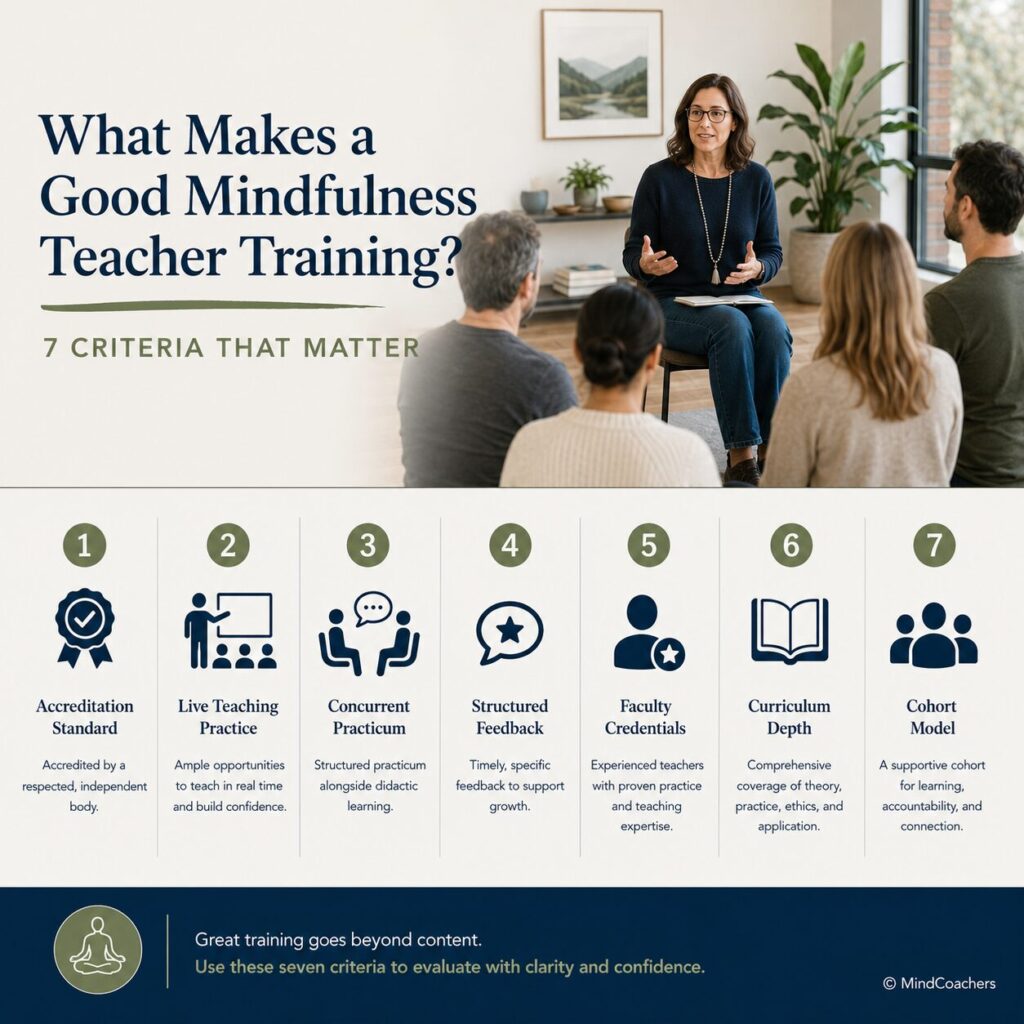
Most people searching for mindfulness teacher training programmes quickly discover that the options vary enormously — in length, format, accreditation status, and price. What almost nobody explains is how to evaluate them. Marketing pages describe curriculum modules and faculty bios. Alumni testimonials describe how the training changed everything. What they rarely provide is a structured framework for assessing whether a programme will actually produce a competent, credible, professionally recognised mindfulness teacher.
This article provides that framework. The seven criteria below reflect what the professional training market, accreditation bodies, and institutions commissioning mindfulness teachers have converged on as the markers of a programme worth taking seriously. They derive from published standards — principally the International Mindfulness Teachers Association’s CMT-P accreditation requirements — and from what the evidence says about how teaching competence actually develops.
Use this article as a checklist. Apply it to every programme you are considering — including the MCMI — MindCoachers Certified Mindfulness Instructor — and see where each one stands.
Key takeaways
– Accreditation body and standard matter more than hours alone — IMTA is the professional benchmark.
– Live teaching practice must begin early, not be saved for the final weeks.
– A concurrent practicum — teaching real people during training — is the critical differentiator.
– Structured peer feedback is what separates learning to teach from practising in isolation.
– Faculty credentials, curriculum depth, and cohort format compound all the above.
Criterion 1: Accreditation standard
Accreditation is the first filter — not because a credential is the end goal, but because it is the most efficient proxy for programme rigour. An accredited programme has been assessed against a published standard by an independent body. An unaccredited programme has not.
The standard that matters most for professional mindfulness teaching is the International Mindfulness Teachers Association (IMTA) CMT-P (Certified Mindfulness Teacher – Professional) accreditation. IMTA sets a 200-hour minimum, requires supervised teaching practice and a concurrent practicum, mandates ethics and trauma-awareness content, and reviews faculty credentials. For a full comparison of the three main accreditation bodies, see IMTA vs Yoga Alliance vs IMMA: mindfulness teacher accreditation compared.
Before evaluating anything else about a programme, confirm its accreditation status on the IMTA accredited programmes list directly. For a deeper look at what IMTA accreditation actually requires, see what is IMTA accreditation for mindfulness teachers — and does it matter? For the full CMT-P credential pathway, see CMT-P certification explained.
Criterion 2: Live teaching practice volume
Accreditation tells you a programme has been assessed. The composition of its hours tells you what you will actually spend your time doing.
The critical question is not how many hours a programme offers, but how many of those hours involve actually teaching. For a complete breakdown of how to assess hour composition, see how many teaching practice hours does a mindfulness training actually need?.
Programmes that front-load theory and save teaching practice for the final weeks are structured on the assumption that you need to know a great deal before you can do anything. The evidence from deliberate practice research suggests the opposite. Teaching competence develops through teaching, with feedback, not through extended preparation followed by a brief supervised period.
When reviewing a programme’s structure, ask for a session-by-session breakdown. Count the live hours. Identify when teaching practice first appears. For the full evidence base on why this matters, see why teaching practice from day one makes better mindfulness teachers. For format comparisons, see 12-week vs 12-month mindfulness teacher training: which is right for you? and online vs in-person mindfulness teacher training: what the evidence says.
Criterion 3: Concurrent practicum
A practicum is a period of real-world teaching that runs alongside formal instruction, not after it. It is the bridge between classroom knowledge and professional confidence — and its timing is everything.
IMTA’s accreditation standards require a concurrent practicum component. Not all practicum models are equivalent. Ask specifically: how many hours? Who does the teaching — you, or a demonstration teacher you observe? Is the practicum supervised, and by whom? For the full case on why concurrent timing produces better teachers, see why teaching practice from day one makes better mindfulness teachers. For a breakdown of what 200 hours should actually contain, see 200-hour mindfulness teacher training: what you actually get for the hours.
Criterion 4: Structured feedback mechanisms
Teaching in a vacuum develops habits. Teaching with structured feedback develops competence. The difference is not subtle — it is the difference between practising golf alone for a year and taking lessons with a qualified instructor.
The MBI-TAC (Mindfulness-Based Interventions Teaching Assessment Criteria) is the peer-reviewed instrument developed at the University of Bangor for assessing mindfulness teaching quality. A programme that uses MBI-TAC or an equivalent structured framework is providing feedback against a consistent professional standard.
Structured feedback should include: video review of your teaching sessions, formal written feedback against competency criteria, and a mechanism for tracking development across the programme.
Criterion 5: Faculty credentials
Mindfulness teacher training is taught at its best by people who are simultaneously practitioners, researchers, and teachers. The minimum credible faculty profile is: active personal practice, formal academic or clinical training in a relevant discipline, and demonstrated experience teaching mindfulness to professional cohorts. For the complementary framework on reading curriculum depth, see how to read a mindfulness teacher training curriculum before you enrol.
Check faculty profiles critically. A PhD in an unrelated field does not constitute clinical expertise. A long personal practice history is not a faculty credential. Published research in mindfulness, Buddhist psychology, or clinical applications of contemplative practice is a meaningful signal.
For programmes teaching clinical professionals — psychologists, therapists — see mindfulness teacher training for psychologists and can therapists teach mindfulness without extra training?. For the British Psychological Society’s guidance on mindfulness and the NICE evidence base, these provide the relevant clinical framework that faculty should demonstrate familiarity with.
Criterion 6: Curriculum depth
Curriculum depth is assessed not by the number of modules but by what each module actually covers, in what sequence, and whether the programme treats ethics, trauma awareness, and scope of practice as substantive content or as token sections. For the complete framework on reading any curriculum critically, see how to read a mindfulness teacher training curriculum before you enrol.
What a rigorous curriculum must include:
- Theoretical foundations: The psychological evidence base for mindfulness — the mechanisms, the RCTs, the applications across clinical and non-clinical populations.
- Trauma-aware teaching protocols: A structured, evidence-based approach to what happens when mindfulness practice surfaces trauma — and what a teacher’s responsibility is in that moment.
- Ethics and scope of practice: What a mindfulness teacher is and is not qualified to do, where the boundary with therapeutic intervention lies, and what the professional liability implications are. See also is mindfulness teacher training regulated? What professionals need to know.
- ACT and third-wave CBT integration: Acceptance and Commitment Therapy overlaps significantly with mindfulness pedagogy. A curriculum that ignores this is missing the most clinically relevant development in applied mindfulness over the last decade.
- Teaching methodology: How to structure a mindfulness session, guide different practices, adapt content for different populations, and hold a group at very different stages of personal practice.
A published curriculum document — available before you enrol, not just after you pay — is the clearest signal of a programme’s willingness to be held to account on content.
Criterion 7: Cohort model
The cohort model is the structural decision that most directly affects how you learn to teach — and it is the one most frequently undervalued by prospective students comparing programmes.
A cohort-based programme — where you progress through the curriculum alongside the same group of practitioners, at the same pace, with live sessions scheduled at fixed times — creates the conditions for the kind of learning that teaching competence requires: repeated exposure to the same people’s development, structured peer teaching with relationships that deepen over the programme, and a group dynamic that mirrors the real classroom.
A self-paced programme can cover the same curriculum content. It cannot replicate the peer learning and teaching dynamics that a cohort model provides. For a direct comparison, see 12-week vs 12-month mindfulness teacher training: which is right for you? and online vs in-person mindfulness teacher training: what the evidence says.
Download the MCMI — MindCoachers Certified Mindfulness Instructor — prospectus: full curriculum, faculty profiles, pricing and cohort information.
Further reading and professional resources
↗ Why teaching practice from day one makes better mindfulness teachers
↗ How many teaching practice hours does a mindfulness training actually need?
↗ How to read a mindfulness teacher training curriculum before you enrol
↗ IMTA vs Yoga Alliance vs IMMA: mindfulness teacher accreditation compared
↗ Best IMTA-accredited mindfulness teacher training programmes: 2027 guide
↗ CMT-P certification explained: how to become an IMTA-certified mindfulness teacher
↗ Is mindfulness teacher training regulated? What professionals need to know
↗ IMTA accreditation standards and programme requirements
↗ NICE guideline NG222: evidence base for mindfulness-based cognitive therapy
↗ MBI-TAC: Mindfulness-Based Interventions Teaching Assessment Criteria
Next steps
These seven criteria were built into the MCMI — MindCoachers Certified Mindfulness Instructor from the ground up. IMTA accreditation is confirmed at CMT-P level. Teaching practice begins in week one. The 35-hour concurrent practicum runs alongside the full twelve-week curriculum. Feedback is structured and documented. Faculty are doctorate-level specialists in their fields. The cohort model ensures you develop your teaching capability in relationship with the same group of practitioners throughout.
Frequently asked questions
About mindfulness teacher training for psychologists and the MCMI — MindCoachers Certified Mindfulness Instructor