
Why Teaching Practice From Day One Makes Better Mindfulness Teachers
What the evidence says about when to start teaching — and why waiting until you feel ready is the wrong strategy.
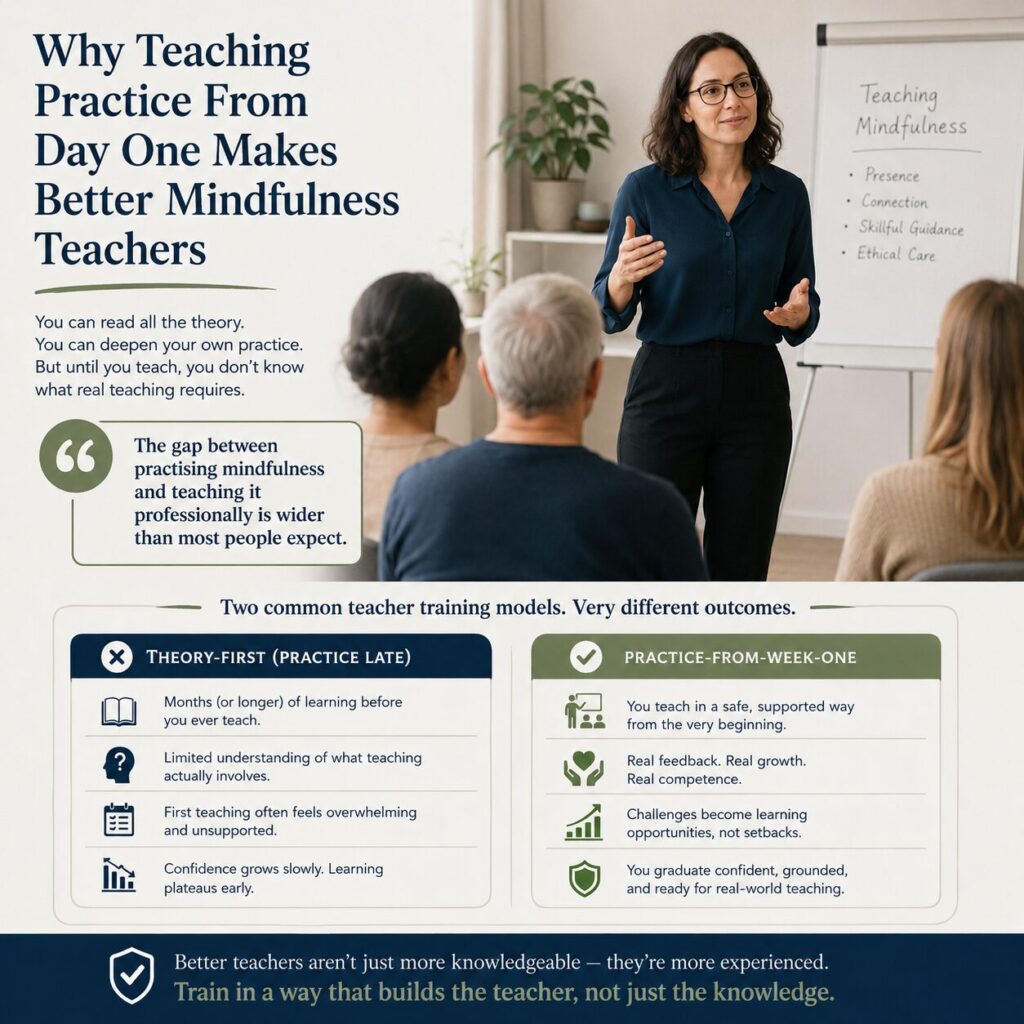
Most mindfulness teacher training programmes are structured around a simple logic: learn first, teach later. Complete the theory modules, absorb the curriculum, attend the supervised sessions, and then — towards the end of the programme, or sometimes after it — begin teaching real people. It sounds reasonable. It is, in practice, one of the most significant design flaws in conventional mindfulness teacher training.
The problem is not with learning theory. Theory matters enormously. The problem is sequencing — the assumption that teaching competence can be prepared for in advance and then deployed when the preparation is complete. Decades of research on skill acquisition, and a growing body of evidence specific to mindfulness teaching, suggest the opposite: competence develops through doing, not through waiting until you are ready to do.
This article examines what the research actually says, why the deliberate practice model is the correct framework for mindfulness teacher training, and what it means in practical terms when evaluating a programme. For the full seven-criteria evaluation framework, see what makes a good mindfulness teacher training?. For a direct look at what hours should consist of, see how many teaching practice hours does a mindfulness training actually need?.
Key takeaways
→ Teaching competence develops through teaching — not through extended preparation followed by a brief supervised period.
→ Deliberate practice research shows that feedback during practice is more important than the volume of prior knowledge.
→ Programmes that front-load theory and defer teaching practice produce graduates who are theoretically informed but practically underprepared.
→ A concurrent practicum — teaching real people from the start of training — is the structural feature that changes outcomes.
→ Feeling ready to teach is not a prerequisite. It is a consequence of having taught.
The deliberate practice framework
– and why it applies to mindfulness teaching
The most rigorous account of how expertise develops comes from the work of Anders Ericsson, whose research on deliberate practice across domains produced a consistent finding: expert performance is built through structured practice with immediate feedback, not through the accumulation of knowledge or experience alone.
The implications for training design are direct. A programme that provides 150 hours of curriculum content and 20 hours of supervised teaching practice is not equivalent to one that interleaves teaching practice throughout — even if the total hours are identical. The timing of practice, relative to the feedback that shapes it, is what determines whether improvement actually occurs.
Mindfulness teaching is not exempt from this dynamic. The skills required to guide a mindfulness practice effectively — presence, attunement, invitational language, the ability to hold a group — are not skills that can be acquired through observation or theoretical study alone. For a breakdown of how hour composition affects outcomes, see how many teaching practice hours does a mindfulness training actually need?. For how to read a curriculum to verify this structure, see how to read a mindfulness teacher training curriculum before you enrol.
What happens when teaching practice is deferred
The standard argument for deferring teaching practice is that students need a sufficient knowledge base before they can teach responsibly. This is partially true — a mindfulness teacher without theoretical grounding is underprepared in a different way. But the argument is typically used to justify a ratio of theory to practice that the evidence does not support.
When teaching practice is deferred to the final phase of a programme, students arrive at their first real teaching session carrying the full weight of accumulated anxiety about performance. They have observed teaching; they have not practised it. The gap between knowing what good teaching looks like and being able to produce it under real conditions turns out to be much larger than anticipated.
There is also a feedback problem. A student who teaches for the first time in week ten of a twelve-week programme receives feedback in weeks ten, eleven, and twelve only. A student who begins teaching in week one receives feedback across the entire programme — and has ten weeks to integrate it. The difference in total feedback cycles is the primary determinant of how much development actually occurs.
The concurrent practicum — what it is and why timing matters
A concurrent practicum is a period of supervised real-world teaching that runs alongside the taught curriculum — not after it. IMTA’s accreditation standards require this component for precisely this reason. For a full comparison of accreditation bodies and what they require, see IMTA vs Yoga Alliance vs IMMA: mindfulness teacher accreditation compared.
This creates what learning theorists call a tight feedback loop: the interval between action and corrective information is short enough that the correction can actually change behaviour. When the feedback loop is long — when you teach in week ten what you learned in week two — the connection between the error and its cause has often become too distant to be useful.
For a breakdown of what 200 hours should look like across categories, see 200-hour mindfulness teacher training: what you actually get for the hours. For a direct comparison between programme formats, see 12-week vs 12-month mindfulness teacher training: which is right for you?.
What “teaching from day one” actually means in practice
Teaching from day one does not mean being placed in front of a group of participants on the first day of training with no preparation. It means that the programme is designed so that teaching practice begins as early as structurally possible — typically within the first two weeks — and continues throughout.
In practice this means:
- Peer teaching exercises begin immediately: Students guide each other through foundational practices from the first workshop.
- Invitational language is practised from the start: The specific vocabulary of mindfulness guidance is rehearsed and corrected in real time from week one.
- The practicum launches at the beginning of training: Students are briefed on the external teaching requirement in the first session and begin their practicum hours as early as week two.
- Feedback is structured and cumulative: Each teaching session generates documented feedback across the full programme.
For practitioners from specific backgrounds, the implications differ. See mindfulness teacher training for psychologists, can therapists teach mindfulness without extra training?, mindfulness teacher training for executive and leadership coaches, and mindfulness teacher training for yoga teachers for segment-specific perspectives.
The evidence from mindfulness-specific training research
Studies examining the MBI-TAC (Mindfulness-Based Interventions Teaching Assessment Criteria) consistently find that teacher competence is not primarily predicted by years of personal practice or curriculum knowledge. It is predicted by supervised teaching experience with structured feedback.
The MBI-TAC domains — embodiment of mindfulness, relational skills, guiding mindfulness practices, inquiry skills, didactic teaching, and group learning environment — are all skills that can only be assessed and developed in real teaching contexts.
What this means when evaluating a programme
When assessing any mindfulness teacher training, ask: when does teaching practice first appear, and how is it structured? For the full evaluation framework, see what makes a good mindfulness teacher training? 7 criteria. For the accreditation lens, see IMTA vs Yoga Alliance vs IMMA: mindfulness teacher accreditation compared. For programme comparisons, see best IMTA-accredited mindfulness teacher training programmes: 2027 guide and best online mindfulness teacher training programmes: ranked and compared.
Ask the programme directly:
- In which week does the first supervised teaching practice session occur?
- How many hours of actual teaching — not observation — does the programme require?
- When does the practicum begin, and how many weeks does it run?
- How is teaching assessed? Against what criteria? By whom?
- Is feedback documented across the programme, or confined to final assessments?
Further reading and professional resources
↗ What makes a good mindfulness teacher training? 7 criteria
↗ How many teaching practice hours does a mindfulness training actually need?
↗ How to read a mindfulness teacher training curriculum before you enrol
↗ IMTA vs Yoga Alliance vs IMMA: mindfulness teacher accreditation compared
↗ 200-hour mindfulness teacher training: what you actually get for the hours
↗ Best IMTA-accredited mindfulness teacher training programmes: 2027 guide
↗ MBI-TAC: Mindfulness-Based Interventions Teaching Assessment Criteria
↗ IMTA accreditation standards — concurrent practicum requirements
Next steps
The MCMI — MindCoachers Certified Mindfulness Instructor is built on this principle. Teaching practice begins in the first workshop. The 35-hour concurrent practicum is launched in session one and runs across the full twelve weeks. Feedback is structured, documented, and mapped against professional competency criteria throughout — not saved for a final assessment. The programme is designed so that by the time you complete it, you have already accumulated a substantial teaching history, not a theoretical readiness to begin one.
Frequently asked questions
About mindfulness teacher training for psychologists and the MCMI — MindCoachers Certified Mindfulness Instructor