
How to Read a Mindfulness Teacher Training Curriculum Before You Enrol
A curriculum document is the most honest signal a programme can give you. Here is what to look for — and what absence tells you.
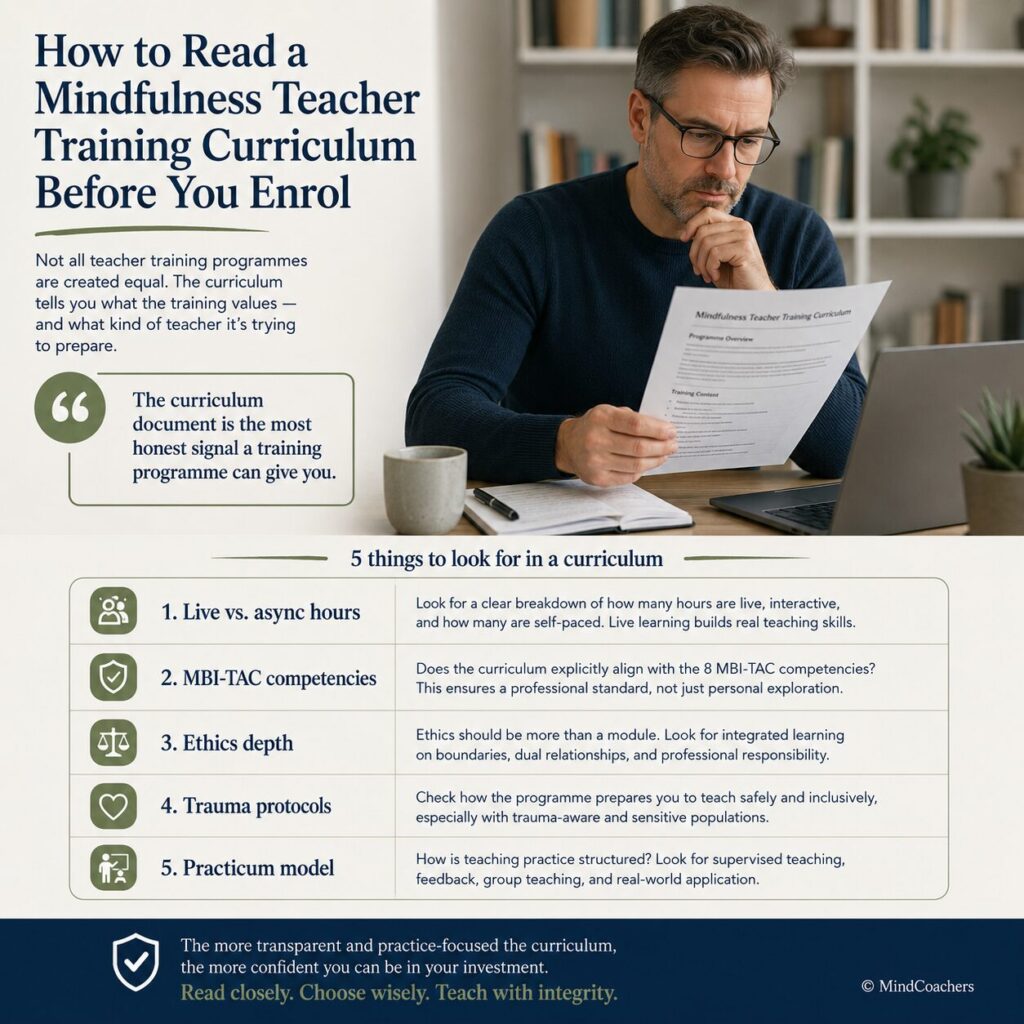
Most people evaluating a mindfulness teacher training spend the majority of their research time on surfaces: the website design, the testimonials, the faculty bios, the programme overview page. These are not useless, but they are all curated. The one document that is hardest to curate — because it has to commit to specifics — is the curriculum.
A curriculum document that shows you module titles and nothing else is not a curriculum document. It is a marketing brochure formatted as a curriculum. A real curriculum tells you what each module covers, in what sequence, with what pedagogical logic connecting one unit to the next. It tells you when teaching practice begins, how ethics is treated, whether trauma-awareness is a substantive thread or a single session, and whether the programme has thought carefully about scope of practice.
This article gives you a practical framework for reading any mindfulness teacher training curriculum critically — including the MCMI — MindCoachers Certified Mindfulness Instructor — before you make a financial and professional commitment. For the full seven-criteria evaluation framework, see what makes a good mindfulness teacher training?. For the hour breakdown question, see how many teaching practice hours does a mindfulness training actually need?.
Key takeaways
→ A curriculum available before enrolment is itself a signal of programme confidence — absence is informative.
→ Module titles without content descriptions are marketing, not curriculum.
→ The sequence of topics matters as much as their presence — look for when teaching practice, ethics, and trauma content first appear.
→ Four non-negotiable content areas: theoretical foundations, trauma-aware protocols, ethics and scope of practice, teaching methodology.
→ A curriculum that treats ACT and third-wave CBT as optional extras is missing the most clinically relevant development in applied mindfulness.
The first signal: is the curriculum available before you pay?
This is the most basic test, and it eliminates a significant number of programmes immediately. A programme that requires you to enrol — or at minimum to submit contact details and enter a sales sequence — before providing curriculum details is making a deliberate choice about information asymmetry.
A programme confident in its curriculum shares it. The module structure, content areas, and hour breakdown should be available to any serious enquirer without requiring payment or a sales conversation. For a breakdown of what the hour structure should look like, see how many teaching practice hours does a mindfulness training actually need?. For programme comparisons, see best IMTA-accredited mindfulness teacher training programmes: 2027 guide and best online mindfulness teacher training programmes: ranked and compared.
What a module title tells you — and what it hides
Most mindfulness teacher training curricula are presented as a list of module titles. These titles confirm that the programme has at least thought about these areas. But they tell you almost nothing about depth, sequencing, or rigour.
The questions to ask about any module title:
- What specifically does this module cover? Not the theme — the content. What psychological models? Which research? What teaching techniques? Which populations?
- How many hours does this module represent? A module called “Trauma-Aware Teaching” that represents two hours of a 200-hour programme is a different proposition from one that represents twelve.
- When in the sequence does this module appear? Ethics in week eleven is structurally different from ethics in week two. Teaching practice in week ten is structurally different from teaching practice in week one.
- What is the assessment for this module? A module with no assessment is a module with no accountability.
The four content areas a rigorous curriculum must include
1. Theoretical foundations
This is the evidence base for mindfulness — the specific mechanisms, the randomised controlled trials, the NICE clinical guidelines, the applications across clinical and non-clinical populations. Look specifically for: coverage of the psychological mechanisms of mindfulness; the evidence base for MBSR and MBCT; the relationship between mindfulness and ACT; and the limits of the evidence.
2. Trauma-aware teaching protocols
Trauma-aware teaching is not sensitivity training. It is a structured, evidence-based approach to what happens when mindfulness practice surfaces trauma in a participant. Look for: coverage of the trauma-sensitive mindfulness framework or an equivalent; specific protocols for what to do when a participant is triggered; understanding of the Window of Tolerance and its implications for practice pacing.
3. Ethics and scope of practice
Ethics should be a thread running through every module that involves contact with participants. Look for: explicit treatment of the boundary between mindfulness teaching and psychological therapy; what to do when a participant discloses clinical history; professional liability considerations. See also is mindfulness teacher training regulated? What professionals need to know and mindfulness teacher certification: which credentials actually matter to employers?.
4. Teaching methodology
Teaching methodology is the practical heart of a mindfulness teacher training. Look for: when teaching methodology first appears in the sequence; whether invitational language is taught as a specific skill; how inquiry is taught and assessed. For the full case on why this should appear early, see why teaching practice from day one makes better mindfulness teachers.
The ACT and third-wave CBT question
Acceptance and Commitment Therapy (ACT) is the most significant development in applied mindfulness over the last two decades. A curriculum that does not include ACT integration as a substantive thread is missing the framework that makes mindfulness most legible to clinical and coaching audiences. For practitioners in those segments, see mindfulness teacher training for psychologists, can therapists teach mindfulness without extra training?, and mindfulness teacher training for executive and leadership coaches.
What good sequencing looks like
- Weeks 1–2: Foundations — what mindfulness is, the evidence base, the teacher’s personal practice.
- Weeks 2–3: Teaching practice begins — peer teaching exercises, invitational language, structured feedback.
- Weeks 3–6: Deepening theory alongside active practice — psychological mechanisms, ACT integration, MBSR/MBCT frameworks.
- Weeks 6–9: Clinical depth — trauma-aware protocols, ethics and scope of practice, working with specific populations.
- Weeks 9–12: Integration and professionalisation — teaching vision, professional identity, CMT-P application pathway.
For accreditation standards that shape what a curriculum must include, see IMTA vs Yoga Alliance vs IMMA: mindfulness teacher accreditation compared. For programme format comparisons, see 12-week vs 12-month mindfulness teacher training: which is right for you?.
Download the MCMI — MindCoachers Certified Mindfulness Instructor — prospectus: full curriculum, faculty profiles, pricing and cohort information.
Further reading and professional resources
↗ What makes a good mindfulness teacher training? 7 criteria
↗ Why teaching practice from day one makes better mindfulness teachers
↗ How many teaching practice hours does a mindfulness training actually need?
↗ IMTA vs Yoga Alliance vs IMMA: mindfulness teacher accreditation compared
↗ Is mindfulness teacher training regulated? What professionals need to know
↗ Best IMTA-accredited mindfulness teacher training programmes: 2027 guide
↗ IMTA accreditation standards — curriculum requirements
Next steps
The full curriculum of the MCMI — MindCoachers Certified Mindfulness Instructor is publicly available before enrolment. It covers all four non-negotiable content areas in depth: theoretical foundations including the full evidence base and ACT integration; trauma-aware teaching protocols as a substantive curriculum thread; ethics and scope of practice from week one; and teaching methodology beginning in the first workshop. The sequence is designed so that teaching practice runs alongside theory from the start, not after it.
Frequently asked questions
About mindfulness teacher training for psychologists and the MCMI — MindCoachers Certified Mindfulness Instructor