
Mindfulness Teacher Certification: Which Credentials Actually Matter to Employers? (2027)
What commissioners, HR departments and clinical employers actually check — and what that means for your credential decisions before you train.
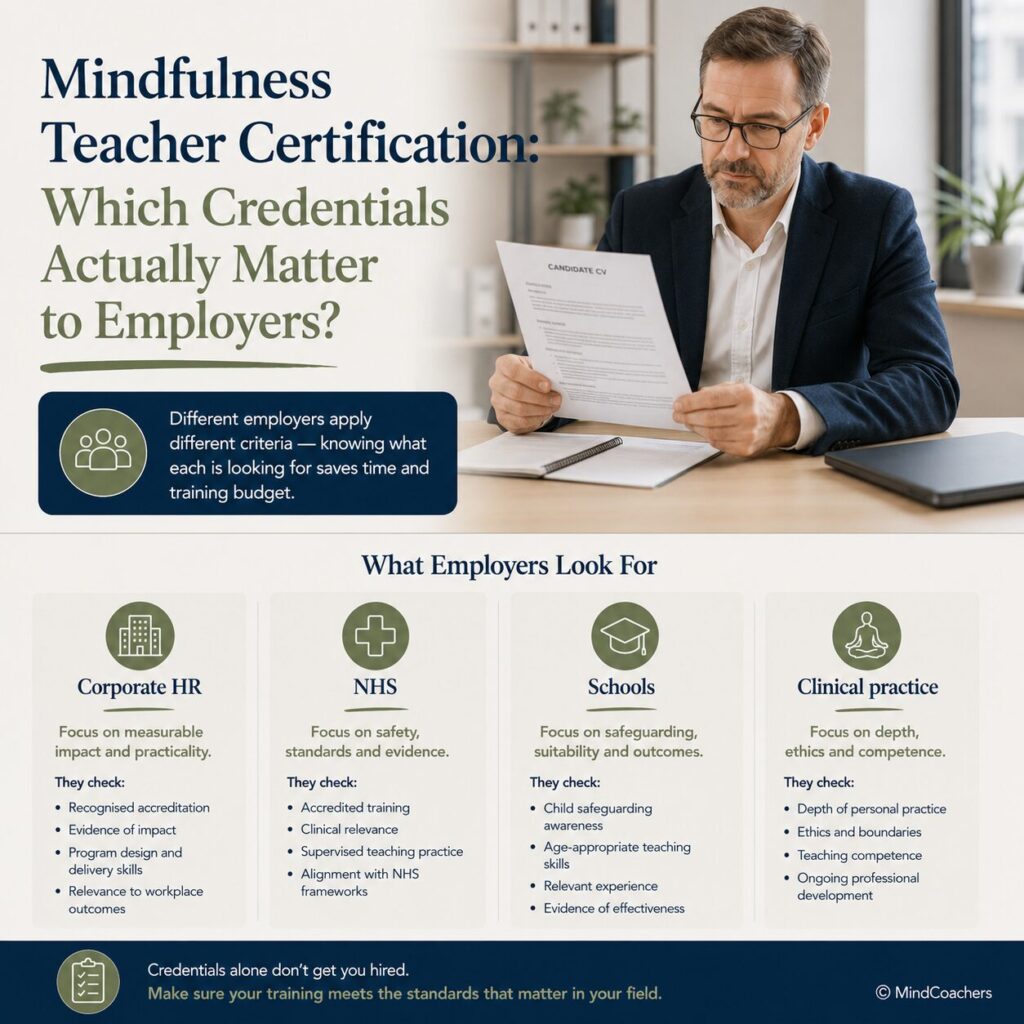
The question of which mindfulness teaching credentials matter is best answered not by training providers — who have an obvious interest in promoting their own credentials — but by the employers, commissioners, and institutional clients who use credentials to make procurement decisions. What do corporate L&D managers actually look for? What does an NHS wellbeing team check before commissioning a mindfulness facilitator? What does a clinical supervisor ask when evaluating a therapist’s mindfulness teaching qualification?
The answers to these questions have shifted significantly since 2020, and they are continuing to shift as the mindfulness teaching market professionalises. This article reports what employers in the three primary professional markets — corporate and institutional, clinical and NHS-adjacent, and coaching and professional development — are actually checking, and what that means for the credential decisions practitioners face before and after training.
For the credential options available, see IMTA vs Yoga Alliance vs IMMA: mindfulness teacher accreditation compared. For the full CMT-P pathway, see CMT-P certification explained: how to become an IMTA-certified mindfulness teacher. For whether a credential is legally required, see do you need a mindfulness teaching certification — or can you teach without one?.
Key takeaways
→ IMTA CMT-P is the credential most consistently specified or recognised across corporate, clinical, and coaching employer contexts in the UK and European market.
→ Corporate procurement teams apply a three-tier check: credential verification, professional liability insurance, and outcome evidence — IMTA CMT-P satisfies the first tier.
→ NHS and clinical commissioners specify IMTA or equivalent — and equivalent in practice means independently assessed, not provider-certified.
→ Yoga Alliance and lighter accreditation frameworks are not recognised as mindfulness teaching credentials by institutional employers in professional contexts.
→ The credential question is most acute for practitioners seeking their first institutional client — subsequent clients rely more heavily on testimonials and referral than initial credential checks.
What corporate employers actually check
Corporate L&D departments and HR functions commissioning mindfulness facilitation apply a procurement process that is more structured than most practitioners expect. The process varies by organisation size and sector, but the following checks are consistently applied by organisations that have formalised their mindfulness facilitation procurement:
Tier 1: Credential verification
The first check is whether the practitioner holds a recognised credential. In 2020, most corporate procurement teams accepted a range of credentials including Yoga Alliance RYT, short online certificates, and provider-issued completion certificates. By 2027, the leading edge of corporate procurement — technology companies, financial services firms, professional service organisations, and large healthcare employers — is increasingly specifying IMTA CMT-P or equivalent as a minimum. “Equivalent” in practice means an independently assessed credential from a recognised professional body — not a provider-issued certificate.
For practitioners targeting corporate contexts, see mindfulness in the workplace: what qualifications do corporate facilitators need? and mindfulness teacher training for executive and leadership coaches. The video why schools, hospitals and corporations increasingly require IMTA accreditation gives the procurement perspective directly.
Tier 2: Professional liability insurance
The second check is professional liability insurance. Most corporate clients require evidence of current professional liability insurance as a condition of commissioning external facilitators. Liability insurers in the UK and Europe typically require evidence of relevant formal training before issuing coverage for mindfulness teaching — and the training standard they most commonly reference is IMTA accreditation or equivalent.
A practitioner without professional liability insurance cannot be commissioned by most corporate clients regardless of credential status. A practitioner with insurance but no recognised credential may pass the insurance check but fail the credential check. Both are required.
Tier 3: Outcome evidence
The third check — increasingly common in corporate procurement — is evidence of measurable outcomes from previous mindfulness facilitation. Large corporate clients commissioning ongoing mindfulness programmes want to see participant feedback data, wellbeing metric improvements, and in some cases before/after assessment data. This tier matters primarily for practitioners seeking contract renewals or large-scale programme delivery — it is less commonly required for initial commissioning of smaller engagements.
The blog post what AI research shows employers value — teachers deliver it gives useful context on what corporate decision-makers are actually looking for as AI changes the professional services landscape. The blog post why HR professionals need a mindfulness teaching credential gives the HR perspective directly.
What NHS and clinical employers check
NHS trusts, IAPT services, and clinical organisations commissioning mindfulness facilitation apply the highest credential threshold of any employer category. The clinical context requires not just credential verification but evidence of appropriate training for working with clinical populations — which includes trauma-aware protocols, scope-of-practice clarity, and understanding of the boundary between mindfulness teaching and therapeutic intervention.
Credential specification
NHS wellbeing teams and IAPT services are the segment most likely to explicitly specify IMTA CMT-P or equivalent in their commissioning criteria. The NICE evidence base for MBCT implies a standard of training that IMTA CMT-P most closely reflects. For MBCT-specific teaching, separate MBCT training is required on top of general mindfulness teacher training — but for broader mindfulness facilitation in NHS-adjacent contexts, IMTA CMT-P is the standard commissioners reference.
Clinical population training
Beyond the headline credential, NHS and clinical employers increasingly verify that practitioners have specific training for working with clinical populations — not just generic mindfulness teaching competency. This means: trauma-aware protocol training, scope-of-practice clarity, understanding of contraindications, and knowledge of when to refer participants to clinical support. A practitioner with IMTA CMT-P and no clinical population training is better positioned than one without it — but one with both is significantly better positioned than either.
For clinical practitioners specifically, see mindfulness teacher training for psychologists and can therapists teach mindfulness without extra training? A clinical perspective. The video what hospitals and schools actually check before hiring a mindfulness teacher gives the institutional procurement perspective.
What coaching and professional development employers check
Executive coaching associations, ICF-credentialed coaches, and professional development bodies integrating mindfulness into their programmes apply a different credential framework from corporate L&D or NHS commissioners. The primary credential context is the coach’s own ICF or professional body registration — the mindfulness teaching credential is evaluated as a CPD addition to that primary professional identity.
In coaching contexts, the credential question is less acute than in corporate or clinical contexts — partly because coaching clients are typically paying directly and rely more on referral and reputation than institutional credential checks, and partly because the coaching market is itself still establishing its credentialing norms for mindfulness integration.
That said, practitioners who can present IMTA CMT-P alongside their coaching credential are positioned significantly better than those who can only present a provider-issued certificate — because the CMT-P provides independent verification that the coaching market increasingly recognises as meaningful. For the coaching context specifically, see mindfulness teacher training for executive and leadership coaches.
What does not satisfy employer credential requirements
The following credential categories are consistently not recognised as mindfulness teaching credentials by institutional employers in professional contexts:
- Yoga Alliance credentials (RYT, E-RYT): Yoga instruction credentials with no mindfulness-specific framework. See IMTA vs Yoga Alliance vs IMMA: mindfulness teacher accreditation compared for the full comparison.
- Short online certificates (under 40 hours): Provider-issued certificates from short courses are not recognised as professional mindfulness teaching qualifications by institutional procurement teams. They may support personal development; they do not satisfy professional credential requirements.
- IMMA accreditation alone: IMMA operates a lighter standard than IMTA and is not consistently recognised by the institutional employers who specify IMTA or equivalent.
- Yoga teacher training with a mindfulness module: A 200-hour yoga teacher training that includes a mindfulness component is a yoga teaching credential, not a mindfulness teaching credential — regardless of the length of the mindfulness module.
For the regulatory context that explains why the credential landscape is self-regulated rather than legally mandated, see is mindfulness teacher training regulated? What professionals need to know.
How credentials are verified in practice
When institutional employers verify credentials, the verification process varies by employer type:
- Corporate L&D: Typically requires submission of credential certificates or links to verifiable online registers. The IMTA accredited programmes list is publicly accessible — commissioning managers can verify programme accreditation directly.
- NHS and clinical: May require original documentation, supervisor references, and in some cases DBS clearance in addition to credential verification.
- EAP provider panels: Panel membership applications typically include credential verification, insurance documentation, and a professional statement. IMTA CMT-P is increasingly specified as a panel eligibility requirement.
Practitioners should be prepared to provide both the MCMI programme completion certificate and the IMTA CMT-P credential (once awarded) separately, with a clear explanation of what each represents. The financial case for pursuing both is made clearly in the blog post the financial case for a mindfulness teaching credential.
The changing credential landscape: 2027 and beyond
The credential requirements across all three employer categories are tightening as the mindfulness teaching market professionalises. Practitioners who currently access institutional work with lighter credentials are likely to find their position more difficult as IMTA CMT-P becomes the norm rather than the differentiator. The direction of travel is unambiguous: the credential threshold is rising.
For practitioners who have not yet trained, this makes the credential decision before training more consequential — choosing an IMTA-accredited programme now positions them in the professional market ahead of the threshold becoming universal. For practitioners who have trained with a non-accredited programme, IMTA CMT-P remains accessible through completing an accredited programme. For the demand context, see demand for mindfulness teachers in Europe: 2027–2030 forecast. For career viability, see is mindfulness teaching a viable career in 2027?.
Download the MCMI — MindCoachers Certified Mindfulness Instructor — prospectus: full curriculum, faculty profiles, pricing and cohort information.
Further reading and professional resources
↗ IMTA vs Yoga Alliance vs IMMA: mindfulness teacher accreditation compared
↗ CMT-P certification explained: how to become an IMTA-certified mindfulness teacher
↗ Is mindfulness teacher training regulated? What professionals need to know
↗ Do you need a mindfulness teaching certification — or can you teach without one?
↗ Mindfulness in the workplace: what qualifications do corporate facilitators need?
↗ Best IMTA-accredited mindfulness teacher training programmes: 2027 guide
Next steps
The MCMI — MindCoachers Certified Mindfulness Instructor provides the pathway to the credentials that institutional employers in the UK and European market are increasingly specifying: the MCMI programme completion certificate and IMTA CMT-P eligibility. IMTA accreditation is confirmed at CMT-P level and verifiable on the IMTA accredited programmes list. The curriculum addresses the corporate, clinical, and coaching contexts where credential requirements are most stringent.
Frequently asked questions
About mindfulness teacher training for psychologists and the MCMI — MindCoachers Certified Mindfulness Instructor