
Mindfulness Teacher Training for Yoga Teachers: Bridging Practice and Formal Instruction (2027)
Yoga training and mindfulness teacher training are distinct professional pathways. Here is what formal mindfulness teacher training adds to a yoga practice — and why the distinction matters professionally.
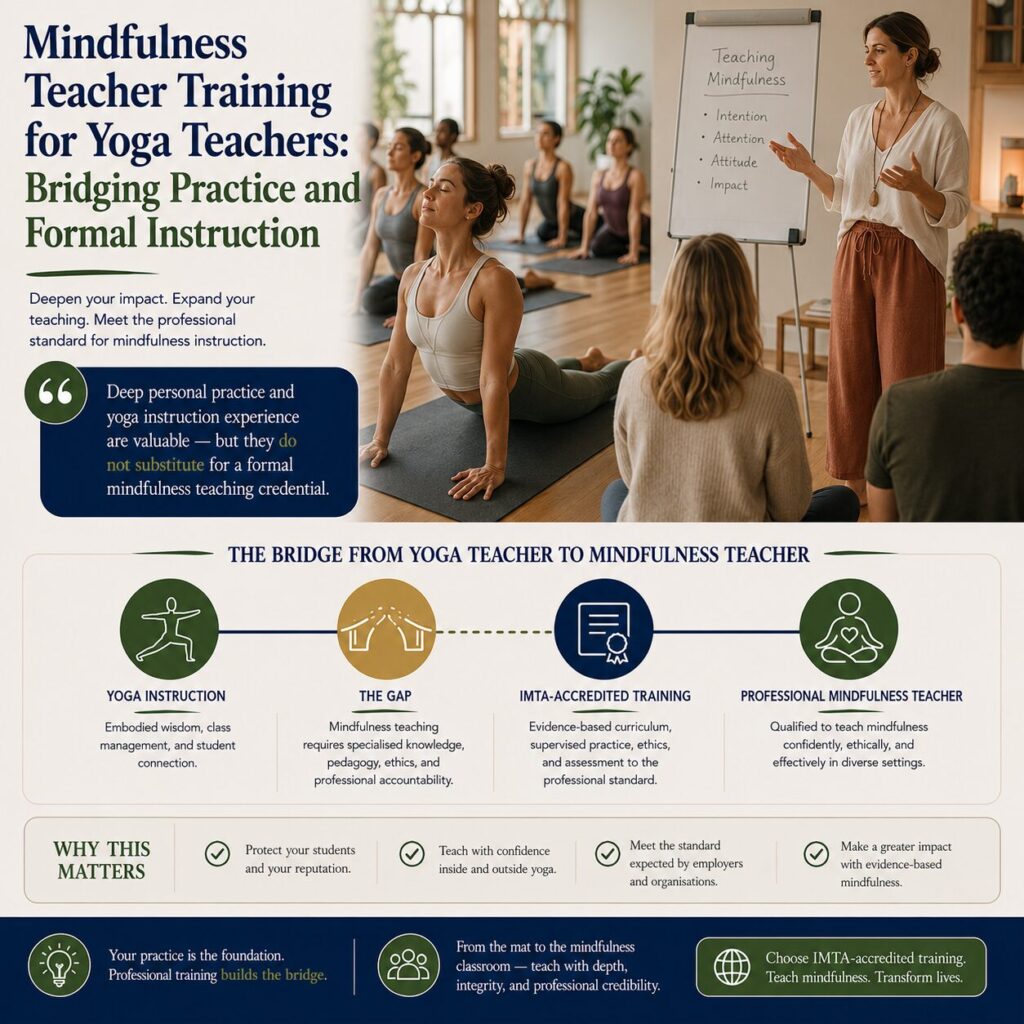
Yoga teachers are among the most natural candidates for formal mindfulness teacher training — and among the most frequently misled about what they already have. The assumption that a Yoga Alliance 200-hour training, or years of yoga practice incorporating mindfulness elements, qualifies a yoga teacher to teach mindfulness formally is one of the most common and consequential misunderstandings in the wellness and professional development landscape.
It does not. Yoga training and mindfulness teacher training are distinct professional pathways. They share philosophical territory — both draw on contemplative traditions, both cultivate present-moment awareness — but the professional credentials, the pedagogical frameworks, and the institutional contexts they serve are different. A yoga teacher who adds IMTA-accredited mindfulness teacher training to their practice is not duplicating what they already have; they are acquiring something substantively different.
This article addresses precisely what formal mindfulness teacher training adds to a yoga practice, which yoga teachers benefit most from it, and what distinguishes the professional contexts that formal mindfulness credentials open from those that yoga credentials alone serve. For the specific five things your training needs to cover, see teaching mindfulness professionally as a yoga teacher: 5 things your training needs to cover.
Key takeaways
→ Yoga Alliance credentials are yoga instruction credentials — they have no mindfulness-specific curriculum requirements and are not recognised as mindfulness teaching credentials by institutional employers.
→ Formal mindfulness teacher training adds secular framing, psychological theory (ACT, third-wave CBT), trauma-aware protocols, and professional credential — none of which yoga training provides.
→ IMTA CMT-P opens corporate, clinical, and educational contexts that are typically inaccessible to yoga teachers with yoga credentials alone.
→ The identity shift from yoga teacher to mindfulness teacher is professional, not philosophical — it changes the context of teaching, the participant populations you serve, and the procurement processes you navigate.
→ Yoga teachers are well-positioned for mindfulness teacher training because of their existing embodiment depth and group facilitation experience — formal training builds on these, not alongside them.
What yoga training provides — and what it does not
A 200-hour or 500-hour Yoga Alliance teacher training provides: yoga philosophy and history, asana instruction and sequencing, pranayama instruction, anatomy relevant to physical practice, and some exposure to meditation and mindfulness within a yogic frame. The better programmes include meaningful meditation content; the standard does not require it.
What yoga training does not provide:
- Secular psychological framing: Yoga training typically embeds mindfulness within a spiritual or philosophical tradition. Formal mindfulness teacher training develops the ability to teach mindfulness in a secular, evidence-based frame — which is what corporate, clinical, and educational employers require.
- ACT and third-wave CBT integration: The theoretical frameworks that make mindfulness teaching credible in professional institutional contexts are largely absent from yoga training.
- Trauma-aware teaching protocols: Yoga training may include brief trauma sensitivity content. IMTA-accredited mindfulness teacher training includes substantive trauma-aware protocols for teaching mindfulness to populations where trauma responses are a risk.
- IMTA CMT-P credential: Yoga Alliance credentials are not recognised as mindfulness teaching credentials by corporate L&D departments, NHS commissioners, or EAP providers. For the full comparison, see IMTA vs Yoga Alliance vs IMMA: mindfulness teacher accreditation compared.
For the regulatory context that explains why this distinction matters professionally, see is mindfulness teacher training regulated? What professionals need to know. For whether a credential is legally required, see do you need a mindfulness teaching certification — or can you teach without one?.
What formal mindfulness teacher training adds to a yoga practice
Secular and evidence-based framing
The most significant professional addition for yoga teachers completing formal mindfulness teacher training is the ability to teach mindfulness in a secular, evidence-based frame — without reference to yogic philosophy, chakra systems, or spiritual traditions. This framing is not a betrayal of yoga’s contemplative roots; it is a distinct professional competency that opens different teaching contexts.
A yoga teacher who can guide a mindfulness programme for a corporate client, or deliver MBSR-adjacent content to a clinical population, without using language that signals spiritual or religious affiliation is serving a different market from one who teaches mindfulness within a yoga framework. Both are legitimate; they serve different participants and access different procurement processes.
Psychological theory for professional contexts
ACT, MBSR theory, and third-wave CBT frameworks provide the psychological scaffolding that corporate and clinical contexts require. A yoga teacher who can explain the psychological mechanisms of mindfulness — attentional regulation, decentering, defusion, the relationship between mindfulness practice and stress response — in language grounded in psychological research is positioned differently from one who can only explain mindfulness in yogic terms.
This is the content gap that formal mindfulness teacher training fills most directly for yoga teachers. For how to evaluate whether a curriculum provides this depth, see how to read a mindfulness teacher training curriculum before you enrol.
Trauma-aware teaching protocols
Yoga trauma sensitivity training (such as trauma-sensitive yoga approaches) and mindfulness trauma-aware protocols are related but distinct. IMTA-accredited mindfulness teacher training provides protocols specifically designed for mindfulness teaching contexts — what to do when a participant dissociates during a body scan, how to structure breath practices safely for participants with trauma histories, when and how to refer a participant to clinical support. These protocols are different from the trauma-sensitive yoga frameworks that yoga teachers may already hold.
For yoga teachers who want to teach mindfulness to populations that include trauma survivors — which is most populations — this content is professionally significant. For the video that explains what trauma-aware training actually involves, see the video standing out in an overcrowded mindfulness teaching market.
Group facilitation in a secular teaching context
Yoga teachers are experienced group facilitators — this is one of their significant advantages when entering formal mindfulness teacher training. But yoga group facilitation has a different dynamic from secular mindfulness teaching. In yoga, the teacher has a form authority — the asana sequence, the physical instruction, the spiritual or philosophical frame — that structures the group. In secular mindfulness teaching, the teacher holds a different kind of space: more inquiry-based, more non-directive, more focused on participants’ own experience and less on prescribed content.
The identity shift from yoga teacher to mindfulness teacher is real and requires attention. The video the identity shift from practising mindfulness to teaching it professionally addresses this transition directly.
The professional contexts that IMTA CMT-P opens for yoga teachers
Yoga teachers who complete IMTA-accredited mindfulness teacher training gain access to professional contexts that are typically inaccessible with yoga credentials alone:
Corporate wellbeing
Corporate L&D departments commissioning mindfulness programmes cannot commission yoga teachers on the basis of yoga credentials — they require mindfulness teaching credentials. A yoga teacher with IMTA CMT-P is positioned to access corporate mindfulness facilitation contracts at professional rates. For the corporate market in detail, see mindfulness in the workplace: what qualifications do corporate facilitators need?.
Educational settings
Schools, universities, and educational institutions commissioning mindfulness programmes for students or staff require mindfulness teaching credentials — not yoga instruction credentials. For yoga teachers specifically interested in educational contexts, see the blog post what qualifies you to teach mindfulness in schools?.
Clinical and NHS-adjacent contexts
NHS wellbeing teams and clinical organisations commissioning mindfulness facilitation require IMTA CMT-P or equivalent. The clinical context is the most demanding credential threshold — and the one where the gap between yoga credentials and mindfulness teaching credentials is most consequential.
Professional wellness positioning
Beyond institutional procurement, IMTA CMT-P changes how yoga teachers can position themselves in the professional wellness market. A yoga teacher with IMTA CMT-P is a credentialed mindfulness teacher who also teaches yoga — a meaningfully different professional identity from a yoga teacher who incorporates mindfulness elements. This distinction matters to clients who are specifically seeking a mindfulness programme, not a yoga class. For income implications, see mindfulness teacher salary guide: realistic income ranges for Europe.
What yoga teachers bring that accelerates mindfulness teacher training
Yoga teachers are not starting from zero when they enter formal mindfulness teacher training. The advantages they bring:
- Embodiment depth: Years of somatic practice give yoga teachers a body awareness and physical sensitivity that many other practitioners are still developing when they enter mindfulness teacher training. This is a genuine advantage for the embodiment dimension of mindfulness teaching — the most developed of the MBI-TAC competency domains for most yoga teachers on entry.
- Group facilitation experience: Yoga teachers are comfortable holding groups — managing the dynamics of a room, pacing instruction, reading participant states. These skills transfer to mindfulness teaching, though the application is different.
- Personal practice depth: IMTA requires documented personal mindfulness practice for the CMT-P application. Yoga teachers typically have extensive personal contemplative practice — which satisfies this requirement more easily than practitioners coming from non-contemplative backgrounds.
- Teaching from experience: Yoga teachers are accustomed to teaching practices they know personally — not teaching about them in the abstract. This disposition — teaching from embodied experience — is central to credible mindfulness instruction. See why teaching practice from day one makes better mindfulness teachers.
What to look for in a mindfulness teacher training as a yoga teacher
- Secular framing throughout: Not just a module on secular mindfulness, but a curriculum that consistently uses secular, evidence-based language rather than spiritual or yogic framing.
- ACT and psychological theory as curriculum thread: The theoretical frameworks that open professional institutional contexts. See how to read a mindfulness teacher training curriculum before you enrol.
- IMTA CMT-P accreditation: The credential that distinguishes mindfulness teaching from yoga instruction for institutional employers. Verify on the IMTA accredited programmes list.
- Trauma-aware protocols at clinical depth: Not general sensitivity guidance, but specific protocols for mindfulness teaching contexts.
- Teaching practice from session one: For yoga teachers who already know how to hold a group, early teaching practice in the mindfulness context accelerates the transfer of existing skills into the new frame. See why teaching practice from day one makes better mindfulness teachers.
For the blog post that addresses the yoga-to-mindfulness transition specifically, see from yoga teacher to certified mindfulness instructor. For the best current IMTA-accredited options, see best IMTA-accredited mindfulness teacher training programmes: 2027 guide.
Download the MCMI — MindCoachers Certified Mindfulness Instructor — prospectus: full curriculum, faculty profiles, pricing and cohort information.
Further reading and professional resources
↗ Teaching mindfulness professionally as a yoga teacher: 5 things your training needs to cover
↗ Mindfulness teacher training for wellness practitioners: a 2027 guide
↗ IMTA vs Yoga Alliance vs IMMA: mindfulness teacher accreditation compared
↗ What makes a good mindfulness teacher training? 7 criteria
↗ Do you need a mindfulness teaching certification — or can you teach without one?
↗ Is mindfulness teaching a viable career in 2027?
↗ Mindfulness in the workplace: what qualifications do corporate facilitators need?
Next steps
The MCMI — MindCoachers Certified Mindfulness Instructor is built for established practitioners — including yoga teachers with deep personal practice and existing group facilitation experience — who are formalising mindfulness teaching as a distinct professional competency. The curriculum uses secular, evidence-based framing throughout. ACT is integrated as a theoretical thread. Trauma-aware protocols are substantive curriculum content. Teaching practice begins in session one. IMTA accreditation is confirmed at CMT-P level.
Frequently asked questions
About mindfulness teacher training for psychologists and the MCMI — MindCoachers Certified Mindfulness Instructor