
Is Mindfulness Teaching a Viable Career in 2027? Jobs, Income and European Outlook
Where the work actually exists, what it pays, and what the European market is beginning to require from mindfulness teachers.
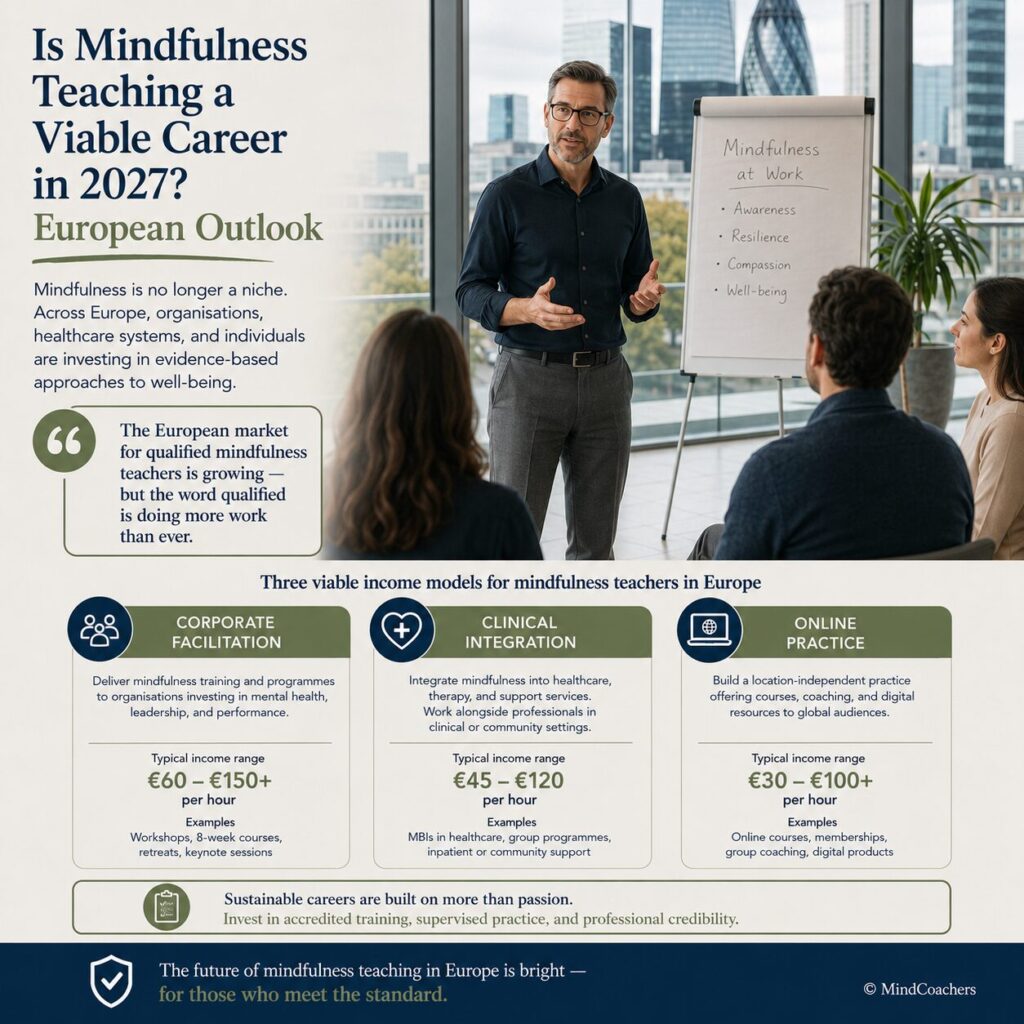
The question of whether mindfulness teaching is a viable career has a more complicated answer in 2027 than it did five years ago — not because the market has contracted, but because it has professionalised. The casual market for mindfulness instruction, where enthusiasm and a short certificate were sufficient, still exists. But the professional market — the one that pays professional rates, involves institutional relationships, and offers sustainable income — is increasingly applying the same credential scrutiny it applies to other CPD and professional training disciplines.
This article gives a realistic account of where mindfulness teaching work exists in Europe, what it pays across different contexts, and what the credential and qualification landscape looks like heading into 2027. It is not a sales pitch for mindfulness as a career. It is an honest picture of a market in transition — one where the gap between practitioners who invested in serious training and those who did not is becoming economically visible.
For related context, see demand for mindfulness teachers in Europe: 2027–2030 forecast, mindfulness teacher salary guide: realistic income ranges for Europe, and do you need a mindfulness teaching certification — or can you teach without one?.
Key takeaways
→ The professional mindfulness teaching market is growing — but the casual market is becoming crowded and underpaid.
→ Corporate, clinical, and coaching contexts pay professional rates; general wellness markets pay wellness rates.
→ The credential gap is becoming economically visible: practitioners with IMTA accreditation access different work than those without it.
→ Most sustainable mindfulness teaching income is portfolio-based — multiple contexts, not a single employer.
→ European demand is highest in the UK, Germany, Netherlands, France, and the Nordics — with distinct market characteristics in each.
The two mindfulness teaching markets
It is useful to distinguish between two overlapping but structurally different mindfulness teaching markets in Europe.
The casual wellness market includes independent classes, drop-in groups, retreat programmes, and direct-to-consumer mindfulness offerings. This market is large, accessible, and saturated. Entry barriers are low, income is variable and often modest, and the credential landscape is largely unregulated. Practitioners in this market compete primarily on reputation, platform, and audience — not on formal qualifications.
The professional institutional market includes corporate wellbeing programmes, NHS and clinical referral pathways, EAP (Employee Assistance Programme) provider panels, educational institutions, and professional CPD delivery. This market is smaller, less accessible, and better paid. Entry barriers are higher — formal credentials, liability insurance, and institutional approval processes — but income is more predictable and rates are significantly better.
The credential question — whether a formal mindfulness teaching qualification is necessary — has a different answer in each market. For the casual wellness market, reputation often matters more than credentials. For the professional institutional market, credentials are increasingly a prerequisite. For a detailed look at this, see do you need a mindfulness teaching certification — or can you teach without one?.
Where the work exists in Europe
Corporate and workplace wellbeing
The corporate wellbeing sector is the fastest-growing source of professional mindfulness teaching income in Europe. Demand is driven by increasing employer awareness of burnout, absenteeism costs, and the evidence base for mindfulness in workplace stress reduction. Procurement is typically through L&D departments, HR functions, or EAP providers — all of whom apply credential and liability checks before commissioning external facilitators.
The UK, Germany, Netherlands, and Scandinavian markets are the most developed. France is growing rapidly following legislative changes around workplace wellbeing obligations. Switzerland, Belgium, and Ireland represent smaller but high-value markets. For practitioners targeting corporate contexts specifically, see mindfulness in the workplace: what qualifications do corporate facilitators need? and mindfulness teacher training for executive and leadership coaches.
Clinical and NHS-adjacent contexts
MBCT (Mindfulness-Based Cognitive Therapy) is recommended by NICE for recurrent depression, which creates a clinical commissioning pathway in the UK that does not exist in most other European markets. Beyond MBCT specifically, NHS wellbeing teams, IAPT (Improving Access to Psychological Therapies) services, and charitable mental health organisations are increasingly commissioning mindfulness facilitators for non-clinical group programmes.
This market requires the highest credential threshold — IMTA CMT-P accreditation or equivalent is increasingly specified. For clinical practitioners considering this route, see mindfulness teacher training for psychologists and can therapists teach mindfulness without extra training? A clinical perspective.
Coaching and professional development
Executive coaches, leadership coaches, and ICF-credentialed practitioners are the fastest-growing segment of professionals adding formal mindfulness teacher training to their practice. The demand driver is client expectation: coaching clients at senior levels are increasingly asking for mindfulness-integrated coaching programmes, and coaches who can deliver mindfulness as a formal practice — not just as a conversational tool — command premium positioning.
For coaches specifically, see mindfulness teacher training for executive and leadership coaches and adding mindfulness certification to your coaching practice: a practical guide.
Yoga and wellness practice
Yoga teachers and wellness practitioners who add formal mindfulness teacher training to their existing offering can access a different client tier — participants who are specifically seeking a mindfulness programme rather than a yoga class with mindfulness elements. The distinction matters commercially: it opens access to corporate and clinical referral pathways that are typically closed to yoga instruction credentials alone.
For practitioners in this position, see mindfulness teacher training for yoga teachers: bridging practice and formal instruction and mindfulness teacher training for wellness practitioners: a 2027 guide.
What mindfulness teaching actually pays
Income ranges vary significantly by market segment, geography, and whether teaching is a primary or supplementary income source. For detailed figures by context and country, see mindfulness teacher salary guide: realistic income ranges for Europe. The summary picture:
- Corporate day rates: €800–2,500 per day in the UK, Germany, and Netherlands for experienced, credentialed facilitators. Lower in France and Southern Europe. Higher in Switzerland and Scandinavian markets.
- Group programme fees: €150–400 per participant for an 8-week structured programme, depending on market and context. Corporate group programmes typically command higher rates than public-facing programmes.
- NHS and clinical context: NHS band 6–7 equivalent for contracted mindfulness facilitators in UK clinical settings. Variable for freelance clinical mindfulness work.
- Online programmes: Highly variable — from minimal income for crowded general wellness programmes to substantial revenue for niche, credential-backed professional development programmes.
The most economically significant variable is not geography or programme type — it is credential status. Practitioners with IMTA CMT-P accreditation access corporate and clinical procurement processes that are closed to uncredentialed practitioners. The rate differential between credentialed and uncredentialed work in professional contexts is typically 50–200%. For context on what credentials the market recognises, see mindfulness teacher certification: which credentials actually matter to employers?.
The portfolio model — how most sustainable mindfulness teaching income works
Full-time mindfulness teaching as a sole income source is realistic for a minority of practitioners — typically those who have built a significant platform, a specialised niche, or a corporate client base over several years. For most practitioners, sustainable mindfulness teaching income is portfolio-based: a combination of teaching contexts that together produce viable income.
A realistic portfolio might include: one or two corporate client relationships generating regular workshop delivery; a quarterly structured programme for a professional or clinical audience; online content or a subscription programme serving a specific niche; and occasional retreat or CPD delivery. Each element reinforces the others — corporate credibility supports CPD positioning, clinical credentials support corporate procurement confidence.
For the timeline question — how long it takes to build to this point — see how long does it take to become a certified mindfulness teacher?. For the demand trajectory, see demand for mindfulness teachers in Europe: 2027–2030 forecast.
What the credential landscape means for career viability
The most important development in the mindfulness teaching market between 2020 and 2027 is the emergence of a credible professional standard. The IMTA CMT-P (Certified Mindfulness Teacher – Professional) credential is not yet universally required — the market is still professionalising. But it is increasingly the credential that corporate procurement teams, clinical commissioners, and institutional partners recognise and specify.
For practitioners at the beginning of their training decision, this means that the choice of programme is not just a training question — it is a market positioning decision. Completing an IMTA-accredited programme places a practitioner in a different professional tier from one who completes a lighter credential. For the full accreditation comparison, see IMTA vs Yoga Alliance vs IMMA: mindfulness teacher accreditation compared. For the best current IMTA-accredited options, see best IMTA-accredited mindfulness teacher training programmes: 2027 guide.
For the regulatory context — whether mindfulness teaching is regulated and what that means for practitioners — see is mindfulness teacher training regulated? What professionals need to know.
Download the MCMI — MindCoachers Certified Mindfulness Instructor — prospectus: full curriculum, faculty profiles, pricing and cohort information.
Further reading and professional resources
↗ Mindfulness teacher salary guide: realistic income ranges for Europe
↗ Demand for mindfulness teachers in Europe: 2027–2030 forecast
↗ Do you need a mindfulness teaching certification — or can you teach without one?
↗ What makes a good mindfulness teacher training? 7 criteria
↗ IMTA vs Yoga Alliance vs IMMA: mindfulness teacher accreditation compared
↗ Mindfulness teacher certification: which credentials actually matter to employers?
↗ Best IMTA-accredited mindfulness teacher training programmes: 2027 guide
↗ Global Wellness Institute — mindfulness and mental health market data
Next steps
The MCMI — MindCoachers Certified Mindfulness Instructor is designed for practitioners who are making a deliberate market positioning decision — not just acquiring a certificate, but entering the professional tier of mindfulness teaching. IMTA accreditation is confirmed at CMT-P level. The curriculum addresses corporate, clinical, and coaching contexts. Faculty are doctorate-level specialists. The cohort format provides the peer network that portfolio-based mindfulness teaching careers depend on.
Frequently asked questions
About mindfulness teacher training for psychologists and the MCMI — MindCoachers Certified Mindfulness Instructor