
Demand for Mindfulness Teachers in Europe: 2027–2030 Forecast
What the institutional data says about where mindfulness teacher demand is heading — and why the credential threshold matters more as demand grows.
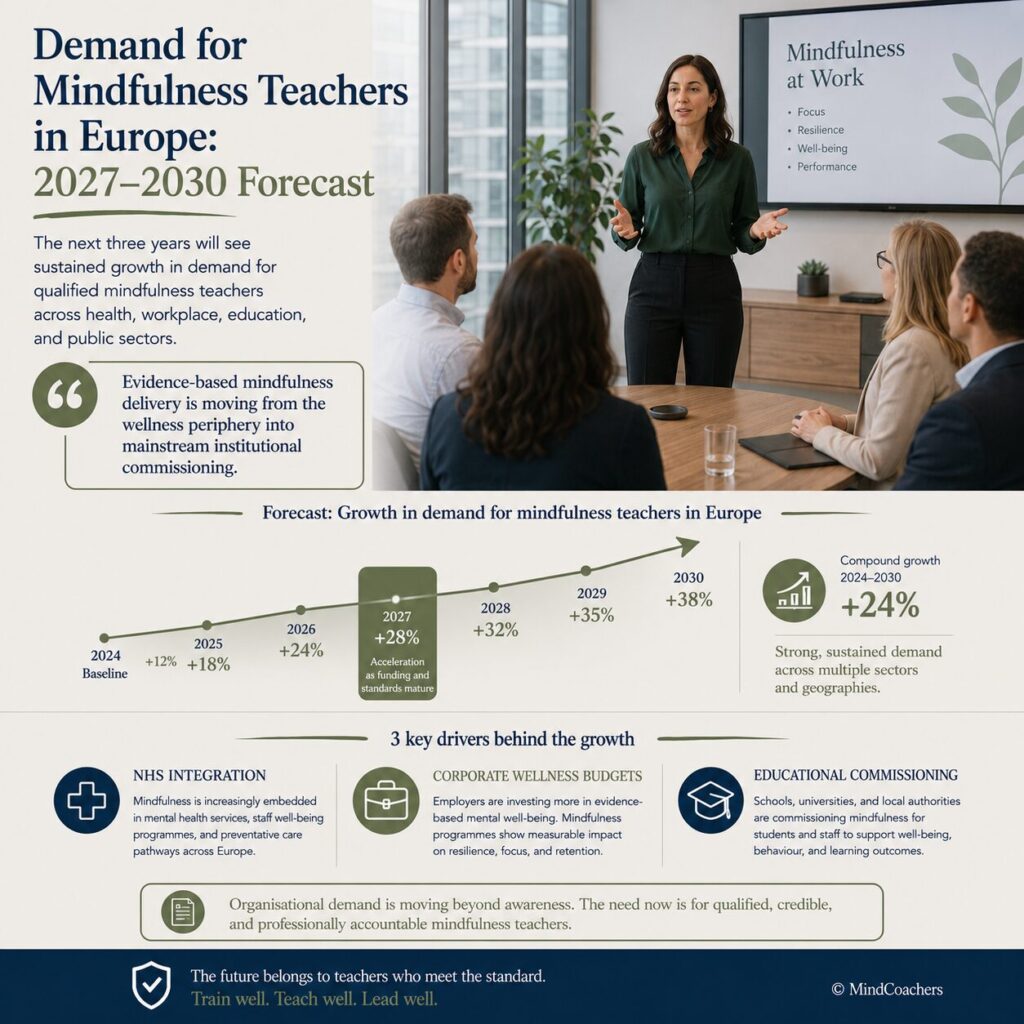
The mindfulness market in Europe is growing. This is not a contested claim — the data from the Global Wellness Institute, WHO mental health action plans, and NHS wellbeing commissioning patterns all point in the same direction. What is less often examined is what kind of growth is occurring, and what it means for practitioners considering entering the mindfulness teaching market between now and 2030.
The headline number — the mindfulness market growing to $9 billion globally by 2027 — tells you very little about what is happening in the European professional market specifically. This article examines the institutional drivers of demand, which segments are growing fastest, and what the credential and qualification landscape will look like for practitioners entering this market over the next three years.
For income context, see mindfulness teacher salary guide: realistic income ranges for Europe. For career viability, see is mindfulness teaching a viable career in 2027?.
Key takeaways
→ Institutional demand — NHS, corporate L&D, EAP providers — is growing faster than the general wellness market and paying significantly better.
→ WHO mental health frameworks and NHS NICE guidelines are the primary institutional drivers of demand for qualified mindfulness teachers.
→ The credential threshold is rising as demand grows — programmes that specified no credential in 2020 are specifying IMTA CMT-P by 2027.
→ Corporate wellbeing spend in Europe is projected to grow 8–12% annually through 2030, with mindfulness as a core component.
→ The supply of credentialed mindfulness teachers is not keeping pace with institutional demand — creating a professional opportunity for qualified practitioners.
The institutional demand drivers
WHO mental health frameworks
The WHO Comprehensive Mental Health Action Plan 2013–2030 and the subsequent European implementation frameworks have created institutional pressure on health systems across the EU and UK to expand access to evidence-based mental health and wellbeing interventions. Mindfulness-based approaches — particularly MBSR and MBCT — sit within this framework as accessible, scalable, and evidence-backed.
The practical effect is that NHS trusts, European health authorities, and workplace health regulators are increasingly commissioning mindfulness programmes as part of their mental health and wellbeing infrastructure — not as optional add-ons but as programmatic interventions with measurable outcomes. This institutional commissioning requires practitioners with recognised credentials, documented outcomes, and professional liability frameworks.
NICE guidelines and NHS commissioning
The NICE guideline NG222 recommending MBCT for recurrent depression creates a specific, funded demand pathway in the UK that does not exist to the same degree in other European markets. NHS trusts commissioning MBCT programmes require practitioners with MBCT-specific credentials — but the broader NHS wellbeing commissioning infrastructure creates demand for mindfulness facilitation that IMTA CMT-P accreditation serves directly.
NHS commissioning patterns are significant for practitioners in the UK, but they also signal a direction of travel for European health authorities — particularly in Germany, the Netherlands, and Scandinavia, where evidence-based workplace health frameworks are well-developed.
Corporate wellbeing legislation and employer obligations
Workplace wellbeing legislation across Europe is creating employer obligations that drive demand for external mindfulness facilitation. In France, the loi sur le bien-être au travail creates explicit employer obligations around psychosocial risk prevention — of which stress and burnout are primary concerns. Germany’s Arbeitsschutzgesetz amendments increasingly reference psychological risk assessment. The UK’s HSE management standards for work-related stress create implicit demand for structured wellbeing interventions.
Corporate L&D spend on mindfulness programmes in Europe is projected to grow 8–12% annually through 2030, according to Global Wellness Institute data. The growth is concentrated in professional service firms, financial services, technology companies, and healthcare organisations — all of which apply credential checks before commissioning external facilitators. For practitioners targeting this segment, see mindfulness in the workplace: what qualifications do corporate facilitators need?.
Demand by segment: 2027–2030 projections
Corporate and institutional: highest growth
The corporate and institutional segment is projected to grow fastest in Europe through 2030. Drivers include legislative pressure, employer insurance requirements, and increasing board-level prioritisation of employee mental health. The UK, Germany, Netherlands, France, and Sweden are the primary markets. For practitioners targeting this segment, see mindfulness teacher training for executive and leadership coaches and mindfulness in the workplace: what qualifications do corporate facilitators need?.
Clinical and NHS-adjacent: steady institutional growth
Clinical demand is growing more slowly than corporate demand but is more stable — driven by NICE commissioning guidelines, NHS wellbeing infrastructure expansion, and growing integration of mindfulness into primary care and IAPT services. For clinical practitioners, see mindfulness teacher training for psychologists and can therapists teach mindfulness without extra training? A clinical perspective.
Professional coaching and CPD: growing rapidly
The professional coaching and CPD market for mindfulness teacher training is growing rapidly as ICF-credentialed coaches, HR professionals, and CPD providers integrate mindfulness into their professional development offerings. This segment is particularly receptive to IMTA-accredited practitioners who can position formal mindfulness teaching as a distinct professional competency. See mindfulness teacher training for executive and leadership coaches.
General wellness: growing but saturating
The general wellness mindfulness market is growing in absolute terms but saturating in relative terms — the supply of practitioners is growing faster than demand in this segment. Drop-in classes, public mindfulness courses, and yoga-adjacent mindfulness offerings face increasing competition and downward price pressure. This is the segment where credential status matters least and where the income ceiling is lowest.
The credential threshold is rising
The most significant structural development in the European mindfulness teacher market between 2020 and 2027 is the rise of the credential threshold. Corporate procurement teams, NHS commissioning bodies, and EAP providers that specified no particular credential in 2020 are increasingly specifying IMTA CMT-P or equivalent by 2027.
This trajectory is consistent with the professionalisation of adjacent fields — coaching (ICF credentials), counselling (BACP/COSCA registration), and workplace health (IOSH membership) all followed similar patterns. The mindfulness teaching market is approximately 5–7 years behind coaching in this professionalisation cycle. Practitioners who complete IMTA-accredited training now are entering the market ahead of the credential threshold, positioning themselves for the institutional demand that will increasingly specify this standard through 2030.
For the full credential comparison, see IMTA vs Yoga Alliance vs IMMA: mindfulness teacher accreditation compared. For what credentials commissioners currently specify, see mindfulness teacher certification: which credentials actually matter to employers?. For the regulatory landscape, see is mindfulness teacher training regulated? What professionals need to know.
Supply constraints — the professional opportunity
The supply of IMTA-accredited mindfulness teachers in Europe is not keeping pace with institutional demand. IMTA publishes its accredited programme list publicly — the number of accredited programmes serving the European market is relatively small relative to the size of the institutional opportunity. This creates a genuine professional opportunity for qualified practitioners in the 2027–2030 window.
The supply constraint operates differently across market segments. In the general wellness market, supply exceeds demand — there are more unqualified practitioners than the market can absorb at sustainable rates. In the professional institutional market, the reverse is true — NHS commissioning teams, corporate procurement managers, and EAP providers consistently report difficulty finding IMTA-accredited practitioners with relevant sector experience.
For the full picture of the professional opportunity, see is mindfulness teaching a viable career in 2027? and mindfulness teacher salary guide: realistic income ranges for Europe.
What this means for practitioners entering training now
Practitioners completing IMTA-accredited training in 2026–2027 are entering the market at an optimal point in the professionalisation cycle — ahead of the credential threshold becoming universal, but after institutional demand has become substantial. The 2027–2030 window represents the period when early-credentialed practitioners will consolidate institutional relationships and testimonials that will be significantly harder to build once the market is more saturated with IMTA-accredited practitioners.
For training timeline context, see how long does it take to become a certified mindfulness teacher?. For credential decisions, see do you need a mindfulness teaching certification — or can you teach without one?. For the best current IMTA-accredited options, see best IMTA-accredited mindfulness teacher training programmes: 2027 guide.
Download the MCMI — MindCoachers Certified Mindfulness Instructor — prospectus: full curriculum, faculty profiles, pricing and cohort information.
Further reading and professional resources
↗ Is mindfulness teaching a viable career in 2027?
↗ Mindfulness teacher salary guide: realistic income ranges for Europe
↗ Do you need a mindfulness teaching certification — or can you teach without one?
↗ What makes a good mindfulness teacher training? 7 criteria
↗ IMTA vs Yoga Alliance vs IMMA: mindfulness teacher accreditation compared
↗ Mindfulness teacher certification: which credentials actually matter to employers?
↗ WHO Comprehensive Mental Health Action Plan 2013–2030
↗ Global Wellness Institute — mindfulness and mental health market data
Next steps
The demand data supports completing IMTA-accredited training now rather than waiting. The MCMI — MindCoachers Certified Mindfulness Instructor launches its next cohort in January 2027 — positioning graduates to enter the professional institutional market during the optimal window in the professionalisation cycle. IMTA accreditation is confirmed at CMT-P level. The curriculum addresses corporate, clinical, and coaching contexts — the three segments where institutional demand is growing fastest.
Frequently asked questions
About mindfulness teacher training for psychologists and the MCMI — MindCoachers Certified Mindfulness Instructor